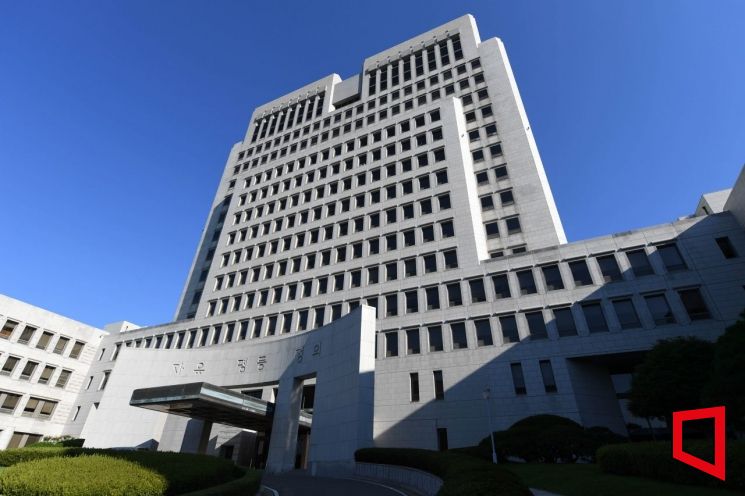
 Supreme Court, Seocho-gu, Seoul. Photo by Mun Honam munonam@
[Asia Economy Reporter Kim Daehyun] The Supreme Court has ruled that the charge of 'obstruction of official duties' is applicable to protestors involved in clashes with police during a memorial rally for the victims of Ssangyong Motor in front of Daehanmun in 2013.
On the 28th, the Supreme Court's 3rd Division (Presiding Justice Kim Jaehyung) announced that it overturned the lower court's ruling which acquitted A and B, members of the National Countermeasure Committee, of obstruction of official duties in their appeal trial for charges including general traffic obstruction, and remanded the case to the Seoul Central District Court.
Previously, A and others had staged a sit-in protest on the sidewalk in front of Daehanmun, Deoksugung, Jung-gu, Seoul, starting from April 2012. When the Jung-gu Office attempted to dismantle the protest site in June of the following year through administrative enforcement procedures, they were prosecuted for allegedly verbally abusing and physically clashing with the police who were confronting them.
The first trial stated, "The execution of official duties must be strictly protected by law," and found most of their charges guilty, sentencing them to suspended prison terms.
The second trial acquitted A and B of obstruction of official duties and reduced their sentences to fines ranging from 1 million to 3 million won. The appellate court noted, "The police could have chosen a method that minimally restricted the freedom of assembly," and added, "The actions of A and others opposing unlawful official duties do not constitute obstruction of official duties." It also mentioned, "The site in question was a symbolic location of great significance to the Countermeasure Committee, as it had long been a memorial altar for union members who passed away during the Ssangyong Motor strike before being forcibly dismantled."
However, the Supreme Court ordered a retrial and reconsideration of the case. It judged that the police were performing legitimate official duties at the time, and that the acts of A and others pushing the police force constituted obstruction of official duties.
The Supreme Court panel stated, "The police force only passively blocked the entry of Countermeasure Committee members around the site," and "This was the minimally necessary measure to prevent the Committee from reoccupying the site and repeating illegal incidents." Furthermore, it added, "The lower court erred in its legal interpretation regarding the 'lawfulness of official duty execution' in obstruction of official duties, the 'lawfulness requirements of restraint measures' under Article 6, Paragraph 1 of the former Police Official Duties Execution Act, and the principle of proportionality, which affected the judgment."
© The Asia Business Daily(www.asiae.co.kr). All rights reserved.
![Clutching a Stolen Dior Bag, Saying "I Hate Being Poor but Real"... The Grotesque Con of a "Human Knockoff" [Slate]](https://cwcontent.asiae.co.kr/asiaresize/183/2026021902243444107_1771435474.jpg)















