Korea Consumer Agency, Results of Investigation on 350 Disinfectant Products
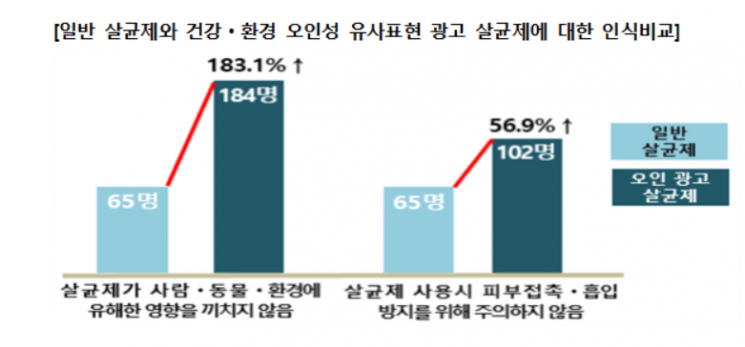 Comparison of Perceptions Between General Disinfectants and Disinfectants Advertised with Misleading Health and Environmental Claims.
[Asia Economy Reporter Lim Chun-han] It has been found that some disinfectant products sold on the market use advertising expressions that may lead consumers to mistakenly believe they are harmless to health or the environment, indicating a need for improvement.
On the 28th, the Korea Consumer Agency announced that after investigating 350 disinfectant products sold on online shopping malls, 34.3% were found to use phrases such as 'harmless,' 'environmentally/nature-friendly,' and 'non-toxic,' which are prohibited by relevant laws.
The Act on the Safety Management of Household Chemical Products and Biocides (Chemical Products Safety Act) stipulates that expressions such as non-toxic, environmentally/nature-friendly, harmless, and human/animal-friendly, which may cause misunderstandings that disinfectants have no or minimal negative effects on human or animal health and the environment, cannot be used in labeling or advertising. However, the investigation revealed that 'harmless' was used in 77 products (22.0%), 'environmentally/nature-friendly' in 59 products (16.9%), and 'non-toxic' in 36 products (10.3%). Among the 350 products, 295 (84.3%) used expressions similar to legally prohibited phrases such as 'safe' and 'reliable.'
A survey conducted by the Consumer Agency on 500 consumers with experience purchasing disinfectants showed that exposure to such misleading expressions increased the perception that the disinfectant is not harmful. In the survey, 51.4% perceived general disinfectants as 'harmful,' while 13.0% responded 'not harmful.' However, for products advertised using misleading expressions, 36.8% answered 'not harmful,' which was higher than the 27.0% who answered 'harmful.'
Regarding precautions to avoid skin contact or inhalation when using disinfectants, 70.0% responded that they 'take precautions' for general disinfectants. In contrast, only 56.6% said they take precautions for products using misleading expressions, indicating a decrease in caution. Notably, consumers perceived disinfectants using similar expressions such as 'free of harmful substances' as having less or no negative impact compared to products using legally prohibited expressions, and these perceptions had a greater influence on purchase decisions.
Based on these findings, the Consumer Agency plans to request the Ministry of Environment to establish guidelines to prohibit the use of misleading expressions and to strengthen management and supervision of disinfectant labeling and advertising.
© The Asia Business Daily(www.asiae.co.kr). All rights reserved.
![Clutching a Stolen Dior Bag, Saying "I Hate Being Poor but Real"... The Grotesque Con of a "Human Knockoff" [Slate]](https://cwcontent.asiae.co.kr/asiaresize/183/2026021902243444107_1771435474.jpg)
















