DGIST Develops Artificial Intelligence Neural Network Module Using Deep Learning
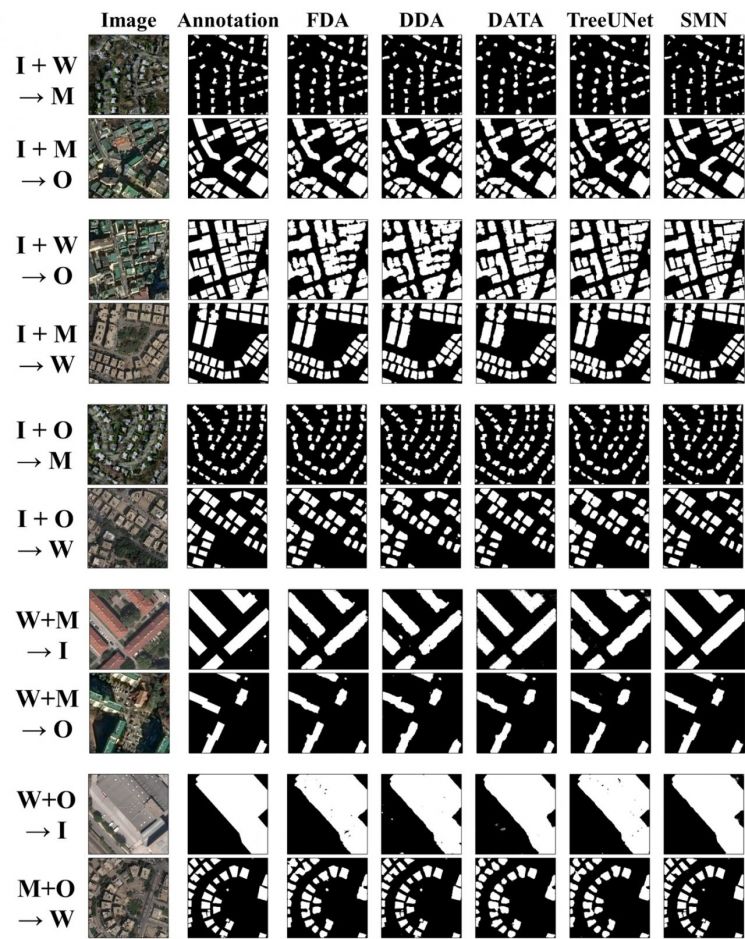 Artificial Intelligence Network and Results for Building Extraction from Aerial Images across Multiple Domains
[Asia Economy Reporter Kim Bong-su] An artificial intelligence (AI) technology capable of rapidly identifying specific buildings or objects from aerial photographs taken from various angles has been developed.
The Daegu Gyeongbuk Institute of Science and Technology (DGIST) announced on the 28th that a research team led by Professor Hwang Jae-yoon from the Department of Information and Communication Convergence (first author Lee Kyung-soo, integrated master's and doctoral student) developed the world's best AI neural network module for object segmentation in images from different domains using deep learning technology. This research achievement is expected to have a positive impact on the advancement of technologies in remote sensing and medical imaging fields.
Recently, as deep learning techniques, a branch of artificial intelligence, have advanced and their performance has rapidly increased, related research has become active. In particular, demand in industrial fields has steadily increased, and aerial images related to broader and more diverse fields are being acquired. However, aerial images differ in domain characteristics depending on the time of shooting, location, and city. When aerial photographs each have different domains, there is a limitation in integrating and comprehensively using multiple aerial images from different domains for detecting specific objects or predicting images.
The research team hypothesized that this problem could be solved by variably fine-tuning the network parameters of aerial images from multiple domains and proceeded with the study. The team succeeded in accurately segmenting buildings on aerial images and precisely detecting buildings in aerial images from various domains. They also extended the structure of generative adversarial networks to develop a domain-adaptive neural network that can autonomously change its parameters according to the domain input of the captured images.
The neural network developed by the research team has the advantage of autonomously modifying its parameters to fit various domains. When applying the algorithm for building detection (segmentation) on aerial images from multiple domains, the AI neural network accurately detected the location, boundaries, and shapes of buildings even in aerial images from various domains other than the domain on which the network was trained.
Professor Hwang said, “The neural network developed through this research is a new network that self-adapts according to the domain,” adding, “If related technologies are further improved in the future, they are expected to be applied in many fields such as remote sensing and medical imaging, positively influencing the development of the AI field.”
This research result was presented at the top conference in computer vision and artificial intelligence, ‘International Conference on Computer Vision (ICCV) 2021’.
© The Asia Business Daily(www.asiae.co.kr). All rights reserved.

















