Graduate Student Quota Increase Plan Review Results
Seoul National University, Korea University, Sungkyunkwan University, Hanyang University
Kyungpook National University, Chonnam National University, Sangji University, Korea Maritime University Selected
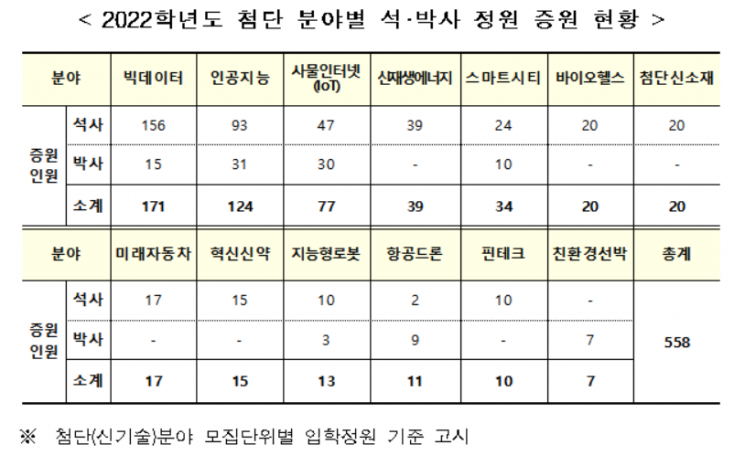
[Asia Economy Reporter Han Jinju] The Ministry of Education will increase the graduate student quotas for master's and doctoral programs by 558 for the 2022 academic year to prepare for the growing demand for high-level talent in new technology fields.
On the 28th, the Ministry of Education announced that after receiving graduate student quota increase plans from universities and conducting a review by the Graduate Quota Review Committee, 36 departments from 8 universities out of 44 departments from 11 universities were selected.
The quota increase by university is as follows: Kyungpook National University 50, Korea University 40, Sangji University 3, Seoul National University 93, Sungkyunkwan University 105, Chonnam National University 50, Hanyang University (including ERICA) 210, and Korea Maritime and Ocean University 7.
The graduate schools that increased their master's and doctoral quotas in advanced fields this time will recruit new students in the first semester of March 2022 and the second semester of September 2022 to operate the corresponding educational programs.
To alleviate the burden caused by quota adjustments between academic fields, the Ministry of Education introduced the "Quota Increase System Utilizing Graduate School Deficit Numbers" starting from the 2022 academic year and plans to gradually expand it from the 2023 academic year.
The quota increase system is divided into two types. Type 1 allows an increase in master's and doctoral quotas in advanced fields for the following year (2022) within the average deficit range of the past three years (2018?2020), and then temporarily reduces quotas in other departments until the year after the quota completion. Among the universities selected this time, Chonnam National University's Department of Data Science master's program (50 students) falls under Type 1.
An official from the Ministry of Education explained, "Since the master's program is two years, if 50 students are added next year, quotas in other departments must be reduced until 2024."
Type 2 allows an increase in master's and doctoral quotas in advanced fields for the following year (2022) within half of the average deficit of the past three years (2018?2020), and if twice the increased quota is secured annually as deficit numbers, the increased quota can be maintained continuously. Quota adjustments must be made while predicting the scale of increased quotas in advanced graduate programs and deficits caused by mid-term dropouts.
The advanced new technology fields announced by the Minister of Education include Artificial Intelligence (AI), Big Data, Next-generation (Intelligent) Semiconductors, Next-generation Displays, Next-generation Communications, IoT (Internet of Things) Home Appliances, AR (Augmented Reality) and VR (Virtual Reality), Advanced New Materials, and Future Automobiles (Electric Vehicles, Autonomous Vehicles, etc.).
Deputy Prime Minister and Minister of Education Yoo Eun-hye said, "We will continue to improve the graduate quota system and ease regulations to expand the cultivation of high-level talent in advanced new technology fields."
© The Asia Business Daily(www.asiae.co.kr). All rights reserved.

















