Need to Reduce Emissions by 55% by 2050... Minimum Cost of 20 to 30 Trillion Won Required
Annual Sales Only 4 Trillion Won, No Capacity... Taking Loans to Invest in Carbon Reduction Facilities
"Burden of Large-Scale Investment Over Decades, Government Financial and Tax Support Needed"
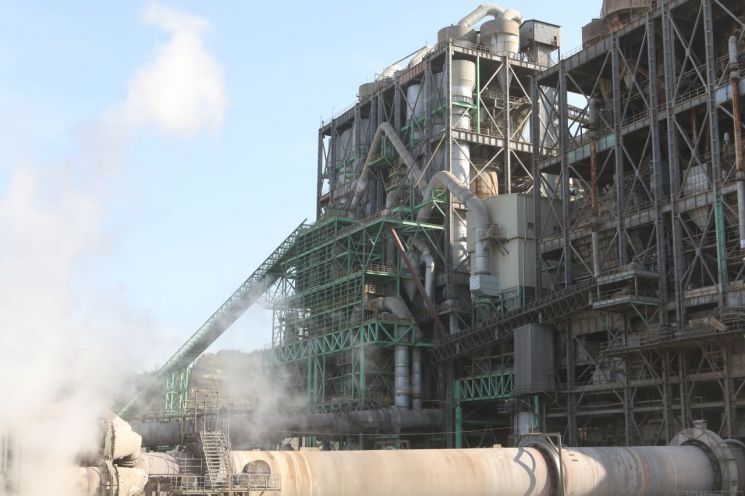 Kiln and cement manufacturing facilities. The blue structures in the photo are newly installed or expanded facilities for carbon neutrality.
 [Photo by Ssangyong C&E]
[Asia Economy Reporter Kim Jong-hwa] "Most companies are taking out loans to invest in carbon reduction facilities because they lack the capacity."
The cement industry is struggling with the government's accelerated carbon neutrality policy. The industry is expanding eco-friendly facilities in accordance with the government's carbon neutrality scenario, which requires a 55% reduction in carbon emissions by 2050 compared to 2018, but financial conditions are tight. A cement industry official said, "The direction has been set, so we have to follow it, but we are worried because of financial difficulties."
According to the cement industry on the 29th, as an essential national infrastructure industry along with steel and petrochemicals, the cement industry, one of the three major carbon-emitting industries, is estimated to require at least 20 to 30 trillion won in carbon neutrality costs by 2050. Although the expected cost is relatively lower compared to the steel and petrochemical industries, it is a burdensome amount relative to the industry's scale.
The Korea Institute for Industrial Economics and Trade announced last October that the carbon neutrality costs for the three industries?steel, petrochemicals, and cement?would require at least 400 trillion won. The Korea Petrochemical Industry Association estimated that up to 270 trillion won would be needed, and the Korea Iron & Steel Association presented research results indicating that applying hydrogen reduction steelmaking technology alone would require 109 trillion won, showing that carbon neutrality costs are increasing over time.
The cement industry, with an annual sales scale of only 4 trillion won, must pour most of its profits into carbon neutrality every year. As of the end of last year, the proportion of carbon emission permit purchase costs relative to cement prices reached 42%. This is three times that of steel (14%) and more than ten times that of petrochemicals (4%). An industry insider said, "The remaining 58% must cover raw material purchases, product manufacturing, carbon neutrality facility investment, management, and tax payments," adding, "We are already squeezing profits from a dry towel, and the more cement we produce, the more we lose. The collapse of the industry does not feel like someone else's problem."
As the industry struggles to secure investment funds for carbon neutrality, the Korea Cement Association requested support from the Korea Development Bank. In June, the Korea Development Bank, the Korea Cement Association, and seven cement companies?Sampyo Cement, Ssangyong C&E, Hanil Cement, Hanil Hyundai Cement, Asia Cement, Sungshin Cement, and Halla Cement?signed an 'Industry-Finance Cooperation Program Agreement for the Realization of Carbon Neutrality in the Cement Industry.'
They agreed to support 1 trillion won in investments for carbon reduction facilities in the cement industry by 2025 at a preferential interest rate in the 1.0% range, but this amount is far from sufficient in the long term, and since it is still debt, it is a burden for the industry. Four months after the agreement, six loans totaling 304.6 billion won have been made, but some companies are still hesitant to take out loans despite signing the agreement.
An official from company S, which invested an additional 26 billion won in eco-friendly facility construction after taking out a loan in August, said, "This is not a one-time investment; large-scale investments must be made continuously over more than ten years," adding, "It is difficult to generate profits, and although the interest rate is low, we have no choice but to rely on loans every year, so honestly, it is burdensome."
Professor Kim Jin-man of Kongju National University emphasized, "Although the cement industry is a national infrastructure industry, its sales scale is small and profits are not large, making it difficult to respond to rapid changes," and added, "The government must take active actions to support capital through various financial and tax support measures."
© The Asia Business Daily(www.asiae.co.kr). All rights reserved.
![Clutching a Stolen Dior Bag, Saying "I Hate Being Poor but Real"... The Grotesque Con of a "Human Knockoff" [Slate]](https://cwcontent.asiae.co.kr/asiaresize/183/2026021902243444107_1771435474.jpg)
















