Hankyungyeon, Comparative Analysis of Next Year's National Budget and Fiscal Rule Legislation
[Asia Economy Reporter Kim Heung-soon] While major countries such as the United States, Germany, and France, which have legislated fiscal rules, are accelerating fiscal normalization in preparation for the post-COVID era, an analysis shows that South Korea is still maintaining the expanded fiscal spending established after COVID-19.
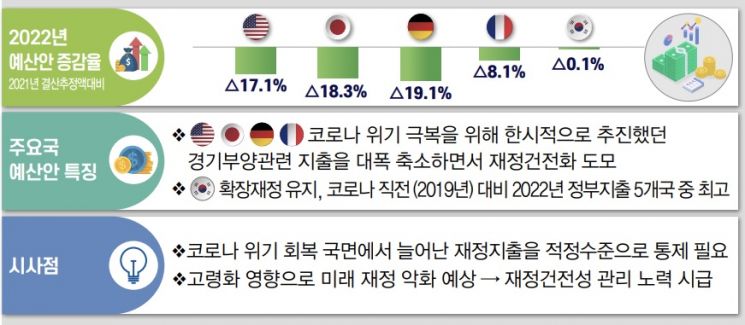
The Korea Economic Research Institute (KERI), under the Federation of Korean Industries, announced on the 28th that an analysis of the 2022 budget plans of South Korea and major countries with legislated fiscal rules revealed that major countries such as the United States, Germany, and France reduced their budget sizes for next year by about 14.8% compared to this year's estimated settlement amount. In contrast, South Korea's budget size for next year is 604.4 trillion won, a 0.1% decrease compared to this year's estimated settlement amount of 604.9 trillion won.
KERI added that when comparing next year's government expenditure size with that of 2019, before COVID-19, South Korea showed the highest increase among the countries compared. According to the International Monetary Fund (IMF), government expenditure (central + local) in 2022 compared to 2019 is projected to be 1.15 times in South Korea, 1.10 times in the United States, 1.07 times in Germany, and 1.01 times in France.
Major Countries Reduce COVID-Related Spending
South Korea Expands Welfare and Education Budgets... Cuts Industry and SME Budgets
The United States' 2022 budget is $6.0 trillion, down $1.2 trillion from the 2021 estimated settlement amount of $7.2 trillion. The federal special unemployment benefits, which were temporarily provided after COVID-19, ended in September this year, reducing the 2022 income support budget to $887.9 billion, a decrease of $946.5 billion from $1.8345 trillion in 2021. The small business support budget is also expected to decrease by $365.6 billion, from $404 billion in 2021 to $38.4 billion in 2022.
Germany's 2022 budget is €443 billion, down €104.7 billion from this year's estimated settlement amount of €547.7 billion. Financial support for unlisted and small businesses was reduced by €58.5 billion, accounting for more than half of the total budget cuts. Social security-related expenditures, which were €19.2 billion this year, are planned to be reduced to €6.5 billion next year, a decrease of €12.6 billion.
France also cut its pandemic relief budget by 99.5%, from €36.9 billion in 2021 to €0.2 billion, reducing next year's budget by €40.2 billion compared to this year's estimated settlement amount.
Among South Korea's budget for next year, the social welfare budget is 74.0 trillion won, a 2.8% increase compared to this year's expenditure of 72.0 trillion won. KERI stated, "Permanent welfare expenditures such as the expansion of basic pensions and increases in child allowances have significantly increased," adding, "These expenditures will be difficult to reduce even after the end of the pandemic and could pose a considerable burden on national finances in the future."
Background of Fiscal Normalization in Major Countries...
Expectations for Economic Normalization and Strict Fiscal Rules
KERI analyzed that the reason major countries reduced the expanded fiscal spending is because they expect the economy to recover to pre-COVID-19 levels next year. According to the Organisation for Economic Co-operation and Development (OECD), the real gross domestic product (GDP) of major countries is expected to exceed the 2019 pre-pandemic level next year.
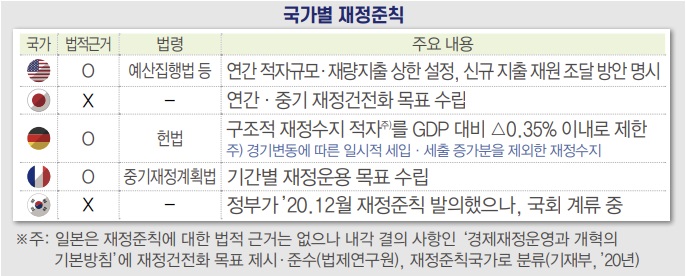
Additionally, major countries such as the United States and Germany enforce binding fiscal rules that compel governments to make efforts to improve fiscal soundness during the COVID recovery phase. South Korea also proposed a Korean-style fiscal rule in December last year as part of a mid- to long-term fiscal soundness plan, but it is currently pending in the National Assembly.
Choo Kwang-ho, Director of Economic Policy at KERI, stated, "The fiscal stimulus effect through government spending diminishes during the economic recovery phase," and emphasized, "It is necessary to carefully review the government expenditures that have been expanded so far." He added, "South Korea is the fastest aging country in the world, and welfare demand is expected to continuously increase," stressing, "Efforts to improve fiscal soundness, such as legislating fiscal rules, are urgent."
© The Asia Business Daily(www.asiae.co.kr). All rights reserved.
![Clutching a Stolen Dior Bag, Saying "I Hate Being Poor but Real"... The Grotesque Con of a "Human Knockoff" [Slate]](https://cwcontent.asiae.co.kr/asiaresize/183/2026021902243444107_1771435474.jpg)












