Korea Real Estate Board, Q3 Commercial Real Estate Leasing Market Trend Survey
[Asia Economy Reporter Kangwook Cho] In the third quarter of this year, both the rental price index and investment yield of commercial real estate, including offices and retail stores, declined.
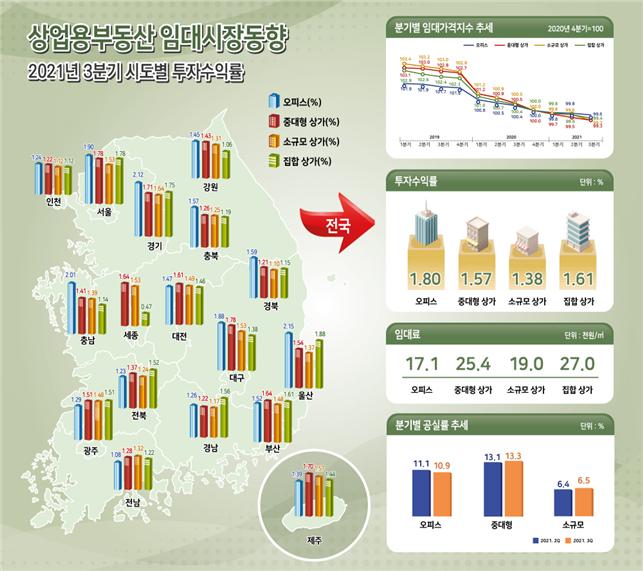
According to the Korea Real Estate Board's Commercial Real Estate Rental Trend Survey on the 28th, the rental price index in the third quarter of this year fell by 0.13% for offices compared to the previous quarter, while retail stores declined by 0.24% for medium to large-sized, 0.30% for small-sized, and 0.23% for collective stores, respectively.
The nationwide average rent was 17,100 KRW/㎡ for offices (average for 3rd floor and above), and for retail stores (based on 1st floor), 27,000 KRW/㎡ for collective, 25,400 KRW/㎡ for medium to large-sized, and 19,000 KRW/㎡ for small-sized stores, in that order.
The Real Estate Board explained, "The rental price index fell as offices, especially older offices with low preference, promoted rent discount policies such as rent-free periods to attract tenants," and "retail stores declined across all types due to business district stagnation and worsening economic sentiment caused by strengthened social distancing measures, including restrictions on gatherings and business hours."
The investment yield, which indicates the investment performance over three months of holding real estate, also decreased compared to the previous quarter. Investment yield is calculated by summing income yield and capital yield.
The office investment yield was 1.80%, down 0.35 percentage points from the previous quarter, and medium to large-sized retail stores dropped 0.18 percentage points to 1.57%. Small-sized retail stores and collective stores recorded 1.38% and 1.61%, respectively, each down 0.18 and 0.17 percentage points.
The income yield, representing rental income, was 0.74% for offices, 0.65% for medium to large-sized retail stores, 0.64% for small-sized retail stores, and 0.89% for collective retail stores. The capital yield, indicating asset value changes, was 1.05% for offices, 0.92% for medium to large-sized retail stores, 0.74% for small-sized retail stores, and 0.71% for collective retail stores.
The Real Estate Board stated, "Income yield declined due to reduced rental income caused by COVID-19 and increased operating expenses from property tax payments in the third quarter, resulting in a decrease in investment yield across all types compared to the previous quarter."
The nationwide average vacancy rate was 10.9% for offices, 13.3% for medium to large-sized retail stores, and 6.5% for small-sized retail stores.
For offices, Chungbuk, Jeonnam, and Gangwon showed vacancy rates higher than the national average (10.9%), while Gyeonggi, Seoul, and Jeju had vacancy rates below 10%.
In Seoul, major business districts where substitution to other regions is difficult maintained stable demand without outflow, showing a vacancy rate of 7.9%. Gyeonggi maintained generally stable demand with a vacancy rate of 6.0%, absorbing tenant demand in Pangyo, which is experiencing supply shortages in the Bundang Station area.
Medium to large-sized retail stores showed higher vacancy rates than the national average (13.3%) in Ulsan, Sejong, and Gyeongbuk, while small-sized retail stores had higher vacancy rates than the national average (6.5%) in Jeonbuk, Sejong, and Daejeon.
© The Asia Business Daily(www.asiae.co.kr). All rights reserved.
![Clutching a Stolen Dior Bag, Saying "I Hate Being Poor but Real"... The Grotesque Con of a "Human Knockoff" [Slate]](https://cwcontent.asiae.co.kr/asiaresize/183/2026021902243444107_1771435474.jpg)
















