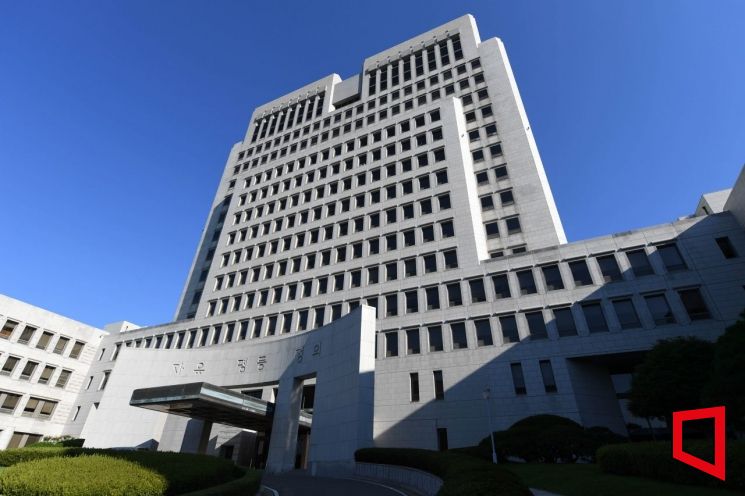
 Supreme Court, Seocho-gu, Seoul. / Photo by Mun Honam munonam@
The Supreme Court has ruled that even if employees dispatched to overseas local subsidiaries due to personnel appointments received interim settlement of severance pay, the domestic original employer is responsible for paying wages withheld by the local subsidiary.
On the 27th, the Supreme Court's 2nd Division (Presiding Justice Jo Jae-yeon) announced that it overturned the lower court's ruling, which dismissed the wage claim lawsuit filed by five employees including Mr. A, who worked at a local subsidiary in China, against STX Shipbuilding & Marine Engineering, and remanded the case to the Busan High Court. The court stated that it is difficult to view the payment of interim settlement severance pay around the time of the personnel order as an indication of termination of the employment contract or as based on the premise of contract termination.
Previously, these employees joined STX Shipbuilding & Marine Engineering and others between 2005 and 2009 and were assigned to the STX local subsidiary established in China. The original employer paid the severance pay for the year as an interim settlement to employees at the end of the year, but from 2009, in accordance with Chinese government policies, the local subsidiary in China paid wages and interim settlement severance pay to Mr. A and others.
Subsequently, due to the worsening financial situation of the local subsidiary, wages and other payments were withheld starting in 2012. Mr. A and others returned to Korea without receiving wages ranging from 30 million to 80 million KRW, and when STX Shipbuilding & Marine Engineering did not pay the overdue wages, they filed a lawsuit.
In court, STX Shipbuilding & Marine Engineering argued that "Mr. A and others terminated their existing employment contracts and entered into new contracts with another employer, namely the local subsidiary in China," and claimed that "the unpaid wages should be paid by the local company."
The first trial ruled in favor of Mr. A and others. The court at the time explained, "It is reasonable to view the plaintiffs as maintaining their employee status while being dispatched to work in China under the overseas dispatch order," and "the defendant is the employer of the plaintiffs and therefore has the obligation to pay wages."
The second trial ruled against the plaintiffs. The appellate court stated, "While the plaintiffs were working at the local subsidiary in China, they ceased providing labor to STX, so there is no obligation to pay wages."
However, the Supreme Court ordered a retrial and reconsideration of the case. The court stated, "While there is a strong possibility that the defendant bears responsibility for paying wages for the labor provided by the plaintiffs at the local subsidiary in China, it is difficult to conclude that the objective intentions of the plaintiffs and the defendant company regarding the termination of the employment contract coincided," and "the lower court erred in its legal interpretation concerning the mutual termination of the employment contract and wage payment responsibility, which affected the judgment."
© The Asia Business Daily(www.asiae.co.kr). All rights reserved.
![From Bar Hostess to Organ Seller to High Society... The Grotesque Con of a "Human Counterfeit" [Slate]](https://cwcontent.asiae.co.kr/asiaresize/183/2026021902243444107_1771435474.jpg)















