October 27 'October 2021 Consumer Sentiment Survey' Released
Inflation Trend to Continue Next Year
Petroleum Products, Agricultural and Marine Products, Public Utility Charges Expected to Rise
Bank of Korea "External Risks Potential... Consumption May Contract if COVID-19 Cases Rise Again"
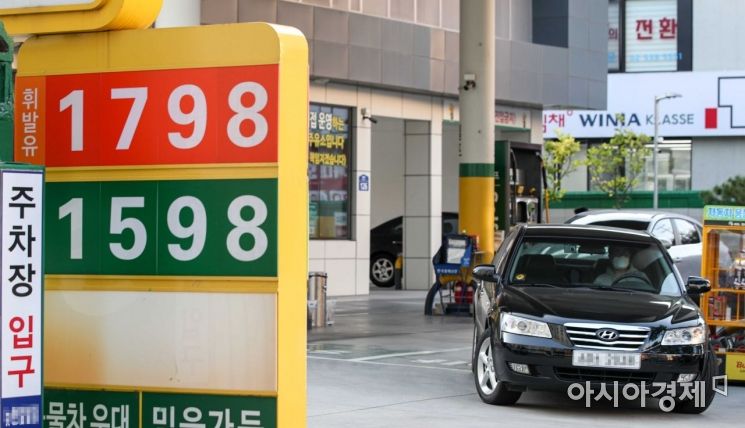 According to Opinet, the oil price information service of Korea National Oil Corporation, the average retail price of gasoline at gas stations nationwide in the third week of October (18-22) was 1,732.4 KRW per liter, an increase of 45.2 KRW from the previous week. On the 24th, a gas station in Seoul was selling gasoline at 1,798 KRW per liter. Photo by Kang Jin-hyung aymsdream@
[Asia Economy Reporter Jang Sehee] Due to the rise in international oil prices and raw material costs, expected inflation recorded 2.4%, maintaining the 2% range for the ninth consecutive month. Expected inflation is the forecasted consumer price increase rate for the next year and is a key indicator likely to lead to actual inflation.
According to the "October 2021 Consumer Sentiment Survey" released by the Bank of Korea on the 27th, expected inflation stood at 2.4%. It has remained in the 2% range for nine months since February (2.0%). After recording the 1% range from September 2019 to January this year, the upward trend appears to be continuing.
Expected inflation reflects the forecasted consumer price increase rate for the next year, indicating that prices are not expected to fall by October next year. The price perception index, which shows awareness of the consumer price increase rate over the past year, also recorded 2.4% for three consecutive months.
The percentage of respondents expecting consumer price increases of 2-3% over the next year rose by 2.7 percentage points from the previous month to 30.9%. The shares expecting 3-4% and 4-5% increases also rose by 0.6 and 0.3 percentage points, respectively. This suggests that the inflation rate is expected to exceed 2%. Major items influencing consumer price increases included petroleum products (53.0%), agricultural, livestock, and fishery products (38.6%), and public utility charges (38.5%).
Hwang Heejin, head of the Bank of Korea’s Statistics and Survey Team, analyzed, "Following the rise in oil prices, public utility charges have also increased, leading to a significant psychological perception of higher prices." He added, "Since inflationary factors remain, the possibility of further increases is high."
With 70% vaccination achievement and the transition to With Corona (gradual return to normal life), the Consumer Confidence Index (CCSI) in August rose by 3.0 points from the previous month to 106.8. The CCSI is calculated using six of the 15 indices that make up the Consumer Sentiment Index (CSI). A value above 100 indicates that consumer sentiment is optimistic compared to the long-term average (2003?2019).
However, there are opinions that consumer sentiment may decline due to future inflation and external risks. Team leader Hwang stated, "Global risk factors such as inflation, China's economic slowdown, and the US tapering announcement remain." He added, "If the number of confirmed cases rises due to the implementation of With Corona, consumption may contract." He further noted, "Optimistic expectations about With Corona coexist with negative outlooks on external risks."
Jung Kyuchul, head of the Economic Forecasting Office at the Korea Development Institute (KDI), stated, "When inflation rises due to supply-side factors, it acts as a constraint on household consumption and corporate investment."
© The Asia Business Daily(www.asiae.co.kr). All rights reserved.

















