Political power seized by military coup, first elected president since the introduction of direct presidential elections in 1987
[Asia Economy Reporter Ryu Jeong-min] Former President Roh Tae-woo, who passed away on the 26th, is a figure symbolizing the twists and turns of modern Korean history. The fact that he came to hold a pillar of political power through a military coup was a political label that followed him throughout his life. However, there are opinions that his political legacy should be evaluated separately, such as pioneering "Northern diplomacy" during his presidency.
Born in 1932, former President Roh was a soldier before becoming a politician. He served as Commander of the Army Capital Defense Command and Commander of the Republic of Korea Army Security Command. A graduate of the 11th class of the Korea Military Academy, he was a key figure in the December 12 military coup in 1980 alongside his classmate, former President Chun Doo-hwan. The new military coup that emerged amid the chaos following the assassination of former President Park Chung-hee led South Korea into a vortex of turmoil throughout the 1980s.
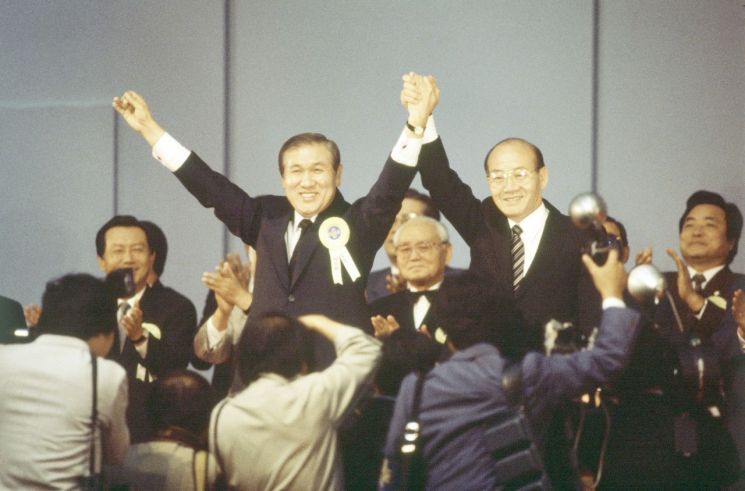
Former President Roh solidified his position as the second-in-command during the Chun Doo-hwan administration. He served as Minister of the Interior and Chairman of the Democratic Justice Party.
In 1987, when Korean society underwent a major transformation through the democratization movement, he came to the political forefront through the "June 29 Declaration." The introduction of the direct presidential election system marked a turning point that removed the shadow of Korean political history, which had elected presidents through so-called "gymnasium elections." The 1987 presidential election was recorded as the most fiercely contested election, with political giants Kim Young-sam, Kim Dae-jung, and Kim Jong-pil running for president.
In particular, candidates Kim Young-sam of the Reunification Democratic Party and Kim Dae-jung of the Peace Democratic Party had a high chance of winning the presidency if they had unified, but their failure to do so ultimately led to former President Roh's victory in the 1987 election.
Roh Tae-woo, then the Democratic Justice Party candidate, was elected as the 13th president with a low vote count of 8,282,738 votes (36.64%) amid the division of the "Two Kims." Although there were many predictions that the Roh administration would be a second term of the Chun Doo-hwan government, former President Roh also achieved meaningful national accomplishments. He is especially highly regarded for his Northern diplomacy, including establishing diplomatic relations with the Soviet Union and China.
However, politically, he became the center of controversy by artificially reversing the minority opposition majority government through the March 1990 three-party merger.
His political original sin as a pillar of the military coup came back as a boomerang after the inauguration of the Kim Young-sam administration. Along with former President Chun, he was imprisoned on charges including leading the December 12 incident, leaving a dark record in Korean political history.
© The Asia Business Daily(www.asiae.co.kr). All rights reserved.

















