Flood of Private Regulation Bills Due to Daejangdong Scandal
Need for Recurrence Prevention but Concerns Over Side Effects
If Private Development Is Suppressed, Local Development May Be Hindered
Experts Say "Preliminary Investigation and Analysis Are Necessary"
Since the emergence of the ‘Daejang-dong development preferential treatment suspicion,’ numerous bills aimed at restricting private development profits have been flooding the National Assembly. These are so-called ‘Daejang-dong Prevention Acts.’ Given the significant public outrage over the incident, many agree that institutional reforms are necessary to prevent recurrence. However, there is also criticism that strengthening private regulations without sufficient investigation while the essence of the situation remains unclear is an inappropriate approach.
According to the National Assembly and real estate industry on the 26th, Park Sang-hyuk, a member of the Democratic Party of Korea, officially proposed an amendment to the Act on the Recovery of Development Gains. Amid suspicions of various preferential treatments and lobbying as a few private developers reaped enormous profits from the Daejang-dong development project in Seongnam-si, Gyeonggi-do, another bill aimed at curbing excessive private profits has been introduced. This can also be interpreted as issues raised during the National Assembly audit process are gradually turning into amendment proposals.
Recovering Profits from Housing Development Too?
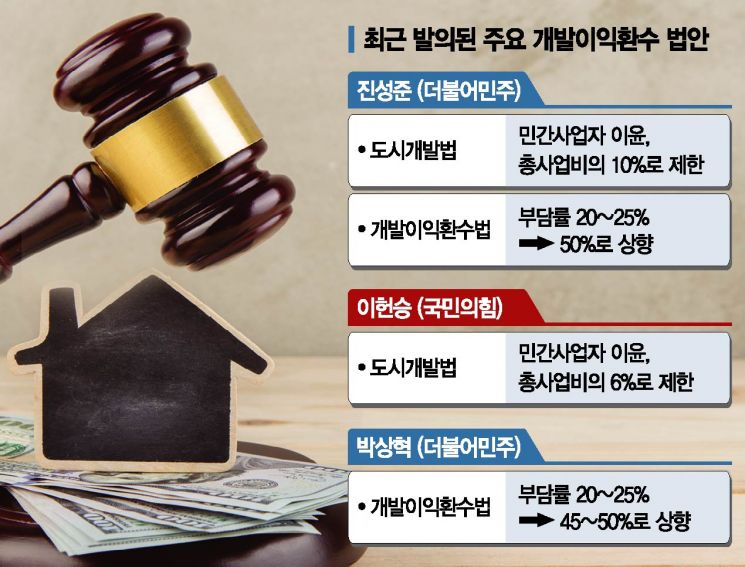
The amendment proposed by Representative Park on the same day changes the title of the law from the ‘Act on the Recovery of Development Gains’ to the ‘Act on the Public Return of Development Gains’ to further strengthen public interest. It includes provisions to use the recovered development gains for national balanced development, housing stability for low-income citizens, improvement of residential environments, installation of public facilities, and development of underdeveloped areas.
In particular, the amendment includes not only land development projects but also projects developing buildings such as houses on the developed land as target projects for returning development gains, thereby establishing a mechanism to recover more development profits. Currently, only the portion exceeding the normal land price increase after development is subject to charges, but going forward, the plan is to calculate charges reflecting the increase in land value after construction of buildings such as apartments.
Additionally, the amendment establishes a new provision for agreements on the public return of development gains, providing a legal basis for the state, local governments, public institutions, and local public enterprises to enter into agreements with private developers regarding the recovery of development gains.
Flood of Bills... Concerns Over Legislative Overreach
Previously, Jin Seong-jun of the Democratic Party and Lee Heon-seung of the People Power Party also proposed amendments aimed at restricting private development profits. Jin proposed amending the Urban Development Act to limit the share of non-public business operators to less than 50% when a corporation established with public project participation undertakes urban development projects, and to cap private developers’ profits at within 10% of the total project cost. The amendment to the Act on the Recovery of Development Gains also includes raising the recovery rate for private developers from the current 20-25% level to around 50%.
Lee’s proposal limits private developers’ investment shares in urban development projects to 50% and caps profits at within 6% of the total project cost, setting an even lower private profit rate than Jin’s proposal.
The industry has expressed concerns about these amendment movements. Since the Daejang-dong incident is still under investigation and its clear facts have not been established, limiting private profit rates prematurely could negatively impact the market. While the amendment’s intent is good, there are warnings that rushing implementation without careful review could repeat the negative consequences seen with the ‘Three Lease Laws,’ which ultimately caused a surge in jeonse (long-term deposit lease) prices.
Experts: "Populist Bills Without Proper Investigation"
Among experts, there is analysis that the Act on the Recovery of Development Gains could suppress private development and adversely affect housing supply, so a cautious approach is necessary. Since private developers bear the same risk of losses, limiting profit rates to 6-10% could make private participation practically difficult. This could lead to concentrated damage in regions outside the metropolitan area, potentially hindering balanced development.
Criticism has also been raised that the National Assembly is rushing legislation excessively without proper fact-finding ahead of the presidential election. Shim Gyo-eon, a professor in the Department of Real Estate at Konkuk University, said, “We need to fully investigate how development gains are currently being recovered and how the amendments will affect private companies and regional development before creating the system. But now, it is flowing into a populist approach of ‘fix it first and see later.’ If bills are made without in-depth discussion, market confusion could increase.”
© The Asia Business Daily(www.asiae.co.kr). All rights reserved.


















