"Jimin-dang May Lose Some Seats Compared to Just Before Dissolution of the House of Representatives"
Leading Opposition Party Ippan Minju-dang May Expand Seat Count
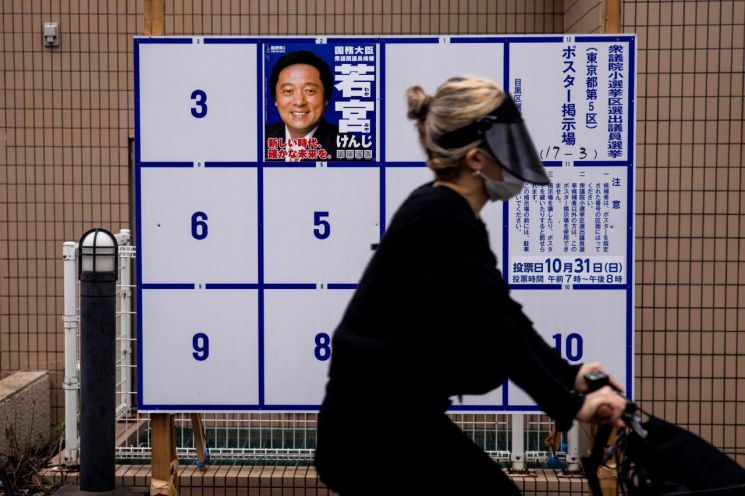 As the Japanese House of Representatives election (general election) to test the confidence in Prime Minister Fumio Kishida's cabinet kicked off with candidate registration on the 19th, a passerby on a bicycle is seen passing in front of an election poster of a ruling Liberal Democratic Party district candidate posted in downtown Tokyo. [Image source=Yonhap News]
[Asia Economy Reporter Kim Suhwan] Reports have emerged that the ruling Liberal Democratic Party (LDP) is expected to comfortably maintain a solo majority in the upcoming Japanese House of Representatives general election scheduled for the 31st.
According to Asahi Shimbun on the 26th, based on a telephone and internet survey conducted from the 23rd to 24th targeting approximately 380,000 voters and its own reporting, the analysis suggests that while the LDP's number of seats is likely to decrease from the previous 276 seats at this point, it is expected to secure a number of seats well above half.
The newspaper predicted that the LDP would secure between 251 and 279 seats. This means it is expected to comfortably hold a majority of the total 465 seats (more than 233 seats).
However, this expected number of seats falls short of the 276 seats held just before the dissolution of the House of Representatives.
The newspaper anticipated that the LDP would secure 65 to 78 seats in proportional representation, similar to the previous 66 seats, but would secure significantly fewer seats in single-member districts (constituencies), with an estimated 186 to 201 seats compared to the previous 210 seats.
The main opposition party, the Constitutional Democratic Party, which previously held 110 seats, is expected to secure 94 to 120 seats.
Although the party is expected to increase its constituency seats through candidate unification with major opposition parties, it is analyzed that its proportional representation seats will hardly expand.
The Japan Innovation Party is projected to make significant gains, securing 25 to 36 seats, about three times its previous number.
However, the election results remain quite fluid.
Respondents who did not clearly state which party they would vote for accounted for about 40% in constituencies and about 30% in proportional representation.
Asahi noted that 74 districts are in a close race and judged that whether the LDP reaches an "absolute stable majority (261 seats)" will depend on the results in these battleground districts. An absolute stable majority means holding all chairmanships of the House of Representatives standing committees and a majority in all standing committees. Since regaining power in 2012, the LDP has secured an absolute stable majority in all three previous general elections.
According to an analysis based on telephone surveys conducted from the 23rd to 24th targeting about 155,000 voters by Sankei Shimbun and Fuji News Network (FNN), the LDP's securing of a majority is uncertain, while the Constitutional Democratic Party is expected to expand its influence.
Sankei projected that the LDP would secure 218 to 246 seats, and the Constitutional Democratic Party would secure 126 to 151 seats.
© The Asia Business Daily(www.asiae.co.kr). All rights reserved.
![Clutching a Stolen Dior Bag, Saying "I Hate Being Poor but Real"... The Grotesque Con of a "Human Knockoff" [Slate]](https://cwcontent.asiae.co.kr/asiaresize/183/2026021902243444107_1771435474.jpg)
















