11.8053 trillion... Largest quarterly record since establishment
Operating profit re-enters 4 trillion won range
[Asia Economy Reporters Heungsun Kim and Hyunjin Jung] SK Hynix has achieved its highest-ever performance since its founding by posting sales exceeding 11.8 trillion KRW in the third quarter of this year, fueled by the boom in the memory semiconductor market. Operating profit also re-entered the 4 trillion KRW range for the first time in two and a half years since the fourth quarter of 2018, when the semiconductor supercycle (long-term boom) arrived. Despite uncertainties such as global semiconductor supply chain disruptions, steady memory demand and price competitiveness are expected to help achieve annual sales of 40 trillion KRW and operating profit of 10 trillion KRW.
Memory Price Increase and Yield Stabilization
NAND Business Turns Profitable
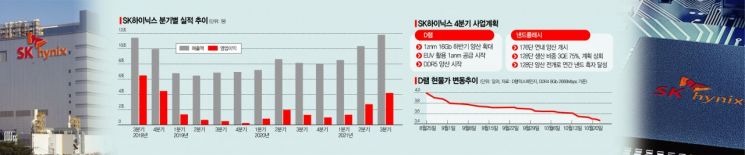
SK Hynix announced on the 26th that it recorded sales of 11.8053 trillion KRW and operating profit of 4.1718 trillion KRW (operating margin 35%) in the third quarter of this year. Sales surpassed the previous record of 11.4168 trillion KRW in the third quarter of 2018, marking the highest performance since the company’s founding. Operating profit ranked as the third-best ever after 6.4724 trillion KRW in Q3 2018 and 4.4301 trillion KRW in Q4 2018, exceeding 4 trillion KRW for the first time in 11 quarters. Compared to the same period last year, sales increased by 45.2% and operating profit by 220.4%. Compared to the previous two quarters, sales rose by 14% and operating profit by 55%.
SK Hynix analyzed that the increase in demand for memory semiconductors used in servers and smartphones (mobile) and the rise in product prices were the driving forces behind the record sales in Q3 this year. Additionally, by improving the yield (the ratio of defect-free qualified products) of key products such as 10nm-class 3rd generation (1z) DRAM and 128-layer 4D NAND and expanding their production share, the company improved cost competitiveness and achieved operating profit in the 4 trillion KRW range.
According to SK Hynix, although PC demand declined and some customers planned to prioritize inventory depletion, resulting in a single-digit low decline in DRAM shipments compared to the previous quarter, the average selling price (ASP) rose by about 10%.
The NAND business, which had been continuously in deficit, also turned profitable. Supported by strong server demand and mobile new product demand, shipments grew to the low 20% range, exceeding the initially planned high teens of 10%, and ASP recorded a mid-single-digit increase compared to the previous quarter. Quarterly sales exceeded 3 trillion KRW for the first time, reaching an all-time high. Multi-Chip Package (MCP), accounting for 24% of SK Hynix’s sales, also recorded its highest quarterly sales with a 29% increase compared to the previous quarter, driven by strong high-capacity demand mainly from Greater China customers.
No Jong-won, Vice President (CFO) of SK Hynix, said, "Despite concerns such as recent global supply chain disruptions, this means the memory semiconductor market continues to grow," and added, "Memory demand will continue to increase steadily."
Shipment Increase and Profitability Secured
Intel NAND Business Acquisition Expected to Complete Within the Year
Annual Sales of 40 Trillion KRW and Operating Profit of 10 Trillion KRW Expected
In the securities industry, the inventory depletion movement that started with PCs is expected to expand to the server and mobile markets, leading to a noticeable decline in DRAM prices in the fourth quarter. The DRAM spot price (based on DDR4 8Gb) has already dropped from about $3.9 at the end of August to about $3.5 at the end of this month. NAND prices are also expected to fall by single digits compared to the third quarter due to weakening front-end demand. Therefore, there is a prevailing view that SK Hynix’s performance will be affected.
Accordingly, SK Hynix plans to expand the mass production of 1z nm (3rd generation, 10nm-class) 16Gb DRAM in the second half of the year and enhance cost competitiveness through supply of 1a nm (4th generation, 10nm-class) products using extreme ultraviolet (EUV) lithography and next-generation DDR5 semiconductors. NAND is also expected to achieve annual profitability through smooth mass production, as the production share of 128-layer-based products exceeded the Q3 target of 75%. Additionally, mass production of 176-layer NAND is planned to start within the year.
Furthermore, if the ongoing review of the Intel NAND business acquisition is completed within the year, the competitiveness of the NAND business, which has turned profitable, is expected to be further strengthened.
An SK Hynix official stated, "(Approval of Intel NAND business in China) was originally expected around the end of Q3, but it has been slightly delayed, and we aim to receive approval and complete the acquisition within the fourth quarter." He added, "Although it is delayed a bit, we expect the Chinese government to make a reasonable decision and approve it within the year," and "We have various backup scenarios internally and expect to operate the business without major disruptions from the existing plan."
If this plan proceeds as expected, SK Hynix’s annual performance is anticipated to surpass 40 trillion KRW in sales and 10 trillion KRW in operating profit. SK Hynix’s sales last year were 31.9004 trillion KRW, and operating profit was 5.0126 trillion KRW. As of the third quarter this year, cumulative sales reached 30.6212 trillion KRW, and operating profit was 8.1908 trillion KRW.
© The Asia Business Daily(www.asiae.co.kr). All rights reserved.
![Clutching a Stolen Dior Bag, Saying "I Hate Being Poor but Real"... The Grotesque Con of a "Human Knockoff" [Slate]](https://cwcontent.asiae.co.kr/asiaresize/183/2026021902243444107_1771435474.jpg)

















