South Korea Ranks 4th Highest in Relative Poverty Among 37 OECD Countries... Elderly Poverty Rate About 3 Times OECD Average
Criticism That It Evokes 'Squid Game'
Parody Mocking Current Government and Kwak Sang-do's Son's Large Retirement Pay Also Emerges

[Asia Economy Reporter Park Hyun-joo] South Korea's relative poverty rate ranked 4th among the 37 member countries of the Organisation for Economic Co-operation and Development (OECD). One in six people fails to enjoy a certain standard of living that most members of society enjoy. Some point out that this figure is related to the craze of the Netflix original series "Squid Game," which satirizes South Korea's severe economic and social inequality.
According to the OECD announcement on the 25th, based on data from 2018 to 2019, South Korea's relative poverty rate was 16.7%, ranking 4th among the 37 member countries surveyed. The relative poverty rate refers to the proportion of the population whose income is less than 50% of the median income, meaning that 16.7 out of every 100 South Koreans earn less than 50% of the median income.
While absolute poverty refers to an income level corresponding to the minimum standard of living, relative poverty means a state where most members of society do not enjoy a certain level of living. As of this year, 50% of the median income is △914,000 KRW for a single-person household △1,544,000 KRW for a two-person household △1,992,000 KRW for a three-person household △2,438,000 KRW for a four-person household.
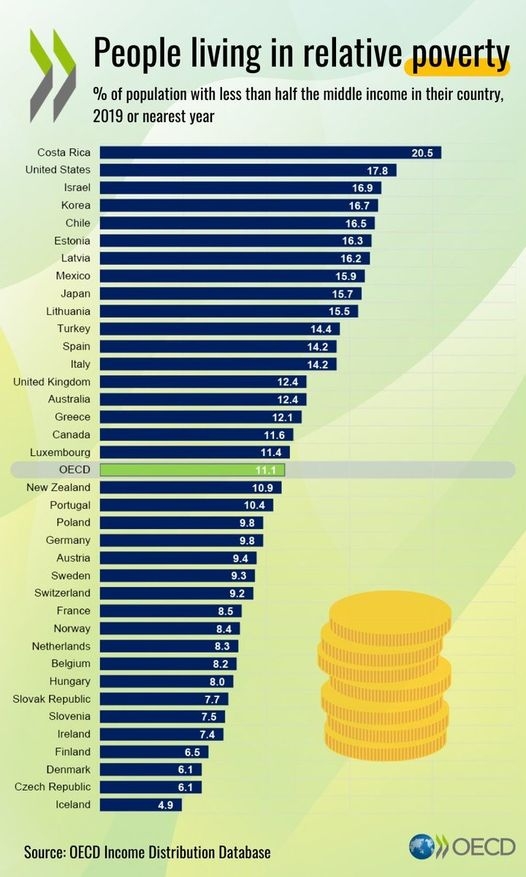 Relative poverty rates among 37 major countries announced by the Organisation for Economic Co-operation and Development (OECD) on the 25th (local time). Photo by OECD Facebook capture
In this announcement, the countries with a higher relative poverty rate than South Korea are Costa Rica (20.5%, 1st), the United States (17.8%, 2nd), and Israel (16.9%, 3rd). South Korea's relative poverty rate is 5.6 percentage points higher than the OECD average of 11.1%, showing a significant gap compared to major advanced countries such as Japan (15.7%), Italy (14.2%), the United Kingdom (12.4%), Canada (11.6%), and France (8.5%). It shows an even larger difference compared to Nordic countries like Finland (6.5%), Denmark (6.1%), and Iceland (4.9%).
A bigger problem is that the elderly poverty rate for those aged 65 and over is 43.4% (as of 2018), about three times the OECD average (15.7%). As rapid aging progresses without many people being prepared for old age, the number of people in relative poverty is rapidly increasing.
Some point out that these relative poverty statistics remind them of "Squid Game." The French daily Le Monde reported on the 17th that South Korea's household debt, which is caught up in the "Squid Game" craze, exceeds 100% of the gross domestic product (GDP), and that among the 800 people who committed suicide at Mapo Bridge in Seoul between 2014 and 2018, many were burdened by debt. On the 28th of last month, the British daily The Guardian also mentioned the Academy Award-winning film "Parasite" in an article titled "Squid Game, a hellish horror show that captivated the world," pointing out, "Even if the deadly game in the work is terrible, how much worse could it be than the situation of those who have been plagued by endless debt?"
On the 15th (local time), the U.S. foreign affairs magazine Foreign Policy also obtained a "diplomatic cable" reported by U.S. diplomats to the State Department, stating that "Squid Game resonated in a highly stratified South Korea, where the presidential candidates of the two major parties are caught up in scandals." The released cable described Squid Game as "depicting the frustration of Korean society regarding the bleak economic situation ahead of next year's South Korean presidential election."
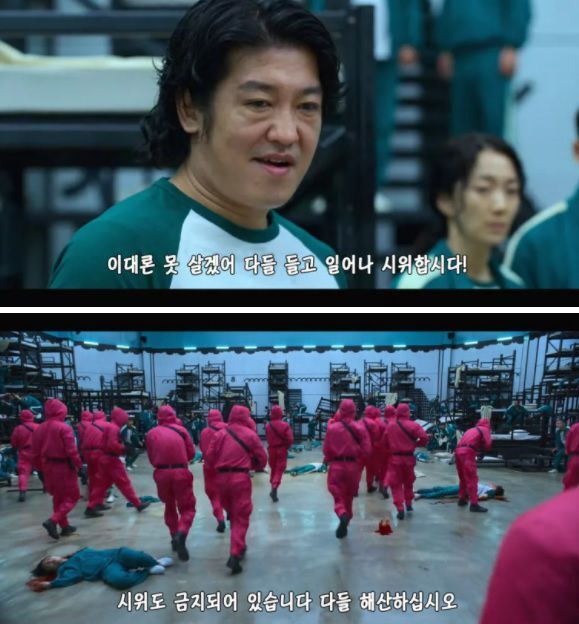 A post titled 'Moon Jae-in Game,' a parody of the Netflix original series 'Squid Game.' Photo by Online Community Screenshot.
Given this situation, political satire parodies of Squid Game have gained popularity in domestic online communities. On the 28th of last month, a post titled "Moon Jae-in Game" was uploaded to an online community. The game in this post includes △tax increase △raising house prices △social distancing △price hikes, and multi-homeowners, non-homeowners, self-employed people, and ordinary citizens who fail to pass these are eliminated.
Another related post parodied the scene in the work where participants distribute food as a scene of distributing disaster relief funds. When a participant asks, "Why don't I have disaster relief funds?" the host replies, "Because you belong to the top 12%." When the participant asks, "Then how am I supposed to live?" the host answers, "Instead, I will give you pride."
When the angry participants say, "We can't live like this. Everyone, rise up and protest," the host says, "Protests are also prohibited. Everyone, disperse," forbidding the protest. This is analyzed as a satire of the fairness controversy surrounding the 5th disaster relief fund and the current situation where large-scale gatherings are banned due to COVID-19.
Earlier, a parody called the "50 Billion Game" criticizing the controversy over the large retirement pay of former lawmaker Kwak Sang-do's son, Mr. A, also appeared. This arose after Mr. A mentioned Squid Game while explaining the allegations surrounding him on the 26th of last month. Mr. A was involved in a controversy after it was revealed that he received about 5 billion KRW in retirement pay and industrial accident compensation from Hwacheon Daeyu, an asset management company accused of preferential treatment in the Daejang-dong development project.
On the 26th of last month, he posted on lawmaker Kwak's Facebook, saying, "I am just a 'pawn' in the meticulously designed Squid Game. A 'pawn' in the game called 'Hwacheon Daeyu.' What could I have done or could do as a 'pawn'? When I joined, all the settings of 'Hwacheon Daeyu' were already completed. I did what I was told from above and did my best. Looking back, from the designer's perspective, I was a very faithful pawn."
© The Asia Business Daily(www.asiae.co.kr). All rights reserved.
![Clutching a Stolen Dior Bag, Saying "I Hate Being Poor but Real"... The Grotesque Con of a "Human Knockoff" [Slate]](https://cwcontent.asiae.co.kr/asiaresize/183/2026021902243444107_1771435474.jpg)


















