Separate Announcement on 'With Corona' Education in November
Additional Expansion of School Attendance in the Capital Area, Normalization Plans for Curricular and Extracurricular Activities
Number of Schools Resolving Overcrowded Classes Increased from 1,155 to 1,221
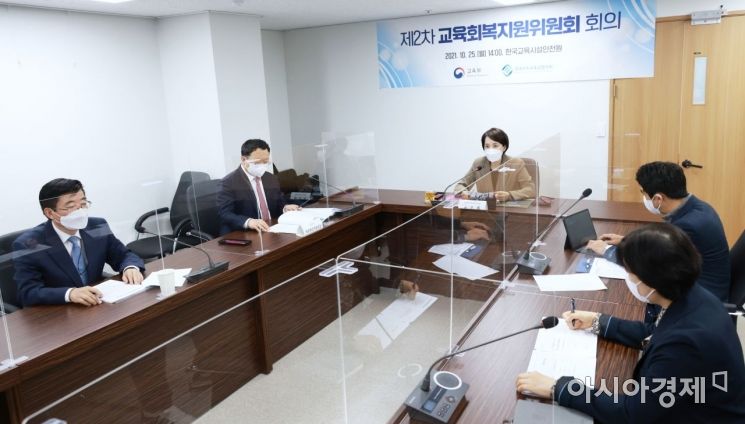 On the 25th, the Ministry of Education held the '2nd Education Recovery Support Committee Meeting' online with the National Council of Superintendents of Education.
[Asia Economy Reporter Han Jinju] The Ministry of Education will announce the 'Education Sector Step-by-Step Return to Normalcy Plan' at the end of this month, which includes measures to expand additional in-person attendance in the metropolitan area and activate off-campus experiential activities.
On the 25th, the Ministry of Education held the '2nd Education Recovery Support Committee Meeting' online with the National Association of Metropolitan and Provincial Superintendents of Education to discuss ▲ the direction for step-by-step return to normalcy in the education sector ▲ the current status of comprehensive education recovery measures ▲ and plans for COVID-19 vaccination for children and adolescents.
The Ministry of Education discussed ways to maintain the school quarantine system as much as possible in line with the nationwide step-by-step return to normalcy, while expanding additional in-person attendance in regions where attendance has been relatively reduced, and normalizing educational activities across curricular and extracurricular activities.
An official from the Ministry of Education explained, "Although the entire country will proceed with 'With Corona (step-by-step return to normalcy)' from early November, the schedule is being set considering special academic calendars such as the College Scholastic Ability Test (CSAT), winter vacation, and midterm and final exams in the education sector."
During the meeting, opinions were gathered on supplementing the school quarantine system to prevent relaxation of quarantine measures during the return to normalcy process, blocking infections from outside the school, and preventing internal group infections.
The Ministry of Education will announce the step-by-step return to normalcy plan for the education sector at the end of this month after discussions with the public-private joint COVID-19 Return to Normalcy Support Committee.
An official from the Ministry of Education said, "Currently, according to the attendance and evaluation record guidelines, off-campus experiential learning can be operated while complying with school or daily quarantine rules, but there has been a general stance to refrain from it as much as possible. While adhering to school quarantine guidelines, some return to normalcy in the school domain can be achieved along with expanded in-person attendance in the metropolitan area during the second semester."
At the meeting, opinions from school sites on supplementary curriculum and psychological and emotional support measures by metropolitan and provincial offices of education were shared and improvement plans were discussed. The number of schools targeted for overcrowded class relief was expanded from the initially announced 1,155 schools to 1,221 schools.
A model to link independently operated student academic diagnosis and emotional support projects by various institutions will be designed, and a pilot project will be promoted next year.
Deputy Prime Minister and Minister of Education Yoo Eun-hye said, "The comprehensive education recovery plan to restore students' learning, psychological and emotional, and social deficits will continue to receive focused support until the second half of next year. The return to normalcy in schools should not be understood as a relaxation of vigilance in school quarantine, and we will establish measures including additional quarantine actions to support the expansion of educational activities."
The Ministry of Education stated that the vaccination rate for children and adolescents and the step-by-step return to normalcy in the education sector will not be linked. As of the 25th, the vaccination reservation rate for children and adolescents aged 12 to 17 is 34.1%. By age group, ▲ 16-17 years old is 60.9% ▲ 12-15 years old is 21.4%.
Since vaccination for children and adolescents is voluntary, the focus is on ensuring that a coercive atmosphere for vaccination is not created in schools. Vaccination status will not be surveyed, and adverse reactions to vaccination will be promptly managed through a cooperative system among related organizations.
Deputy Prime Minister Yoo said, "Considering that the College Scholastic Ability Test and winter vacation are approaching and the burden on schools carrying both education and quarantine responsibilities, we will minimize confusion caused by the transition to return to normalcy in schools as much as possible."
© The Asia Business Daily(www.asiae.co.kr). All rights reserved.

















