Comprehensive Analysis of the 2022 Budget Proposal by the National Assembly Budget Office
Next Year's 'Mandatory Spending' Budget at 301 Trillion Won, Approaching Half of Total Expenditure... Highest Growth Rate in 10 Years
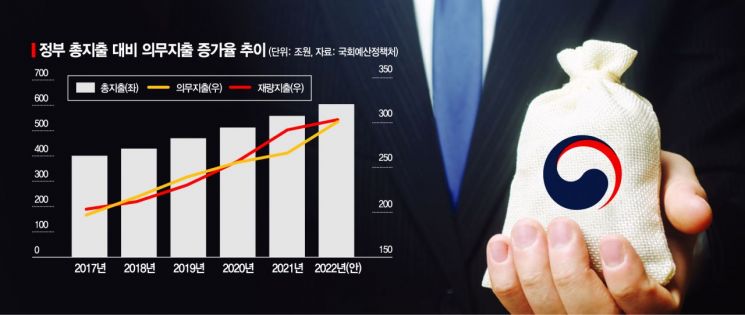
[Sejong=Asia Economy Reporters Son Seon-hee and Moon Chae-seok] When government support budgets for the public sector increase, fiscal management becomes more difficult. This is because as fixed expenditures grow, the funds available for urgent needs inevitably decrease. This is the point highlighted by the National Assembly Budget Office in its analysis of next year’s budget proposal. Following the COVID-19 crisis, national fiscal spending has expanded rapidly, and even as demands for fiscal normalization rise during the economic recovery phase, budgets for public sector support, as well as various welfare, employment, and administrative expenditures, are likely to remain as ‘structural expenditures.’
According to the National Assembly Budget Office’s “2022 Budget Proposal Comprehensive Analysis” report released on the 25th, the size of mandatory expenditure for next year is 301.1 trillion won, approaching half (49.8%) of the total expenditure (604.4 trillion won). The growth rate of mandatory expenditure surged to 13.2%, marking the highest level in 10 years since 2012. According to the “2021-2025 National Fiscal Management Plan,” mandatory expenditures are expected to increase by an average of 6.5% annually over five years from the 2021 main budget to 2025, which is a 1.2 percentage point upward revision from the previous “2020-2024 Plan” average annual increase of 5.3%. If this trend continues, the scale of mandatory expenditures, which represent fixed spending within the total budget, could grow even larger.
Mandatory expenditures consist of statutory expenditures and interest payments that are legally required, with their scale, unit cost, and targets determined by law, leaving the government little room to reduce spending. The Budget Office stated, “It is necessary to manage the scale of these expenditures from the perspective of controlling spending and maintaining fiscal soundness.”
◆Rigid Discretionary Spending on Health and Welfare Increased 1.7 Times= Not only mandatory expenditures but also ‘rigid’ discretionary expenditures have increased due to trends such as low birth rates and aging populations, including civil servant salaries, the National Employment Support System, and health and welfare sectors. Although discretionary, once increased, these expenditures are difficult to reduce and are practically close to mandatory spending. In particular, the ‘health, welfare, and employment’ sector saw the highest budget growth, with an increase of 17 trillion won in one year, totaling 216.7 trillion won. The growth rate was 8.5%, accounting for about 36% of total government spending. Compared to the early days of the Moon Jae-in administration (approximately 130 trillion won), this represents about a 1.7-fold increase. Considering Korea’s low birth rate and aging population trends, further spending increases are expected in the future.
General and local administration budgets also increased by 14.3% from this year, reaching 96.8 trillion won. Especially under the current administration, the number of civil servants increased by more than 120,000, significantly raising related personnel costs. Civil servant salaries started at 33.4 trillion won in 2017 and are reflected as 41.3 trillion won in next year’s budget proposal, an increase of about 23.6%.
While the government planned to reduce four major recurring expenses directly used by civil servants (special activity expenses, specific task expenses, National Assembly travel expenses, and business promotion expenses) as part of fiscal innovation measures in next year’s budget, the reduction amounted to only 12.8 billion won. Moreover, the Budget Office pointed out that 23 ministries, including the Ministry of Employment and Labor and the Ministry of Science and ICT, actually increased their budgets compared to the previous year. The Budget Office stated, “Departments with increased recurring expenses need to participate in budget reduction efforts considering fairness,” and “The National Assembly should closely review the budget details of agencies with increased expenses during the examination of next year’s budget proposal.”
◆Carbon Neutrality-Related Budget ‘Uncalculable’= In addition, employment-related budgets such as the National Employment Support System and climate crisis response budgets are also expected to see significant expenditure increases. In particular, the massive fiscal resources to be invested in achieving carbon neutrality by 2050 have not yet been accurately estimated.
Experts diagnose that, given the long-term weakening of the tax base due to the low birth rate trend, it is urgent for the government to reduce rigid fiscal expenditures. Professor Sung Tae-yoon of Yonsei University’s Department of Economics said, “The problem is that as the overall budget size grows, rigid expenditures have also increased accordingly,” and advised, “Even with the same budget size, a system to evaluate whether the budget is rigid or non-rigid should be included within fiscal rules.”
© The Asia Business Daily(www.asiae.co.kr). All rights reserved.

















