Revealing Intent to Tax Income Tax Following Industrial Accident and Employment Insurance
Delivery Industry Interprets "Government Has Played Its Last Card"
"Burden Should Not Be Passed to Common People... Must Participate in Delivery Ecosystem"
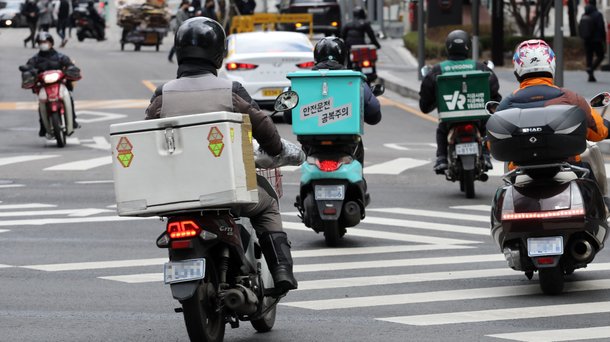
The government’s intention to impose income tax on riders starting next year has put the delivery agency platform industry on edge. Not only income tax but also the burden of industrial accident and employment insurance premiums, which are shared equally between employers and riders, is expected to increase, making a rise in delivery fees inevitable. Since delivery fee hikes directly affect consumer prices for delivery services and the cost burden on self-employed business owners, it will impact the everyday economy.
"Rider Income Tax, Government’s Last Card"
According to the delivery industry on the 25th, the National Tax Service recently held a meeting with representatives from domestic delivery agency companies such as Barogo, Logiol (Saenggakdaero), and Mesh Korea (Booroong). The meeting was to require platform companies to mandatorily submit monthly income data of riders registered with their platforms starting February next year. Until now, rider income data had been managed by regional delivery agencies operating hubs or branches in each area, but this responsibility has now been assigned to platform companies.
An industry insider said, "The National Tax Service cited the reason that ‘it was difficult to determine eligibility for disaster relief payments because rider income was not transparently identified’."
The industry anticipates that this government policy will cause riders who are basic livelihood security recipients, credit delinquents, or those working multiple jobs to avoid income exposure and possibly leave. Another insider said, "While it is right for the government to properly collect taxes, it must consider that the delivery industry is currently facing a shortage of riders." He added, "Seeing the discussion about rider income tax, I thought, ‘The government has pulled out its last card.’”
The government has been attempting to incorporate riders into social safety nets through industrial accident and employment insurance systems, and the imposition of income tax marks the peak of these efforts. Industrial accident and employment insurance premiums are split equally between employers and riders, but income tax is a cost borne solely by the riders.

Into Industrial Accident and Employment Insurance Systems from Next Year
Next year, the enrollment of approximately 400,000 riders in industrial accident insurance is expected to expand significantly. In July, the government effectively made industrial accident insurance enrollment mandatory for workers in special types of employment (special-type workers). The conditions for exemption applications were limited to cases such as absence due to injury, illness, childcare, or employer’s fault causing more than one month of leave. A bill to amend the Industrial Accident Insurance Act to abolish the ‘exclusivity requirement,’ which had been a reason for low enrollment rates among riders, was also submitted this month by Representative Im Jong-seong of the Democratic Party of Korea.
Additionally, under the government’s roadmap for the ‘National Employment Insurance System’ to enroll all workers by 2025, riders will be required to enroll in employment insurance starting January next year.
The delivery agency industry, which had been smiling broadly due to increased delivery demand amid the COVID-19 pandemic, is now concerned about rising costs and delivery fee hikes. They face not only the heavy workload of submitting tax data for about 30,000 to 50,000 riders per platform company but also the burden of industrial accident and employment insurance premiums. Currently, delivery fees are shared between customers (consumers) and restaurant owners (self-employed business owners).
Professor Lee Byung-hoon of Chung-Ang University’s Department of Sociology said, "Building employment safety nets for platform workers is the right long-term direction for our society," but added, "Rather than passing costs onto consumers and self-employed business owners, it is necessary to have social dialogue among the stakeholders in the delivery industry ecosystem to ensure appropriate and fair cost-sharing."
© The Asia Business Daily(www.asiae.co.kr). All rights reserved.


















