"Financial Authorities Must Develop Measures to Slow Down Store Closure Pace"
[Asia Economy Reporter Park Sun-mi] Concerns are growing that the indiscriminate closure of bank branches is threatening jobs. As the banking sector is expected to conduct large-scale voluntary retirements ahead of year-end personnel changes and organizational restructuring this year, calls are gaining momentum for financial authorities to devise measures to slow down the pace of branch closures.
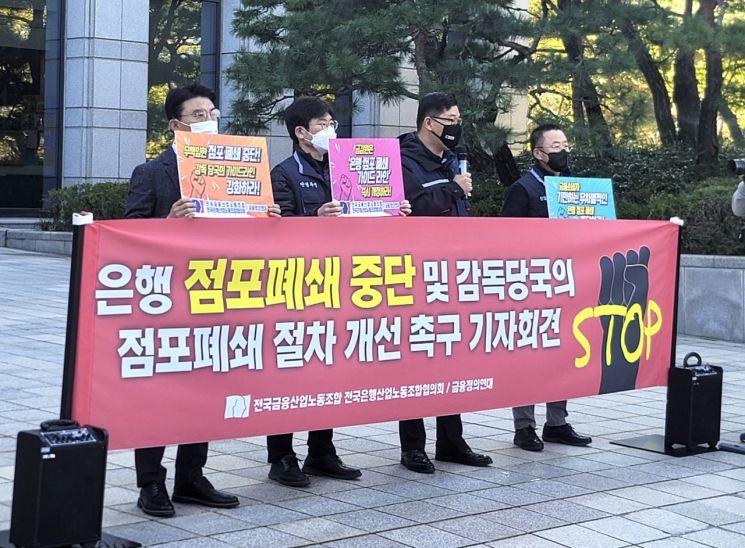
On the 25th, the National Bank Industry Labor Union Council held a press conference in front of the Financial Supervisory Service, urging a halt to bank branch closures and improvements in the supervisory authorities' branch closure procedures. At the event, the Bank Labor Union Council and Financial Justice Solidarity warned, "If indiscriminate bank branch closures continue, continuous workforce reductions will be inevitable," adding, "Social confusion that widens financial disparities based on age and residence will also increase." They urged, "Financial authorities must strengthen guidelines to control irresponsible branch closures."
The Financial Labor Union claimed that although the Financial Supervisory Service revised the bank branch closure guidelines in March this year to mandate prior impact assessments when closing branches, allowing alternatives such as converting branches to business offices or operating ATMs has been exploited as a means to encourage closures.
According to the Financial Supervisory Service, the number of domestic bank branches, which was 6,789 at the end of 2017, decreased to 6,326 by the end of the first half of this year. While the number of branches decreased by tens annually in 2018 and 2019, the reduction accelerated last year with a decrease of more than 300 branches.
To minimize the shock of branch closures, the Korea Federation of Banks recently launched the ‘Joint Bank Branch Pilot Operation Review Task Force (TF)’ in cooperation with the five major commercial banks and IBK Industrial Bank of Korea, but the financial labor union insists that strengthening guidelines at the level of financial authorities is necessary.
In particular, as the banking sector is forecasting record-high performance this year, reports that large-scale voluntary retirements will be enforced at year-end to improve branch operation efficiency have sparked strong opposition from labor unions. SC First Bank has started the honorary retirement (special retirement) process this month, offering up to 600 million KRW in retirement pay, and Citibank Korea, which decided to withdraw from the consumer finance sector for the first time in 17 years, has also formalized large-scale voluntary retirements. Following about 2,500 voluntary retirements at the five major banks at the end of last year, a similar scale of voluntary retirements is expected to continue this year.
Park Hong-bae, chairman of the Financial Labor Union, expressed concern, saying, "As branch reductions and the expansion of non-face-to-face channels coincide, the number of bank employees is rapidly decreasing, and if branch closures continue, workforce reductions are inevitable." He added, "Following the disappearance of 161 bank branches by September this year, it is reported that about 100 additional branches will be closed at the five major banks by year-end, indicating that the financial authorities' measures are not effective at the field level at all."
© The Asia Business Daily(www.asiae.co.kr). All rights reserved.

















