Korea Electrotechnology Research Institute Transfers Coprecipitation Manufacturing Technology for Sulfide-Based Solid Electrolytes for All-Solid-State Batteries to Private Companies
Mass Production to Begin Next Year, Leading Commercialization of All-Solid-State Batteries
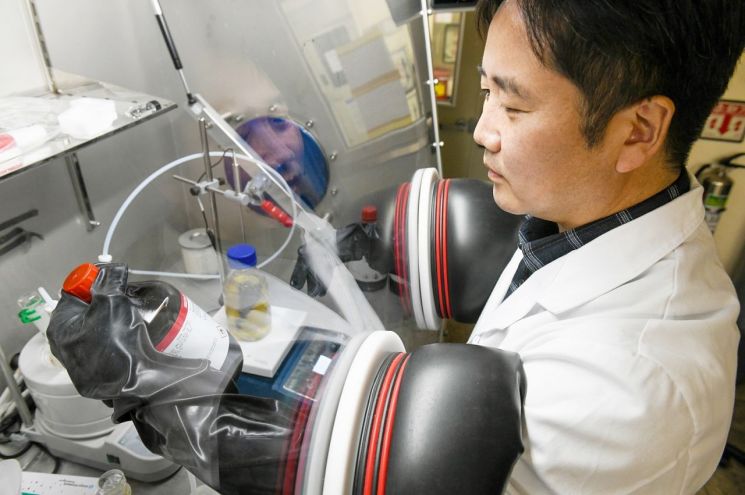 ‘Co-precipitation Manufacturing Technology for Sulfide-based All-solid-state Battery Electrolytes’ developed by Dr. Ha Yoon-cheol's team at the Next-generation Battery Research Center, Korea Electrotechnology Research Institute.
[Asia Economy Reporter Kim Bong-su] Regarding all-solid-state batteries, which are attracting attention as next-generation battery technology, a technology that can drastically reduce the manufacturing cost of the core material, solid electrolyte, has been developed in Korea and has entered the mass production stage.
The Korea Electrotechnology Research Institute (KERI) announced on the 25th that the 'Co-precipitation manufacturing technology for sulfide-based solid electrolytes for all-solid-state batteries,' developed by Dr. Ha Yoon-cheol's next-generation battery research team, has been transferred to a domestic company.
Sulfide-based solid electrolytes have the advantage of high ionic conductivity and high ductility, making it easy to manufacture electrodes and separators. However, the main raw material, lithium sulfide (Li2S), is expensive. Additionally, the process uses a 'ball milling method,' which consumes high energy when mixing with other raw materials. For these reasons, production has been limited to small quantities, with prices reaching several million won per 100 grams.
The research team developed the world's first technology to mass-produce sulfide-based solid electrolytes at low cost using a simple one-pot solution synthesis process called the 'co-precipitation method,' without using expensive lithium sulfide.
The co-precipitation method simultaneously precipitates various different ions in aqueous or non-aqueous solutions and is widely used in the industrial mass production of cathode materials for lithium secondary batteries. Through continuous efforts, the research team developed a process to co-precipitate lithium, sulfur, phosphorus, halogen elements, etc., and succeeded in manufacturing solid electrolytes at the same level as the conventional method using expensive lithium sulfide.
Based on pure raw material costs, KERI's manufacturing method is about 1/15th the cost of the existing method, and considering that it does not require high-cost, high-energy processes like ball milling, the cost reduction effect is even greater.
KERI transferred this technology to Daejoo Electronic Materials, a domestic company specializing in electrical and electronic materials and silicon anode materials for lithium secondary batteries. The company plans to expand investment in mass production facilities for solid electrolytes, including establishing a pilot production facility on the site of its second plant by 2022. Through the 'Small and Medium Materials, Parts, and Equipment Strong Small Giants 100' project awarded in September, they aim to develop various silicon materials that can replace lithium metal (Li metal) anodes for all-solid-state batteries and lead the all-solid-state battery market expected to bloom after 2025.
Dr. Ha said, "This is an achievement that simultaneously solves the issues of 'low cost' and 'mass production' of solid electrolytes, which are key to the commercialization of all-solid-state batteries." He added, "Through this technology transfer to companies, mass production of solid electrolytes will be realized, playing a leading role in the commercialization of all-solid-state batteries, known as the dream battery."
© The Asia Business Daily(www.asiae.co.kr). All rights reserved.

















