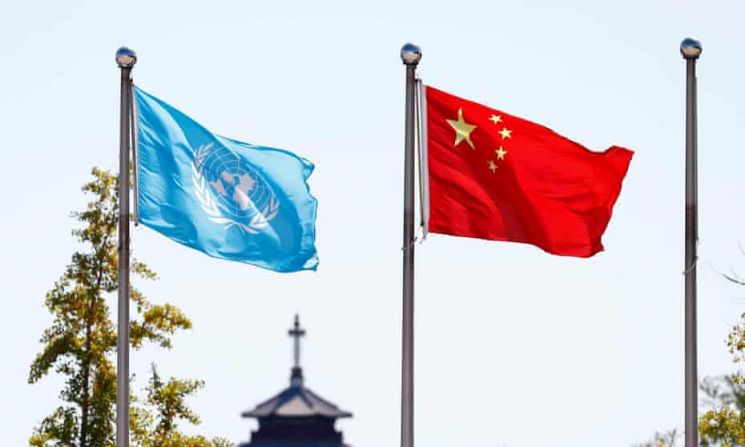
[Asia Economy Reporter Jo Yoo-jin] The governments of the United States and Taiwan held talks to discuss expanding Taiwan's participation in the United Nations (UN) just before Chinese President Xi Jinping's speech commemorating the 50th anniversary of China's UN membership. This meeting took place a day after US President Joe Biden's statement that the US would defend Taiwan if China attacks, which sparked tensions between the US and China.
According to the UK Guardian and others on the 24th (local time), the US State Department stated in a press release the previous day that officials from both countries met via video conference to focus on discussions supporting Taiwan's meaningful participation in the UN.
It added, "US participants reaffirmed America's commitment to helping Taiwan have meaningful participation in the World Health Organization (WHO) and the UN Framework Convention on Climate Change, and discussed ways to emphasize Taiwan's ability to contribute to efforts on various issues."
The State Department said that the video conference was attended by Hugo Yon, Acting Assistant Secretary for International Organization Affairs at the State Department; Rick Waters, Deputy Assistant Secretary for China, Taiwan, and Mongolia; and Wang Liangyu, Taiwan's Deputy Ambassador to Washington.
This meeting came a day after President Biden stated that the US would defend Taiwan if China attacks.
At a CNN town hall event held in Baltimore on the 21st, President Biden responded "Yes" when asked if the US would defend Taiwan if China attacked.
Earlier, in an interview with ABC News in August, President Biden mentioned Taiwan alongside NATO and other allies, implying that the US could militarily intervene if China launched a forceful invasion of Taiwan.
Following Biden's remarks, China reacted angrily, urging not to undermine the "One China" principle, which sparked controversy. The White House emphasized that there has been no change in the US policy of strategic ambiguity regarding Taiwan.
Currently, under the Taiwan Relations Act, the US supports Taiwan's self-defense by allowing arms sales and maintains a basis for military support in emergencies. However, it has deterred Chinese military actions by maintaining "strategic ambiguity," not clearly stating its position on military intervention in Taiwan.
Foreign media noted that the meeting was held just before President Xi Jinping's scheduled speech on the 25th commemorating the 50th anniversary of China's UN membership. Major foreign outlets reported that amid new Cold War tensions, China is intensifying political and military pressure on Taiwan, highlighting Taiwan as a core issue in US-China conflicts.
Taiwan was a founding member of the WHO when it was established in 1948 and participated as an observer in the World Health Assembly (WHA), the WHO's highest decision-making body, from 2009 to 2016. However, since the pro-independence Tsai Ing-wen administration took office, Taiwan has been unable to attend due to China's opposition. The US officially requested Taiwan's participation in the WHA in May, but the effort was blocked by China.
Meanwhile, the Chinese Ministry of National Defense announced that it conducted its first joint patrol with a Russian warship in the Western Pacific on the same day. The Ministry stated that this exercise aims to develop a comprehensive partnership between China and Russia in the new era, enhance both sides' operational capabilities, and jointly maintain regional and strategic stability.
© The Asia Business Daily(www.asiae.co.kr). All rights reserved.

















