Subway Lines 2, 5-9, Uisinseol Line, City and Village Buses Return to Pre-Reduction Operation
Passenger Numbers and Congestion Increase Despite 4th Phase Distancing... Responding to Citizen Safety and Convenience Needs
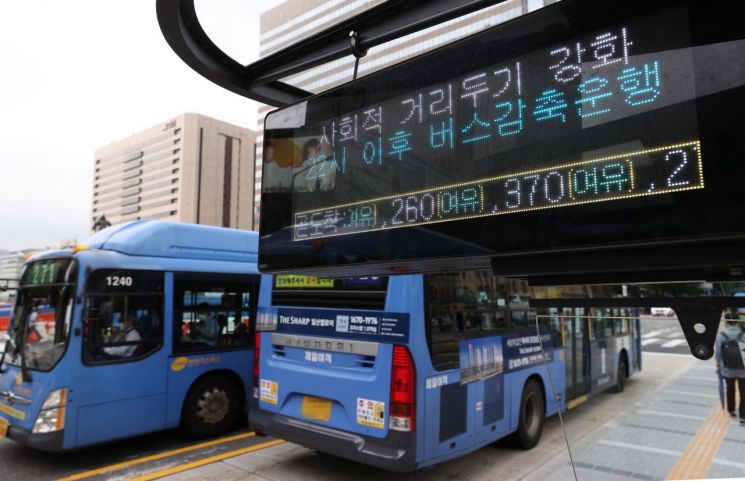
[Asia Economy Reporter Lim Cheol-young] The Seoul Metropolitan Government will normalize the reduced weekday public transportation operations, which have been implemented in connection with the government's Level 4 social distancing measures, starting from the 25th.
On the 24th, Seoul announced that subway lines 2, 5 to 9, the Uisinseol Line, and city and village buses will return to normal operations prior to the reduction starting on the 25th, and that subway lines 3 and 4, which operate in connection with Korail, will be gradually normalized from December 1.
Earlier, to prevent the spread of COVID-19 by reducing nighttime traffic, Seoul had reduced public transportation operations by up to 20% after 10 p.m. on weekdays since July 9. According to Seoul, the number of public transportation users after 10 p.m. on weekdays has maintained a 35% decrease compared to before the reduction. After limiting dining inside restaurants and cafes to 9 p.m., subway ridership dropped by more than 52%, from 241,000 to 115,000. City buses decreased from 230,000 to 158,000, and village buses from 56,000 to 35,000.
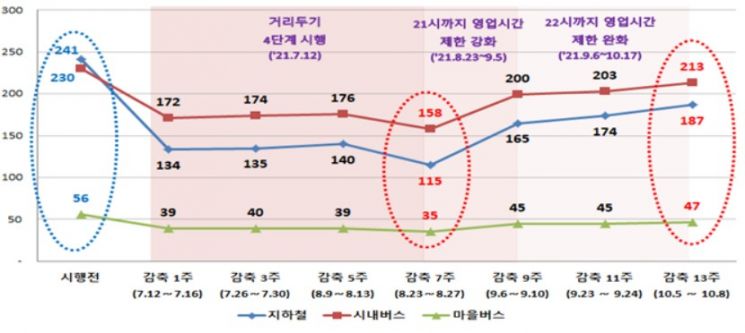
However, considering the increase in nighttime ridership due to the easing of nighttime business restrictions from September, Seoul decided to resume normal weekday nighttime operations. From September 6, as the allowed dining time inside restaurants and cafes was extended to 10 p.m., recent ridership increased to 187,000 for subways, 213,000 for city buses, and 47,000 for village buses. As ridership increased, congestion levels recovered to pre-reduction levels: 50.1% for subways, 30.2% for city buses, and 27.9% for village buses.
Seoul will continue to conduct ongoing monitoring and flexibly manage onboard congestion by adding extra services during peak congestion times, while maintaining quarantine measures to ensure citizens can safely use public transportation. In case of congestion, additional trains will be added on the always-congested subway lines 2 and 7, and buses will maintain minimum intervals during rush hours to manage congestion.
Baek Ho, Director of Urban Transportation at Seoul City, said, “We will create a safe public transportation environment through continuous congestion monitoring and thorough quarantine management,” and added, “We also ask for active compliance with quarantine guidelines to prevent the spread of COVID-19 within public transportation.”
© The Asia Business Daily(www.asiae.co.kr). All rights reserved.
![Clutching a Stolen Dior Bag, Saying "I Hate Being Poor but Real"... The Grotesque Con of a "Human Knockoff" [Slate]](https://cwcontent.asiae.co.kr/asiaresize/183/2026021902243444107_1771435474.jpg)

















