[Asia Economy Reporter Ji Yeon-jin] The stock market's difficult period, which intensified since last month, is reaching a turning point. Since the beginning of this month when the KOSPI index fell below 3000, the market's attention is focused on whether the recent calming phase will lead to a trend reversal.
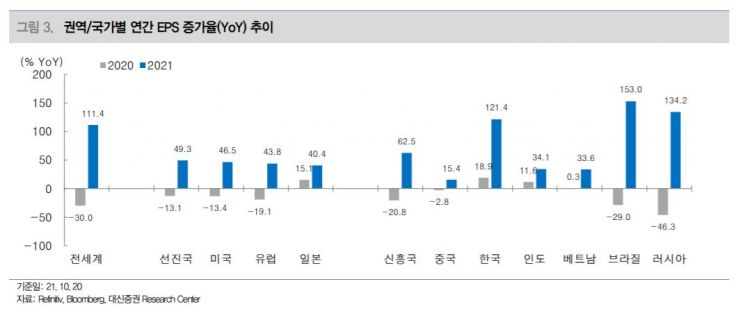
According to the financial investment industry on the 24th, the primary reason for the global stock market calming down this month was the Senate's passage of the U.S. temporary budget and debt ceiling suspension bills. The power of policy subdued the market anxiety. Therefore, there is a high possibility that the passage of two infrastructure investment bills, whose processing deadline is at the end of this month, will determine the direction of the stock market from next month through the end of the year.
The bills include $1 trillion physical infrastructure and $3.5 trillion human infrastructure. Initially, the Republican Party opposed the human infrastructure, and even within the Democratic Party, progressives stated that if the human infrastructure is not guaranteed to pass the Senate, they would vote down the physical infrastructure in the House. Moderates suggest either reducing the scale of the human infrastructure or passing only the physical infrastructure.
After the Senate passed the debt ceiling suspension bill, the Democrats shifted their stance to reduce the original scale of the human infrastructure, pushing for congressional approval by cutting the budget to $1.9 trillion. This is significantly lower than global investment banks' expectations of the bill being revised to about $3 trillion, and is seen as a compromise considering opposition within the Democratic Party. Namjung Moon, a researcher at Daishin Securities, predicted, "The weak U.S. Q3 GDP to be announced on the 28th of this month could provide the Biden administration with a rationale to urge the passage of the infrastructure investment bill for economic revitalization. Although there may be noise due to discord ahead of the red line, the market-desired outcome is expected."
The global stock market has maintained a preference for risk assets due to abundant liquidity from accommodative monetary policies and expanded fiscal spending to overcome COVID-19. With the expansion of vaccinations, expectations for economic recovery have grown, and limited recovery in the economy and corporate profits is anticipated. Therefore, stocks related to structural social changes after COVID-19 and policies of U.S. President Joe Biden, such as IT, healthcare, low-carbon, electric vehicles, hydrogen vehicles, and other renewable energy sectors,
as well as next-generation communication and healthcare infrastructure stocks, are considered beneficiaries.
© The Asia Business Daily(www.asiae.co.kr). All rights reserved.
![Clutching a Stolen Dior Bag, Saying "I Hate Being Poor but Real"... The Grotesque Con of a "Human Knockoff" [Slate]](https://cwcontent.asiae.co.kr/asiaresize/183/2026021902243444107_1771435474.jpg)
















