Higher Manufacturing Share Than Competitors... Unrealistic Government Carbon Neutrality Goals
Job Losses Inevitable if Key Industries Suffer
[Asia Economy Reporter Changhwan Lee] The reason why the industry and academia have expressed concerns about the government's carbon neutrality plan is that it could deal a fatal blow to the manufacturing sector driving South Korea's economy, including steel, petrochemicals, refining, and shipbuilding.
If the core manufacturing industries suffer damage, not only will jobs significantly decrease, but there is also a limit to the efficiency of renewable energy power generation, which could lead to a severe power shortage. There are also concerns that the damage to companies could be greater than expected, as there are no estimates of the enormous transition costs incurred during the carbon neutrality implementation process nor concrete corporate support measures.
The manufacturing sector's share is among the highest in the world, but the pace of carbon neutrality is too fast
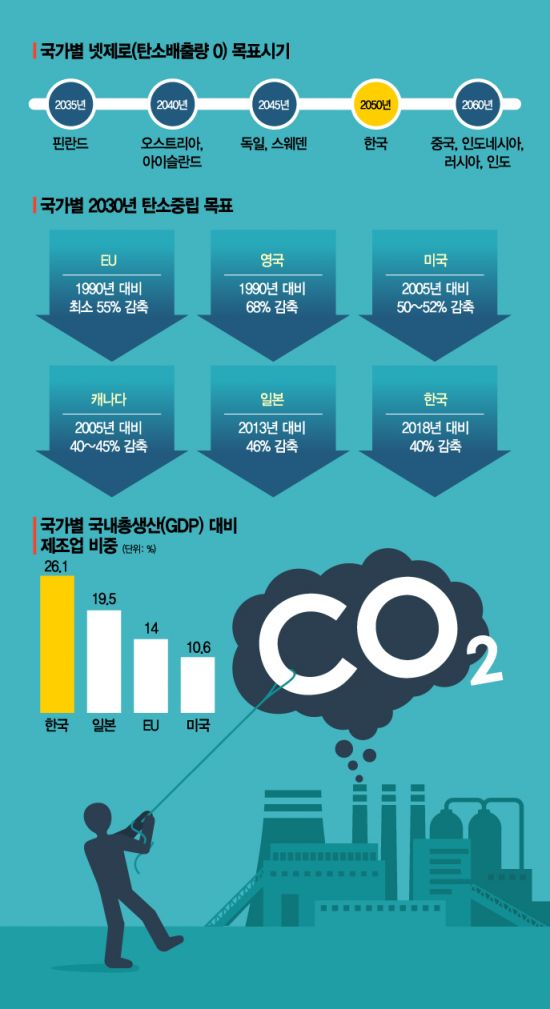
According to the Carbon Neutrality Committee on the 22nd, as of last year, South Korea's manufacturing sector accounted for 26.1% of its Gross Domestic Product (GDP), which is much higher than major countries such as Japan at 19.5%, the European Union (EU) at 14%, and the United States at 10.6%. Manufacturing competitiveness is also among the highest in the world. In the World Manufacturing Competitiveness Index (CIP index) released this year by the United Nations Industrial Development Organization (UNIDO), South Korea was ranked third among 152 countries worldwide, following Germany and China.
According to the Korea Institute for Industrial Economics and Trade, industries that emit a large amount of greenhouse gases, such as steel, chemicals, cement, semiconductors, and displays, account for 40% of manufacturing. This high dependence on greenhouse gas?intensive industries means that, due to the characteristics of our economy, achieving carbon emission targets is more difficult compared to other countries.
Jae-yoon Lee, head of the Materials Industry Environment Office at the Korea Institute for Industrial Economics and Trade, explained, "While major countries peaked in greenhouse gas emissions during the 1990s and 2000s and have recently been reducing emissions, South Korea's peak came later, making it difficult to transition industries in a short period."
The low level of carbon neutrality technology is also a problem. Even in the steel industry, a representative greenhouse gas?emitting sector, alternatives such as hydrogen reduction steelmaking are still not properly researched and developed (R&D), and carbon capture, utilization, and storage (CCUS) technology remains at the basic research stage.
Nam Jeong-im, head of the Climate Environment Safety Office at the Korea Iron & Steel Association, said, "We have set a challenging goal to reduce emissions by 95% through hydrogen reduction steelmaking technology by 2050, but there is insufficient additional reduction capacity by 2030. Regarding the recent upward revision of the Nationally Determined Contribution (NDC), the steel industry has reflected all reduction technologies, including innovative technologies planned for 2040, beyond existing technologies, so time is needed to develop reduction technologies."
Lee Dong-geun, vice chairman of the Korea Employers Federation, also emphasized, "The biggest immediate problem is that with only eight years left until 2030, it is practically impossible to achieve the sharply increased reduction targets with South Korea's carbon neutrality technology level lagging behind Europe, the United States, and Japan."
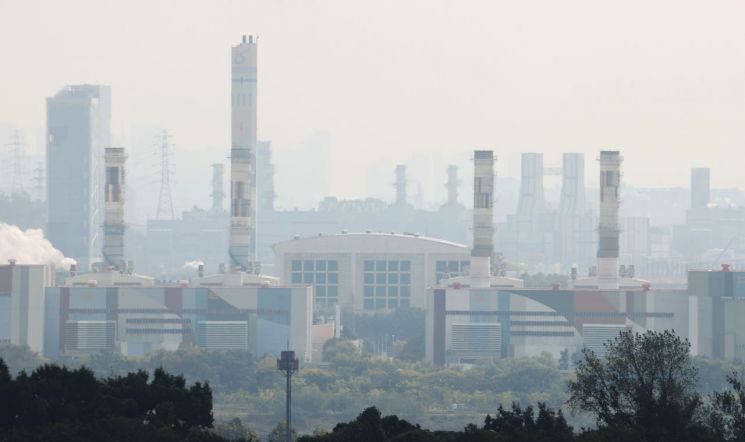 View of the power plants in Seo-gu area from Gyeongin Ara Waterway, Seo-gu, Incheon on the 19th.
 [Image source=Yonhap News]
Carbon neutrality could worsen job and power supply issues
There are also concerns that accelerating carbon neutrality could worsen job losses and power shortages. As the business structures of major greenhouse gas?emitting industries such as steel, refining, petrochemicals, and automobiles rapidly change, existing jobs may be eliminated. In particular, latecomers like China and India, whose carbon neutrality targets are set later than South Korea's, may replace our position.
Kwon Eun-kyung, head of the Eco-friendly Mobility Office at the Korea Automobile Manufacturers Association, said, "Due to the 2030 NDC upward revision and the rapid transition to electric and hydrogen vehicles, most small-scale companies manufacturing internal combustion engine parts face limitations in transitioning to future vehicle businesses. Because electric vehicles require less labor and fewer parts compared to internal combustion engines, employment reduction is a concern."
Professor Yoo Seung-hoon of the Department of Energy Policy at Seoul National University of Science and Technology urged, "The government must recognize that the list we leave to future generations includes not only a planet with reduced greenhouse gas emissions but also jobs. The government should prepare measures to preserve jobs as well."
The expected worsening power shortage is also a problem. Although the carbon neutrality scenario proposes completely phasing out coal-fired power generation by 2050 and focusing on expanding renewable energy, South Korea's climate characteristics result in lower renewable energy generation efficiency. With nuclear power also being reduced, future power supply crises and electricity price increases are inevitable.
Professor Yoo said, "Phasing out coal, nuclear, and even liquefied natural gas (LNG) power generation seriously undermines our power supply stability and could ultimately derail the energy transition itself. Even as renewable energy increases, we must actively consider utilizing the reserve capacity of existing power sources to ensure stable power supply."
There were also calls to strengthen incentives for companies transitioning to carbon neutrality. Lee Jae-yoon said, "South Korea's high dependence on greenhouse gas?emitting manufacturing and the burden of short-term industrial transition are unfavorable conditions compared to major countries. Overcoming these is key. Expanding incentives for carbon neutrality technology investment and enhancing communication among various stakeholders are important."
Vice Chairman Lee said, "Uncertain policies and unmanageable reduction targets like now will ultimately lead not only to weakened international competitiveness of companies but also to industrial contraction due to production cuts and overseas relocation, and job losses, resulting in national economic stagnation. The government must actively listen to the industry's voices, reset the 2030 NDC and carbon neutrality scenarios, and actively prepare concrete corporate support measures."
© The Asia Business Daily(www.asiae.co.kr). All rights reserved.


















