Today Nuriho-Related Stocks Open Lower
"Expecting Momentum in Follow-up Space Projects"
[Asia Economy Reporter Ji Yeon-jin] Defense industry stocks are gaining attention following the launch of the Korean Launch Vehicle-II (KSLV-II) Nuri rocket. The financial investment sector predicts that although Nuri failed to achieve a stable orbit, the entire process was carried out using purely domestic company technology, marking a de facto success that will give momentum to subsequent space projects. However, on the day of the launch, stocks related to Nuri showed a widespread decline.
According to the Korea Exchange on the 22nd, Korea Aerospace Industries opened 1.56% lower than the previous day and continued to widen its losses during the session. Hanwha Aerospace also fell more than 4% at one point during the trading day, while LIG Nex1 and Hanwha Systems showed weakness as well.
The Nuri rocket, launched the previous day from Naro Space Center, is the first domestic low Earth orbit practical satellite launch vehicle, with the entire process from design to manufacturing, testing, and operation conducted using purely domestic company technology. Korea Aerospace Industries was responsible for the final assembly, and Hanwha Aerospace supplied the engines.
Nuri secured independent technology for liquid rocket engines, large propulsion tanks, and launch pad systems, clustering four 75-ton class engines in the first stage to achieve 300 tons of thrust. This achievement made South Korea the seventh country to launch a satellite weighing over 1 ton into orbit. The second Nuri launch is planned for around May next year, with four additional launches scheduled by 2027. Lee Dong-heon, a researcher at Daishin Securities, stated, "With the Nuri launch being a de facto success, follow-up space projects such as next-generation medium satellites, the Korean Positioning System (KPS), and clustered low Earth orbit satellites (LEO) are expected to gain momentum." He added, "Due to the limited size of the domestic private market, a U.S.-style private-led space development is difficult, and the structure is transitioning from ‘government’ to ‘private’ through public-private cooperation."
Korea Aerospace Industries is responsible for comprehensive development starting from the second next-generation medium satellite and is collaborating with SpaceX in the U.S. for launches. Hanwha Aerospace leads key engine technologies and is developing them together with its subsidiaries, Satrec Initiative and Hanwha Systems. In particular, Hanwha Systems is expanding its business into low Earth orbit satellites and electronic antennas through partnerships with Kaimeta, Hanwha Phazer, and OneWeb, while LIG Nex1 plans to work on satellite transceivers and the Korean Positioning System (KPS).
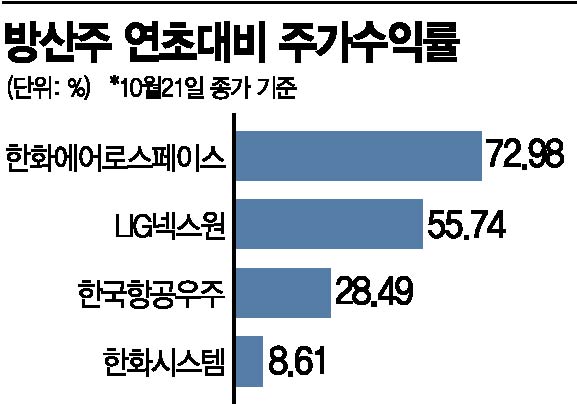
The stock prices of these companies surged earlier this year as interest in growth stocks increased but experienced some correction after a period of sideways movement. However, compared to the beginning of the year, the price returns are 28.49% for Korea Aerospace Industries, 72.98% for Hanwha Aerospace, 55.74% for LIG Nex1, and 8.61% for Hanwha Systems. Jung Eui-hoon, a researcher at Eugene Investment & Securities, said, "The growth of the domestic launch vehicle market is expected to accelerate further in the future."
© The Asia Business Daily(www.asiae.co.kr). All rights reserved.
![Clutching a Stolen Dior Bag, Saying "I Hate Being Poor but Real"... The Grotesque Con of a "Human Knockoff" [Slate]](https://cwcontent.asiae.co.kr/asiaresize/183/2026021902243444107_1771435474.jpg)
















