Vice Minister Ki Jae: "Announcement on Fuel Tax Reduction Rate and Application Timing on the 26th"
Opening Remarks at the 31st Price-Related Vice Ministers' Meeting
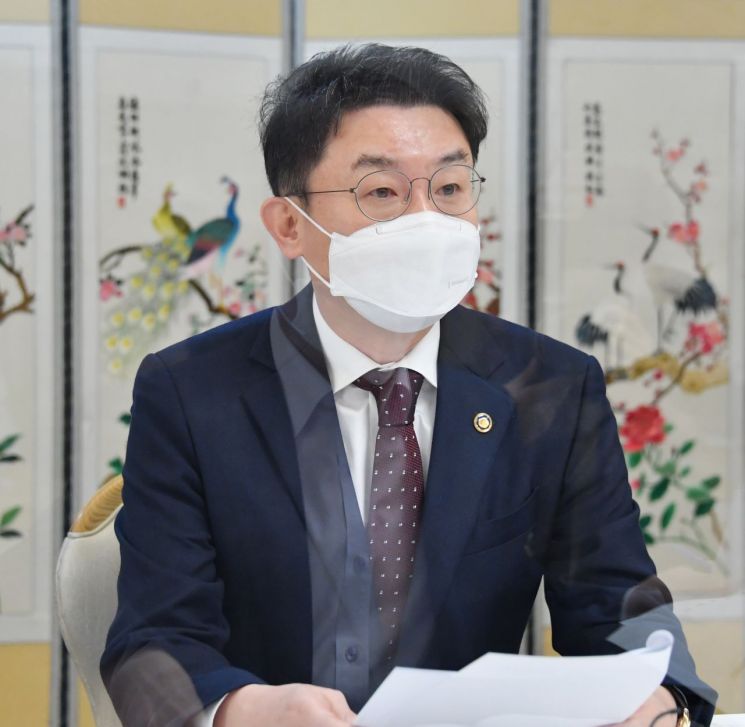 Lee Eok-won, First Vice Minister of the Ministry of Economy and Finance, speaking at the '36th Policy Review Meeting and 31st Vice Ministers' Meeting on Prices' held at the Government Seoul Office Building on the 22nd. (Photo by Ministry of Economy and Finance)
[Sejong=Asia Economy Reporter Moon Chaeseok] The government has officially announced a reduction in the fuel tax. It also stated that it will lower the tariff rate on liquefied natural gas (LNG) allocations.
Lee Eokwon, the 1st Vice Minister of the Ministry of Economy and Finance, presided over the '36th Policy Review Meeting and 31st Vice Ministerial Meeting on Prices' at the Government Seoul Office on the 22nd, saying, "We will promptly finalize specific measures such as the extent and timing of the fuel tax reduction and announce the details at the Emergency Economic Central Disaster and Safety Countermeasures Headquarters meeting next week (on the 26th)."
According to Vice Minister Lee, international oil prices are currently at the low 80-dollar range per barrel, the highest since 2018. Natural gas prices have also reached $35.3, about seven times last year's average price. As natural gas prices rise, demand for natural gas shifts to oil demand, pushing up oil prices. Korea's energy supply and demand situation remains stable. Crude oil is being imported steadily at 80 million barrels per month. The government has completed purchasing the target amount of reserve oil this year, securing a total of 100 million barrels. The proportion of long-term contracts for natural gas is around 80%, and 50% of that, used for power generation, can be reduced through other power sources.
The problem is that the price increase burdens the economy of ordinary citizens. The government has no choice but to use the fuel tax reduction card. Vice Minister Lee said, "The recent surge in global energy prices can exert upward pressure on domestic prices, so we intend to actively pursue preemptive measures to stabilize prices and alleviate the burden on the ordinary economy," adding, "To this end, we will temporarily reduce the fuel tax."
He added, "We will promptly finalize specific measures such as the extent and timing of the fuel tax reduction and announce the details at the Central Disaster and Safety Countermeasures Headquarters meeting next week," and "We will also announce a plan to further reduce the current 2% tariff rate on liquefied natural gas (LNG) allocations."
He emphasized, "Through the fuel tax reduction and additional LNG allocation tariff reduction, we will support the alleviation of the burden of living costs such as energy expenses on the ordinary economy," and "We will make every effort to manage stable prices, including managing the supply and demand of agricultural, livestock, and fishery products and freezing public utility charges, so that recent global inflation concerns do not spread into excessive inflation expectations."
Regarding the extent and timing of the fuel tax reduction, many expect it to be "around 15% for about six months." The day before, Deputy Prime Minister and Minister of Economy and Finance Hong Namki said at the National Assembly's Planning and Finance Committee audit, "(The fuel tax reduction period) will likely extend beyond the winter season." The government is also reportedly weighing a reduction of around 15%. In the most recent case in 2018, the fuel tax was lowered by 15% for six months, reducing the average gasoline price from about 1,690 KRW per liter to 1,560 KRW. The government is reportedly considering a reduction range of 10-15%. The maximum reduction rate that the government can implement by revising the Enforcement Decree of the Transportation Energy Consumption Tax Act and the Individual Consumption Tax Act without parliamentary approval is 30%.
© The Asia Business Daily(www.asiae.co.kr). All rights reserved.

















