[Asia Economy Reporter Su-yeon Woo] As the US-China trade dispute has intensified since 2018, it is argued that while the ASEAN market benefited in terms of trade volume, South Korea actually suffered losses.
According to the analysis of changes in the global trade structure after the US-China trade war and South Korea's future trade policy tasks released by the Federation of Korean Industries on the 21st, total imports in the US and Chinese markets decreased by 5.7% in 2020 compared to 2018, but imports from ASEAN increased by a remarkable 20.3%. On the other hand, imports from South Korea decreased by 10.6%, a larger decline than the overall import decrease. Accordingly, ASEAN's share in the US and Chinese import markets in 2020 compared to 2018, when the US-China trade war began, increased by 2.6 percentage points, while South Korea's share decreased by 0.3 percentage points.
In the current year as well, exports from the 10 ASEAN countries to the US and China continue to expand. In the first half of this year, ASEAN exports to the US and China increased by 24.9% and 38.1% respectively compared to the previous year, surpassing South Korea (US exports up 23.3%, China exports up 25.5%) and Japan (US exports up 17.7%, China exports up 27.2%). Particularly, the biggest beneficiary is Vietnam. Vietnam ranked 12th in the US import market in 2018 but surged to 6th place in the first half of this year.
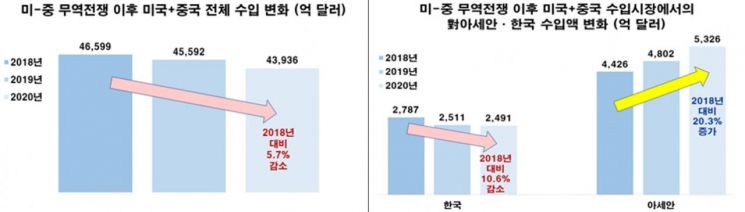
Meanwhile, China, engaged in a trade war with its largest export partner, the US, saw its exports to the US decrease by 5.3% and imports from the US drop by 11.9% compared to 2018. However, China quickly shifted its export destinations to ASEAN and Europe. Additionally, with the economic and industrial activities in advanced countries such as the US and Europe halted due to COVID-19 last year, China's total exports increased by 5.0% compared to 2018.
During the halt of economic and industrial activities in advanced countries like the US and Europe due to COVID-19 last year, China's exports increased, expanding China's share of the global export market from 12.7% in 2018 to 14.9% in 2020, an increase of 2.2 percentage points.
However, the Federation of Korean Industries predicted that China's dominance in the global export market is likely to enter a downward trend in the future. In April this year, the United Nations Conference on Trade and Development (UNCTAD) forecasted that due to rising domestic consumption and labor costs in China, reshoring of production facilities by advanced country companies back to their home countries, and the ASEAN shift, China's dominance in global trade will decrease.
Kim Bong-man, head of international cooperation at the Federation of Korean Industries, stated, "As the ASEAN shift in the global supply chain has progressed following the US-China trade war, the importance of the ASEAN region has greatly increased," and emphasized, "Prompt ratification and enforcement of the 'Korea-Indonesia Comprehensive Economic Partnership Agreement (CEPA)' approved by the National Assembly's Foreign Affairs and Unification Committee in June is necessary."
He added, "If South Korea joins the Comprehensive and Progressive Agreement for Trans-Pacific Partnership (CPTPP), our companies will be able to source efficiently from suppliers within the CPTPP region through origin rules, and if Korea, the US, and China all join CPTPP in the future, South Korea's long-term real GDP will increase by 4.79 percentage points," urging, "The pursuit of CPTPP membership should also be formalized."
© The Asia Business Daily(www.asiae.co.kr). All rights reserved.

![Clutching a Stolen Dior Bag, Saying "I Hate Being Poor but Real"... The Grotesque Con of a "Human Knockoff" [Slate]](https://cwcontent.asiae.co.kr/asiaresize/183/2026021902243444107_1771435474.jpg)















