From 2016 to 2017, Self-Employed Income Increased
In 2018-2019, When Minimum Wage Rose Rapidly, Income Decreased by 3.9846 Trillion Won
Under Moon Administration, Loan Amount Increased by 300 Trillion Won
Experts Say "Minimum Wage Cannot Resolve Polarization in Structure with Many Small Self-Employed"
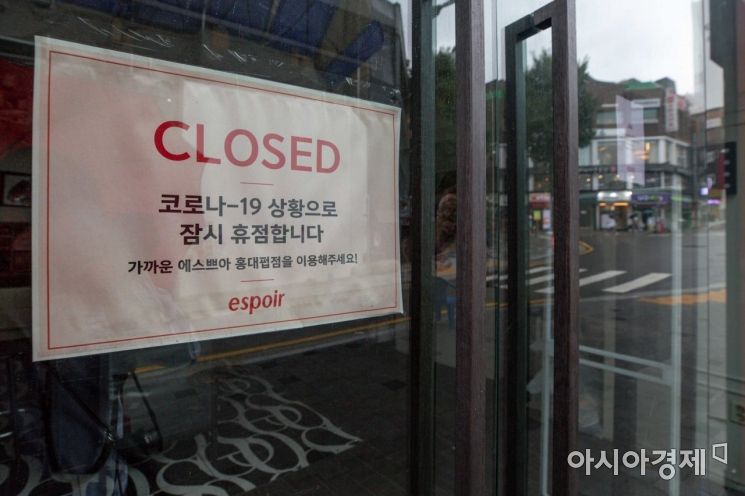 On the 8th, as non-face-to-face classes continued due to COVID-19, the worries of merchants in university commercial districts deepened. A cosmetics store near Ewha Womans University in Seodaemun-gu, Seoul, was seen temporarily closed. Photo by Jinhyung Kang aymsdream@
[Sejong=Asia Economy Reporter Moon Chaeseok]
The Moon Jae-in administration came to power with the slogan of income-led growth. The idea was that increasing income would boost consumption, leading to a virtuous cycle of economic development. For this reason, the minimum wage was raised by more than 10% annually. However, the minimum wage increase resulted in a sharp decline in the income of small business owners. It even set a record with a loss of 4 trillion won in a single year. There are concerns that statistics after 2020, when the COVID-19 pandemic fully hit, will be even more severe.
On the 21st, by combining the mixed income data of household non-corporate enterprises (small business owners) from the Bank of Korea and the minimum wage increase statistics from the Minimum Wage Commission, it can be seen that from 2011 to 2019, the period when the Bank of Korea compiled the data, the income of self-employed individuals and the minimum wage increase rate were generally inversely proportional. There were six years when the minimum wage increase rate was over 6% and the income of self-employed individuals decreased.
In particular, in the early years of the Moon Jae-in administration, 2018-2019, the minimum wage increase rate exceeded 26% over two years. This was a significant deviation from the 4-7% range maintained over the previous seven years (2011-2017). According to the income-led growth theory, it should have led to ‘increased income for low-income groups including the self-employed → revitalized consumption → resolution of economic polarization and economic growth.’ However, during this period, the income of self-employed individuals decreased by 364 billion won and 3.9846 trillion won compared to the previous year. After a rare increase of about 1 trillion won for two consecutive years in 2016-2017, the sharp increase in the minimum wage in 2018-2019 broke the upward trend.
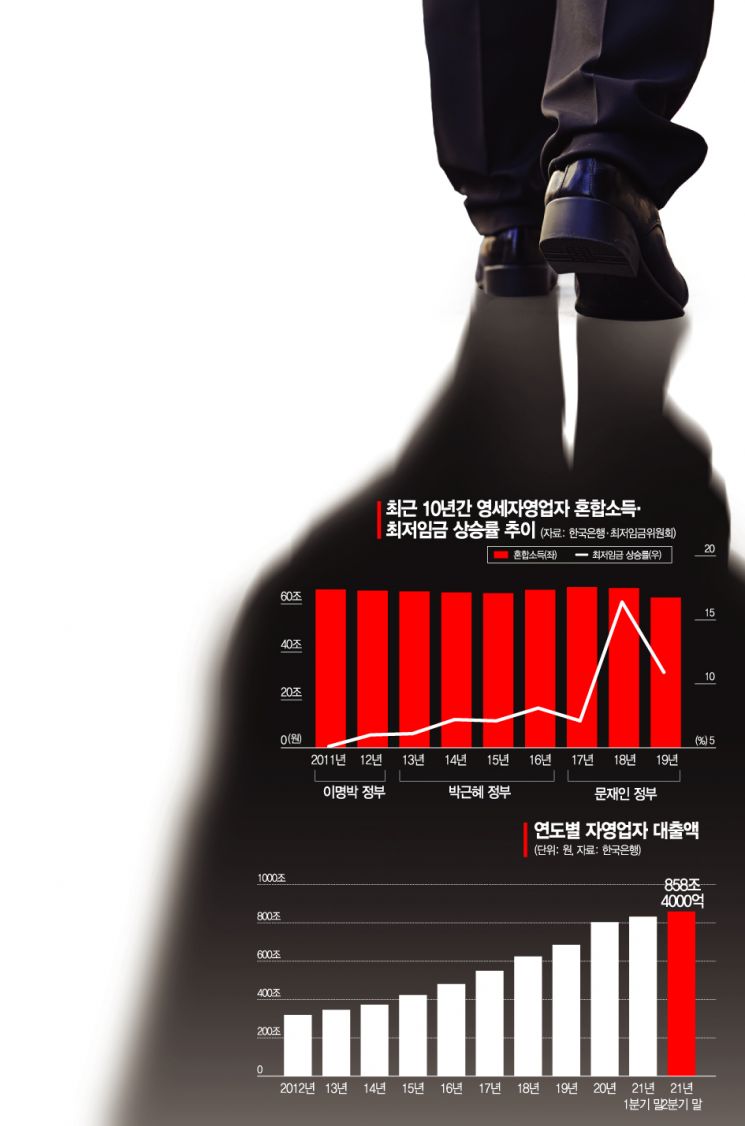
◆Self-employed loans also surged= When income decreases, loans tend to increase. During this period, loans for self-employed individuals also surged. According to the Bank of Korea, self-employed loans, which recorded around 300 trillion won in 2012-2014 and 400 trillion won in 2015-2016, rose sharply to 549.2 trillion won in 2017, 624.3 trillion won in 2018, 684.9 trillion won in 2019, 803.5 trillion won last year, and 858.4 trillion won by the end of the second quarter this year. The loan amount increased by 50 trillion won from 2015, then surged to 69 trillion won (14.9% increase) in 2017, 75.1 trillion won (13.7%) in 2018, and 60.6 trillion won (9.7%) in 2019.
Looking at the trend of a sharp increase in self-employed loans after the COVID-19 pandemic swept Korea in 2020, there are many concerns that the 2020 household non-corporate enterprise income to be announced by the Bank of Korea at the end of the year will also sharply decline. Self-employed loans increased by 118.6 trillion won (17.3%) from 684.9 trillion won in 2019 to 803.5 trillion won in 2020. This year, by the end of the second quarter, it reached 858.4 trillion won, an increase of 54.9 trillion won (6.8%) compared to last year. The loan growth rate soared from 7-8% (2012-2014) to 13-14% (2015-2018), and after the COVID-19 pandemic, it surged to 17.3% last year. The growth rate up to the second quarter of this year is also 6.8%. Even if the growth rate is the same, if the loan amount at the comparison point is larger, the economic impact can be considered more severe. This means that an increase from 300 trillion won to 400 trillion won (2014→2015) is less serious than an increase from 600 trillion won to 800 trillion won (2019→2020).
While the global trend, including the United States, is to focus on employment recovery as a kind of COVID exit strategy, the consensus is that Korea’s situation is somewhat different. This is because the proportion of self-employed individuals in the economy is too large. According to academia, in the paper titled ‘Where Do Good Jobs Come From’ posted by Daron Acemoglu, a professor at the Massachusetts Institute of Technology (MIT), on ‘Project Syndicate,’ a platform where major global figures contribute articles, there is a warning that ‘if minimum wage policies are used well, they can be beneficial, but if not, they can be harmful,’ but there is no message that ‘raising the minimum wage will activate the economy and should be actively pursued.’ Professor Acemoglu, a Turkish-born American economist, is considered a strong candidate for the next Nobel Prize in Economics. Relatedly, Kim Kyung-soo, honorary professor of economics at Sungkyunkwan University, pointed out, “In any case worldwide, if the minimum wage is raised ‘rapidly,’ the negative ripple effects are bound to be significant. Korea, which has the second-largest proportion of self-employed individuals among OECD member countries after Mexico, is especially vulnerable.”
◆Temporary measures to compensate self-employed damage= Although the government recently introduced the ‘gradual return to normal life’ (With COVID) policy with the slogan of ‘recovery of small business owners and self-employed damage,’ many opinions say it cannot be a fundamental solution. The government plans to selectively compensate for damages incurred during the COVID-19 period and prepare measures focused on financial (loan) support, but it is difficult to prevent the collapse of self-employed individuals.
Concerns about the income decline of self-employed individuals are expected to continue next year. Once the minimum wage is raised, it is practically impossible to lower it again, and next year the hourly wage will surpass 9,000 won. Former Korea Labor Institute Director Choi Young-gi said, “In an economic structure like Korea’s, where there are many low-wage workers and small business owners, it will be difficult to realize the idea of significantly raising the minimum wage to increase the income of low-income groups and resolve polarization.”
Professor Sung Tae-yoon of Yonsei University’s Department of Economics said, “Unless it is some monopolistic large franchise companies where monopoly is possible and perfect competition is unnecessary, it is difficult to see the minimum wage increase in Korea, where many self-employed individuals are exposed to perfect competition, as directly leading to increased income for low-income groups.”
© The Asia Business Daily(www.asiae.co.kr). All rights reserved.


















