Successful Localization of Welding Materials After About One Year of Development
Cost Reduction of Over 30% Compared to Imported Materials
Promotion of 9% Nickel Steel and Welding Materials Package Supply
Targeting Onshore and Offshore LNG Storage Tank Markets
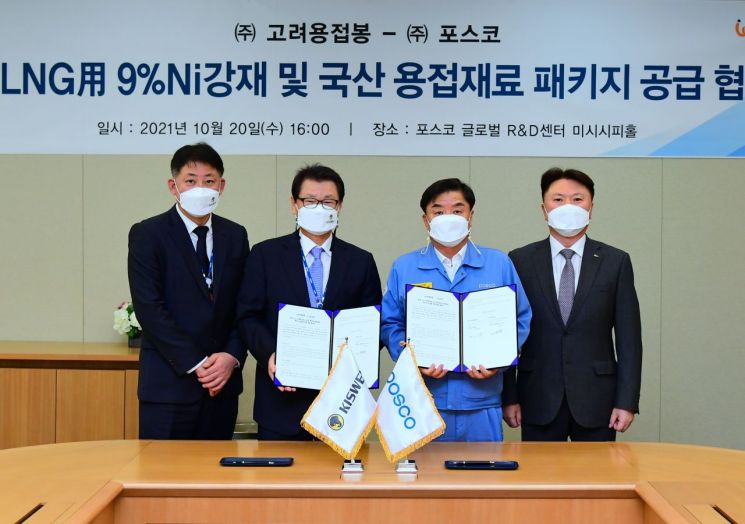
[Asia Economy Reporter Hwang Yoon-joo] POSCO and Goryeo Welding Rod have succeeded in domesticating welding materials required for the production of onshore liquefied natural gas (LNG) storage tanks.
On the 21st, POSCO announced that it jointly developed three types of welding materials with Goryeo Welding Rod that can be used for all welding methods including manual, automatic, and semi-automatic. The two companies signed a strategic technology development agreement last year and began developing domestic welding materials for 9% nickel steel.
Onshore LNG storage tanks are recently designed as models with seismic special grade A to increase capacity and improve safety, requiring the steel and welded parts of the storage tanks to have higher strength and toughness than before, as well as impact-resistant toughness.
In particular, the inner tank that stores LNG at minus 165°C uses 9% nickel steel and expensive nickel-based welding materials that can withstand cryogenic environments. POSCO was the first in Korea to develop cryogenic 9% nickel steel in the early 1990s and has supplied it to domestic and overseas LNG projects, but welding materials have been entirely imported due to issues such as high toughness and work efficiency.
The domestically developed welding materials have secured quality levels equivalent to imported materials and have even better weldability, minimizing welding defects.
The welded parts applied with POSCO’s 9% nickel steel and domestic welding materials passed large-scale fracture tests conducted in July and September this year by Korea Gas Corporation, the domestic LNG storage tank client, and overseas construction designers. They secured high reliability by meeting all quality standards of Korea Gas Corporation and test items of overseas construction designers. Additionally, the domestication of welding materials is expected to reduce costs by more than 30% compared to imported materials.
The global LNG market is expected to grow by 3-5% compared to the previous year, and continuous growth is projected until 2040. In Korea, new demand for industrial and eco-friendly fuel LNG is expected to increase continuously, with domestic LNG demand projected to reach 52.35 million tons in 2034, an increase of about 7 million tons compared to this year.
Accordingly, 18 additional storage tanks, including 10 by Korea Gas Corporation and 8 by the private sector, are expected to be constructed by 2031 to import and store LNG, leading to a significant increase in demand for 9% nickel steel and welding materials.
Going forward, the two companies plan to package and supply 9% nickel steel and welding materials. Starting with the large-capacity LNG storage tanks at the Dangjin LNG base, whose construction begins this year, they plan to expand application to domestic and overseas onshore LNG projects and actively target the offshore storage tank market such as LNG-fueled ship fuel tanks and LNG bunkering.
© The Asia Business Daily(www.asiae.co.kr). All rights reserved.

















