Hankyung Research Institute Compares Successful Labor Reform Cases and Implications in Major Countries Including Germany, the UK, and the Netherlands
[Asia Economy Reporter Kim Heung-soon] An analysis of successful labor reform cases in major countries has suggested that continuous structural reforms, such as institutional improvements to establish a balance of power between labor and management and alleviation of labor market rigidity, are necessary to revitalize domestic employment.
On the 21st, the Korea Economic Research Institute (KERI) under the Federation of Korean Industries presented this opinion by analyzing the major labor policies and implications of Germany, the United Kingdom, and the Netherlands, which successfully implemented labor market structural reforms and significantly improved employment indicators.
Germany Introduces Working Time Account System
Freely Use Accumulated Working Hours
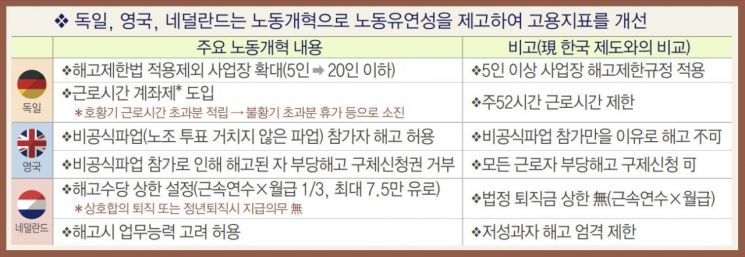
The Schr?der administration in Germany (2003?2005) implemented the Hartz reforms, expanding the exemption from the Employment Protection Act from workplaces with 5 employees to those with 10 employees. The upper limit on dispatch periods (2 years) was also abolished. Subsequently, under the Merkel administration (from 2006), the exemption was expanded to workplaces with 20 employees, and the 'working time account system' was introduced. This system allows employees to accumulate overtime hours during busy periods and use them as leave or time off when workload is lighter.
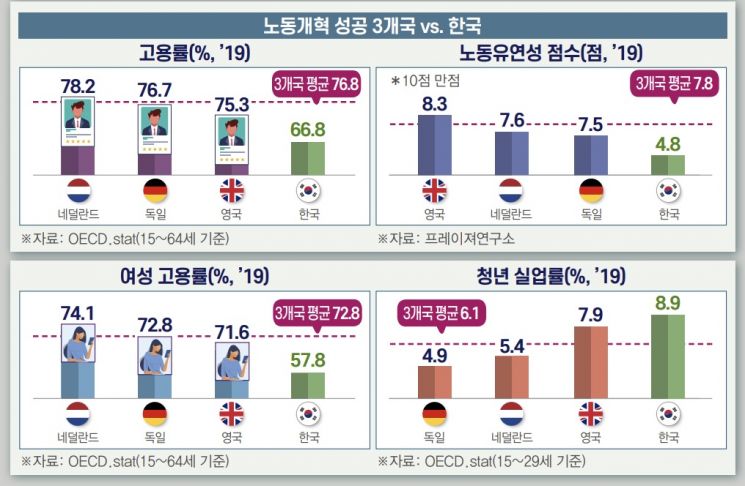
As a result, Germany's labor market flexibility score (maximum 10 points) rose from 3.5 in 2003, when the Hartz reforms began, to 7.5 in 2019. During the same period, the employment rate increased from 64.6% to 76.7%, and the unemployment rate decreased from 9.4% to 3.2%. Additionally, due to the relaxation of dispatch regulations, the number of dispatched workers increased 3.1 times from 327,000 in 2003 to 1,001,000 in 2018, enhancing workforce management efficiency.
United Kingdom Regulates Union Collective Activities and Tightens Strike Procedures
During the Thatcher government (1979?1990), the UK reformed excessive union collective activities to prevent unreasonable strike practices that disrupted normal business operations. Notably, sympathy strikes aimed at supporting other unions and 'closed shop' clauses requiring hiring only union members were outlawed. Later, under the Cameron government (2010?2016), to limit sudden and prolonged strikes, strike ballots were required to specify the strike duration on the ballot papers. The prior notice period for strikes was also extended from 7 to 14 days, establishing strict procedures for strike actions.
Consequently, the annual average number of lost working days due to strikes decreased from 13.076 million during the Callaghan government (1976?1979) to 8.626 million during the Thatcher government, and further dropped to 533,000 under the Cameron government. The labor market flexibility score rose from 6.7 in 1980 to 8.4 in 2016. Employment rates increased from 65.9% in 1984 to 73.8% in 2016, while unemployment rates fell from 11.9% to 5.0% during the same period.
Netherlands Expands Part-Time Employment and Sets Caps on Severance Pay
Enhancing Workforce Management Efficiency
The Lubbers government in the Netherlands (1982?1994) reached a tripartite agreement through the Wassenaar Agreement to expand part-time employment. They also eased labor cost burdens by abolishing the wage indexation system and freezing minimum wages and public sector wages. Subsequently, the Wim Kok government (1994?2002) shortened the notice period for dismissal from 6 months to 1 month, relaxed dismissal regulations including allowing dismissal due to lack of work ability, and abolished the dispatch business permit system to improve workforce management efficiency. Later, under the Rutte government (from 2014), structural labor market reforms were implemented, including further easing of dismissal regulations and shortening the maximum unemployment benefit period from 38 months to 24 months.
Accordingly, the Netherlands' labor market flexibility score rose from 3.0 in 1980 to 7.6 in 2019. Enhancements in labor flexibility, such as promoting part-time employment and relaxing dispatch and fixed-term contract regulations, provided diverse employment opportunities especially for youth and women, who traditionally faced difficulties entering the labor market. In fact, the female employment rate in the Netherlands increased from 35.8% in 1982 to 74.1% in 2019, while the youth unemployment rate decreased from 11.3% to 5.4% during the same period. Overall employment rose from 52.8% to 78.2%, and unemployment fell from 9.7% to 3.4%.
Korea Regularizes Non-Regular Workers
Introduces Pro-Labor Policies Including Allowing Union Membership for Dismissed and Unemployed Workers
Korea has introduced many labor policies that strengthen labor market rigidity. KERI evaluated that since 2017, policies such as regularizing non-regular workers, reducing the workweek to 52 hours, and rapid minimum wage increases have increased labor costs for companies and restricted workforce management autonomy. In July, policies strengthening union rights, such as allowing dismissed and unemployed workers to join unions and permitting non-workers to enter workplaces, were implemented, which could potentially worsen labor-management relations.
According to KERI, Korea's labor market flexibility score was 4.8 in 2019, below the average of 7.8 for the three successful labor reform countries, and the employment rate was 66.8%, 10.0 percentage points lower than the 76.8% average of those countries. The number of lost working days due to strikes decreased from 861,000 in 2017 to 402,000 in 2019 but has been increasing again. Last year, it was 554,000 days, and up to September this year, it recorded 302,000 days. Considering the trend of significant increases in lost days during the second half of each year, the figure is likely to rise further.
Choo Kwang-ho, Director of Economic Policy at KERI, emphasized, "To improve domestic employment, it is necessary to expand companies' employment capacity through continuous labor market structural reforms, including institutional improvements to establish labor-management balance and easing labor market rigidity."
© The Asia Business Daily(www.asiae.co.kr). All rights reserved.
![Clutching a Stolen Dior Bag, Saying "I Hate Being Poor but Real"... The Grotesque Con of a "Human Knockoff" [Slate]](https://cwcontent.asiae.co.kr/asiaresize/183/2026021902243444107_1771435474.jpg)

















