Q&A - Oh Seung-hyeop, Head of Launch Vehicle Propulsion Development Department at KAIST
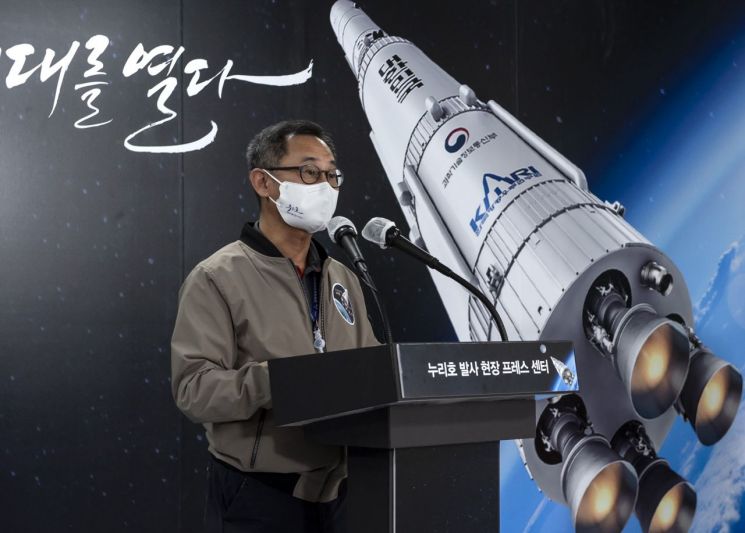 Oh Seung-hyeop, Head of Launch Vehicle Propulsion System Development Department at KARI. Photo by Joint Press Corps
[Asia Economy Reporter Kim Bong-su] The first launch operation of Korea's indigenous space launch vehicle 'Nuriho,' which will lead South Korea's space independence, is progressing smoothly. On the morning of the 20th, Nuriho was transported to and secured at the second launch pad installed at Naro Space Center in Goheung-gun, Jeollanam-do. In the afternoon, umbilicals (tethers) for electrical power and propellant injection were connected, and inspections for any abnormalities are being conducted. The Korea Aerospace Research Institute (KARI) cautiously expressed expectations for success, saying "do your best and leave the rest to heaven." Below is a Q&A session between Oh Seung-hyeop, Head of the Launch Vehicle Propulsion Development Department at KARI, and the press corps at Naro Space Center.
- Please explain the umbilical operation.
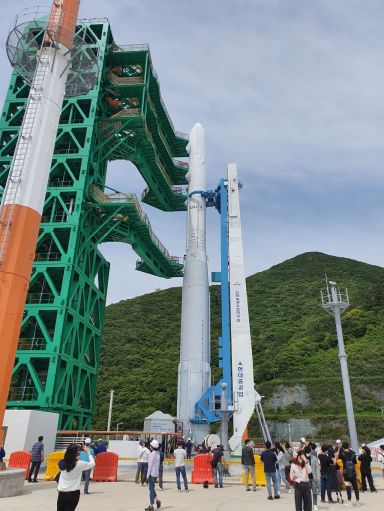
▲ We refer to it as the tether. Nuriho uses a three-stage liquid rocket. When it leaves the assembly building, the oxidizer and fuel tanks are empty. After standing it vertically, there are five umbilicals in total: oxidizer fuel filling umbilicals for each stage, electrical umbilicals, and umbilicals for payload air conditioning. The umbilicals are assembled today, and their functions and inspections will be completed. They play a critical role in separation during launch.
- There are many inspections today; what is the core pre-launch task?
▲ If I were to pinpoint the most important task, it would be avionics, specifically the inspection of the electrical system. Basic connections and checks were done in the assembly building, but after standing the rocket vertically, we conduct electrical and mechanical inspections to ensure normal function for tomorrow's launch. Also, radar linkage tests for tracking at the space center are important. The umbilical section is also critical because it must maintain airtightness while filling cryogenic oxidizer.
- Please briefly explain tomorrow's procedures.
▲ Preparations start at 9 a.m., and officially, launch operations begin at 10 a.m. at the control center. Nuriho has about 170 supply system valves. We perform system checks to ensure they operate normally and maintain pressure. After this, the longest process is injecting liquid oxygen and fuel. Liquid oxygen is at minus 183 degrees Celsius, so we cool the supply lines and oxidizer tanks and inject it simultaneously with fuel two hours before launch. If all sequence functions are judged normal before flight, the automatic launch operation device (PLO) is activated 10 minutes before launch. Finally, we check the functions of electronic equipment and pressure valves of the oxidizer tanks, and take off 10 minutes later.
- What about land, sea, and air traffic control and timing?
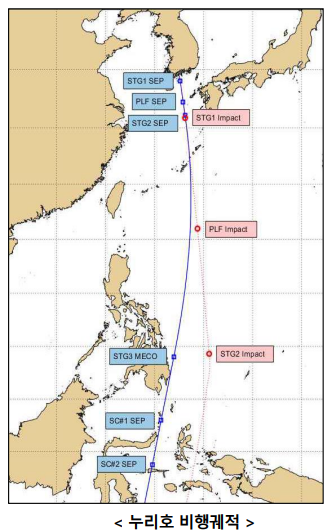
▲ Over 1,300 personnel from 11 organizations are mobilized. On land, from 10 a.m., personnel and vehicle traffic within a 3 km radius is prohibited. At sea, a 12 km zone on both sides of the flight path will be controlled by the Navy and Coast Guard starting two hours before the scheduled launch time. Airspace control extends 24 km on both sides of the flight path, covering a distance of 96 km, coordinated with the Air Force and others. Additionally, related agencies are prepared to respond to any disasters, wildfires, or explosions that may occur during the launch process or preparations.
- How is the launch time decided and by what procedure?
▲ Currently, a tentative target time is set, and procedures are underway accordingly. The launch window is between 3 p.m. and 7 p.m. Tomorrow's expected weather, potential avoidance of space debris, and high-altitude wind analysis are comprehensively evaluated. The launch will be confirmed through a launch control committee meeting this afternoon, and the final launch time will be decided in two meetings centered on the Ministry of Science and ICT tomorrow.
- What is your mindset with the launch just one day away?
▲ Not only KARI but also about 30 major companies, totaling around 300 companies and 500 people, have worked together. Everyone shares the same sentiment. We have checked, inspected, and improved all possible issues within the scope, so D-day has arrived. We are hopeful as we have done our best. We trust in "do your best and leave the rest to heaven." The initial success rate of any space launch vehicle is about 20-30%. I believe it is inappropriate to say whether it is a success or failure at this point. Tomorrow's event is a flight test. The launch vehicle's mission does not end on the ground; the flight test is the final confirmation through flight. Even if the satellite is not placed in the desired orbit or speed initially, achieving expected results step by step is a significant gain.
- What should be carefully considered during transport, assembly, and launch preparations?
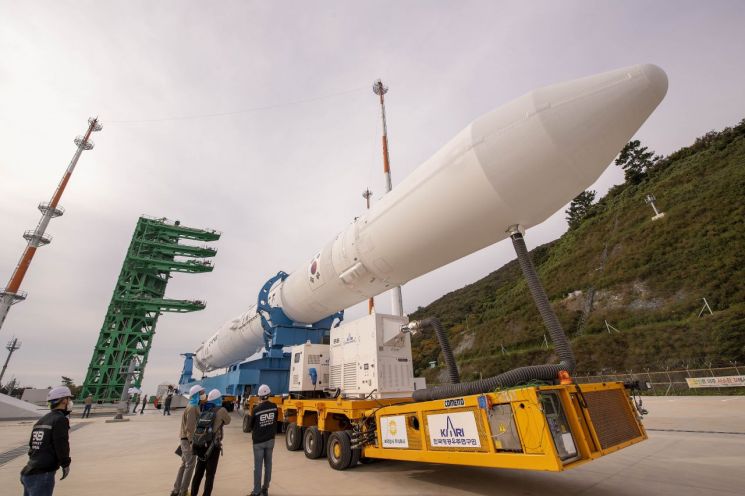
= As you know, Nuriho is 47.2 meters long and weighs 200 tons when fuel and oxidizer are filled. When rolling out from the assembly stand, the vehicle weighs 20 tons. Although it weighs 20 tons, its length of 47.2 meters means there are two hinge points. It was operated at low speed with a special vehicle to keep shocks within a certain range. Also, the oxidizer tank is made of lightweight aluminum and is about 10 meters long and 3 meters in diameter. If empty, it can be damaged, so it was transported with a certain pressure maintained.
- Why use a dummy satellite this time?
= Since this is the first test launch, the mission is to place a 1.5-ton payload into low Earth orbit. It is the first launch for functional checks and is called a test launch. If we do not carry a payload during a test launch, various problems can arise, so we carry a dummy satellite and proceed as if it were a real satellite. If confident, one could launch an actual satellite from the start, but there is risk in the first launch. We use the dummy to gather data needed from the first launch. The second launch scheduled for May next year will carry a 200 kg satellite, with the rest filled by dummies.
© The Asia Business Daily(www.asiae.co.kr). All rights reserved.
![Clutching a Stolen Dior Bag, Saying "I Hate Being Poor but Real"... The Grotesque Con of a "Human Knockoff" [Slate]](https://cwcontent.asiae.co.kr/asiaresize/183/2026021902243444107_1771435474.jpg)


















