Ssangyong Motor Administrator to Submit Opinion on Uhyup Selection to Court This Afternoon
Decision Expected Within This Week After Reviewing Administrator's Opinion
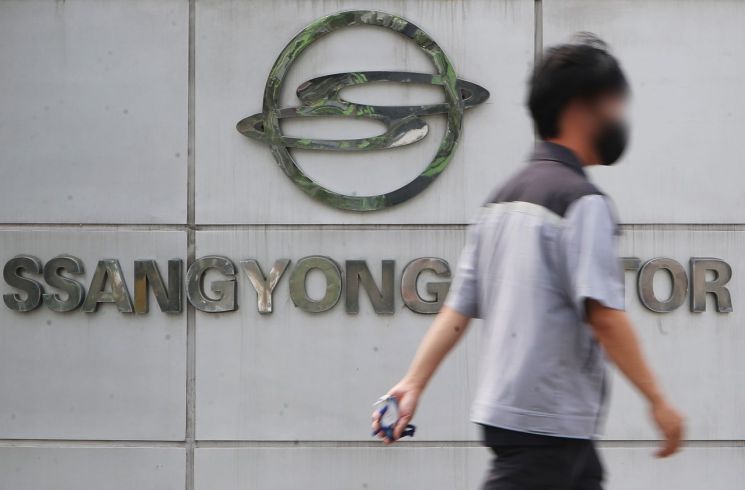
[Asia Economy reporters Ki-min Lee and Dae-hyun Kim] The court is deeply deliberating at the last minute over the candidates for the new owner of Ssangyong Motor, which is undergoing corporate rehabilitation procedures.
According to the legal and industry circles on the 20th, the Seoul Bankruptcy Court is expected to postpone the selection of the preferred bidder for the Ssangyong Motor acquisition and merger (M&A), which was scheduled for the afternoon of the same day. The court told reporters, "Today is the day when the (Ssangyong Motor) administrator and others report the results of the ongoing review to the court. There is nothing for the court to decide or approve today," adding, "Future schedules will proceed according to the review results and intentions of the debtor side (Ssangyong Motor)."
Jung Yong-won, the administrator of Ssangyong Motor, is known to have presented his opinion to the court on whether to select either ELB&T or Edison Motors as the preferred bidder or to declare the bidding invalid.
The court’s postponement of the preferred bidder selection is interpreted as a measure to carefully consider preventing Ssangyong Motor from falling into insolvency again after the sale. Ssangyong Motor has repeatedly faced corporate rehabilitation (court management) and was acquired by Shanghai Automotive Industry Corporation and Mahindra, among others, but has continued to experience management difficulties.
For this reason, after the main bidding deadline, the court requested the bidding companies to supplement their investment funds and management normalization-related supporting documents twice. In particular, the court has kept open the possibility of a failed bid and has been analyzing the financial proofs such as balance statements, loan commitment letters, investment commitment letters (LOC), and detailed management normalization plans submitted by the two companies.
Within the industry, ELB&T, which offered an acquisition price of 500 billion KRW, is seen as having an advantage over Edison Motors, which proposed a price in the high 200 billion KRW range. However, ELB&T’s capital and sales last year were only 3 billion KRW and 100 million KRW respectively, which raises concerns about its ability to acquire Ssangyong Motor, which had sales of 2.9502 trillion KRW and an operating loss of 449.4 billion KRW last year. ELB&T is reported to have supplemented and submitted detailed investment plans supported by a European investment company.
Moreover, ELB&T has yet to disclose any performance related to electric vehicle platforms or battery-related technologies, making it uncertain whether it can acquire Ssangyong Motor and normalize its management. ELB&T states that it has developed its own dedicated electric vehicle platform technology and plans to disclose it in the future.
Edison Motors, which has partnered with private equity funds KCGI and Keystone Private Equity (PE), is reported to have recently raised its acquisition price to dispel concerns about its acquisition intentions. If Edison Motors acquires Ssangyong Motor, it plans to improve financial soundness by resolving public claims amounting to 700 billion KRW and request loans from the Korea Development Bank using Ssangyong Motor’s land, buildings, and facilities as collateral.
Additionally, Edison Motors plans to maintain Ssangyong Motor’s internal combustion engine vehicle production while leveraging its experience in electric bus production to manufacture and sell 10 new electric vehicle models, including sedans and sport utility vehicles (SUVs), by next year; 20 models by 2025; and 30 models by 2030.
However, Edison Motors’ scale is small, with last year’s sales and operating profit at 89.7 billion KRW and 2.7 billion KRW respectively. There are still doubts about whether it has the technological capability to immediately launch around 10 electric vehicle models next year. According to the Ministry of Land, Infrastructure and Transport, only Hyundai Motor and Kia Daewoo Bus have the ability to develop electric buses independently and possess self-certification facilities. Other companies, including Edison Motors, are classified as assemblers who purchase key components rather than manufacturers.
© The Asia Business Daily(www.asiae.co.kr). All rights reserved.
![Clutching a Stolen Dior Bag, Saying "I Hate Being Poor but Real"... The Grotesque Con of a "Human Knockoff" [Slate]](https://cwcontent.asiae.co.kr/asiaresize/183/2026021902243444107_1771435474.jpg)











