Connecting Different Materials Without Defects to Simultaneously Enhance Power Conversion Efficiency and Stability of Thin-Film Perovskite Solar Cells
Professor Seok Sang-il's Team at UNIST Develops 25.8% Efficient Cell... Highest Record Reported in Official Paper
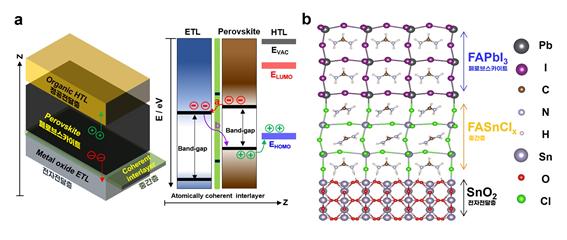 Formation of an intermediate layer between the perovskite solar cell photoactive layer and the electron transport layer.
(a) Illustration of the layered electron transport layer, new intermediate layer, perovskite layer, and hole transport layer. (b) Theoretical simulation of intermediate layer formation.
Image courtesy of Ulsan National Institute of Science and Technology.
[Asia Economy Reporter Kim Bong-su] A Korean research team has once again broken the highest efficiency record of perovskite solar cells, considered the next-generation solar cells. This was the result of developing a new technology that simultaneously improves the power production efficiency and stability of thin-film solar cells by connecting heterogeneous materials without defects.
According to Ulsan National Institute of Science and Technology (UNIST), the international academic journal Nature published these research results online on the 20th (local time).
According to the report, the research team led by Professor Seok Sang-il of the Department of Energy and Chemical Engineering revealed the principle of forming an intermediate layer that can minimize concentrated defects between the layers of thin-film solar cells, and applied this to perovskite solar cells to develop a cell with 25.8% efficiency. This is the highest efficiency officially reported in a paper worldwide. The certified record recognized by the U.S. National Renewable Energy Laboratory is also the highest at 25.5%.
The intermediate layer formed inside the cell acts as a buffer between the thin-film heterogeneous materials, drastically reducing defects. Defects not only affect durability but also hinder the flow of electrons (electric particles), lowering efficiency. Especially at the interface where heterogeneous materials with different constituent elements and atomic arrangements meet, defects such as distorted arrangements and missing atoms easily occur because they are connected only by weak physical bonds.
The research team experimentally verified this intermediate layer material formed between the electron transport layer and the perovskite photoactive layer. The results confirmed that this material connected the electron transport layer and the photoactive layer atomically coherently without defects. The Pohang Accelerator Laboratory X-ray beamline was utilized in the experiments.
This intermediate layer was created thanks to the tin component in the electron transport layer. Tin (Sn) can exist as both divalent cation (Sn2+) and tetravalent cation (Sn4+). It can also bond not only with oxygen ions in the electron transport layer but also with chlorine ions in the perovskite. The research team derived the intermediate layer that connects the electron transport layer and perovskite crystallographically at the atomic level based on these two principles.
Professor Seok explained, “Based on an in-depth understanding of the materials and structures of the perovskite photoactive layer and the electron transport layer, we were able to develop perovskite solar cells that have both efficiency and stability,” adding, “Achieving the world’s highest certified efficiency and the systematic analytical approach provide great inspiration for subsequent researchers, making this a meaningful study.”
Previously, Professor Seok’s research team was the first to surpass the so-called 20% efficiency barrier for perovskite solar cells and has broken the world’s highest certified efficiency record five times by themselves. They still hold the world’s best record. These results are thanks to the perovskite heterojunction solar cell structure independently developed in 2012. Most high-efficiency perovskite solar cells exceeding 24% currently have this structure. This is also their eighth paper reported in the world’s most prestigious scientific journals, Nature and Science. In September, they were jointly awarded the 2022 Rank Prize in Optoelectronics for their contributions to the birth and development of perovskite solar cells. This prize, awarded by the UK Rank Foundation, is a distinguished scientific award that has produced Nobel laureates.
Meanwhile, unlike commercialized silicon solar cells, perovskite solar cells can be made thin, light, and flexible. They can be produced cheaply through solution processing, making them a promising next-generation solar cell. Perovskite is used as the photoactive layer material that generates charge carriers (electrons and holes).
© The Asia Business Daily(www.asiae.co.kr). All rights reserved.

















