5 Major Banks' Jeonse Loan for Single-Homeowners Only Available at Bank Counters
New Early Repayment Penalty Introduced, Previously Exempted for Non-Face-to-Face Loans
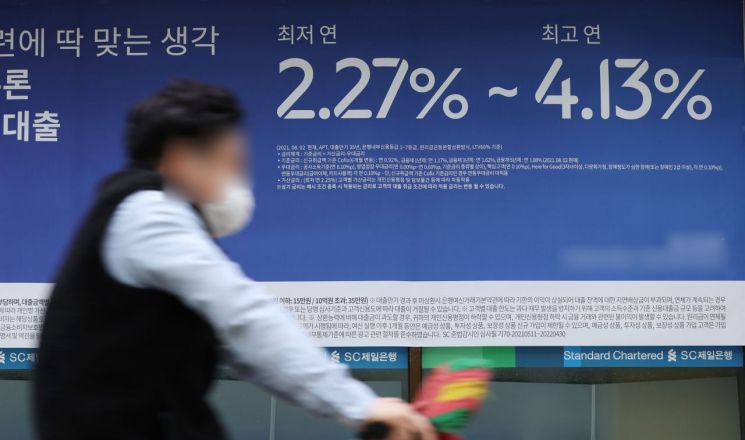
[Asia Economy Reporter Park Sun-mi] Office worker Kim Yujin (41, pseudonym) recently visited Bank A, which is located far from her workplace, during lunch break for a loan consultation. Although she could have applied for a loan non-face-to-face at her main bank, she went to another bank where she had already pre-applied for a loan due to the atmosphere of loan suspension and limit reduction in the banking sector. It took about an hour from consultation at the counter to loan application. Ms. Kim was barely able to get the loan after mechanically signing dozens of times on documents that the staff asked her to sign.
As banks raise the bar to manage total loan volume, the number of customers visiting banks in person rather than clicking online is rapidly increasing. Although 100% non-face-to-face loans have become convenient due to the digital transformation of financial services at commercial banks, non-face-to-face services are losing strength as financial authorities tighten household debt regulations.
According to the financial sector on the 20th, the five major commercial banks?KB Kookmin, Shinhan, Hana, Woori, and NH Nonghyup?plan to prohibit non-face-to-face jeonse (key money deposit) loans for single-homeowners starting from the 27th. Loans will only be possible after passing screening at the bank counter. The strategy is to screen out people who take jeonse loans for real estate gap investments or invest in stocks and coins through face-to-face applications.
At a review meeting on real demand loans held on the 14th by financial authorities and the five major commercial banks, it was shared that it is difficult to identify real demand borrowers through non-face-to-face loan methods. However, it is uncertain whether the suspension of non-face-to-face jeonse loans will spread to other regional banks and internet banks beyond the five major banks. This is due to opposition from some internet-only banks at a working-level meeting on jeonse loan management measures held on the 18th involving all banks.
There is also a sense that non-face-to-face loan windows are closing first at commercial banks. Hana Bank stopped selling its non-face-to-face loan products, ‘Hana One Q Credit Loan’ and ‘Hana One Q Apartment Loan,’ from 6 p.m. the previous day. The suspension of non-face-to-face loans will continue at least until the end of the year while monitoring the situation of household loan growth calming down. KB Kookmin Bank has not been selling the KB Star Credit Loan, a non-face-to-face exclusive loan product that boasted low interest rates, since last month. A KB Kookmin Bank official explained, "With the implementation of the household loan all-in-one process, the product lineup for online and offline has been unified, and the sale of non-face-to-face exclusive products has ended."
Meanwhile, prepayment penalties (fees), which were previously exempted for non-face-to-face loan products to attract customers, are now being introduced. Shinhan Bank recently decided to impose prepayment penalties on non-face-to-face credit loans as well, charging 0.8% of the loan amount for fixed interest rates and 0.7% for variable interest rates, similar to face-to-face credit loan products. Earlier, Woori Bank applied prepayment penalties of 0.6% for variable interest rates and 0.7% for fixed interest rates on its non-face-to-face credit loan products ‘Woori WON Workplace Loan’ and ‘Woori Main Workplace Loan (Internet)’ starting from July.
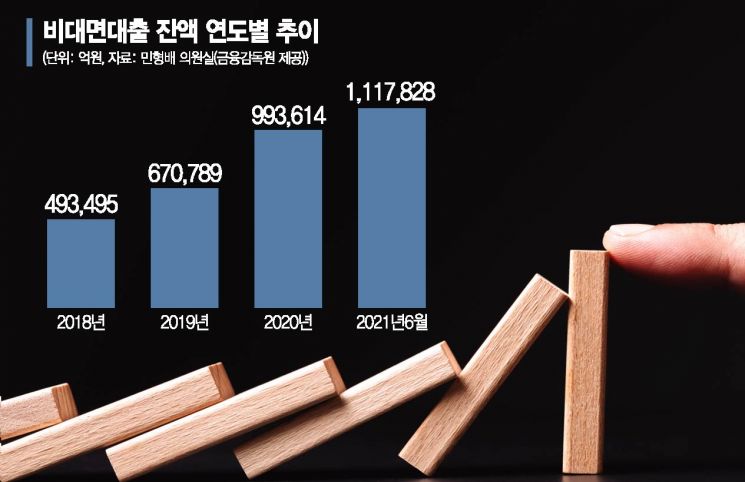
'Fast and Convenient' Non-face-to-face Loans... Non-face-to-face Loan Balance of 111.78 Trillion Won in the First Half
The activation of non-face-to-face loans, which allow borrowing money without visiting a bank counter, is considered a major cause of the increase in household debt.
According to data received by Min Hyung-bae, a member of the National Assembly's Political Affairs Committee from the Financial Supervisory Service, the balance of non-face-to-face loans at 18 domestic banks as of the first half of this year was 111.7828 trillion won, about 2.8 times the 39.4093 trillion won at the end of 2017. 100% non-face-to-face loans, where the entire process from application to execution is conducted non-face-to-face, accounted for 95.7414 trillion won or 85.6% of the total as of the first half of this year.
Among banks, the internet bank KakaoBank had the largest non-face-to-face loan balance (23.1265 trillion won). However, commercial banks also performed well by offering interest rate benefits on non-face-to-face loan products and enabling 100% non-face-to-face processing, including Hana Bank (22.5726 trillion won), Woori Bank (21.568 trillion won), and Shinhan Bank (17.5339 trillion won).
The market sentiment is that as long as financial authorities continue to tighten loans, banks will find it difficult to focus more on non-face-to-face loans. According to the ‘Financial Institution Loan Behavior Survey’ announced by the Bank of Korea, the domestic banking sector's expected credit risk index for the fourth quarter rose by 10 points to 20 compared to 10 in the third quarter. The bank loan attitude index fell to -12, entering negative territory. This means banks have no choice but to tighten loan screening and raise loan thresholds.
© The Asia Business Daily(www.asiae.co.kr). All rights reserved.


















