KMA-MOST to Conduct Preliminary Feasibility Study
Total Budget of 598 Billion KRW Over 7 Years from 2023
Continuous Observation of Korean Peninsula Every 2 Minutes Enabled
4x Improvement in Ultra-Short-Term Hazard Weather Detection and Wildfire Detection Capability
[Asia Economy Reporter Han Jinju] The Korea Meteorological Administration (KMA) and the Ministry of Science and ICT are promoting the selection of the geostationary meteorological and space weather satellite system project, "Chollian Satellite 5," for a preliminary feasibility study.
Currently, weather observation is handled by Chollian Satellite 2A, whose mission will end in 2029. Chollian Satellite 5 will succeed the mission of 2A, launching in 2029 and operating for 10 years until 2039.
The Chollian Satellite 5 project will proceed over seven years from 2023, including the testing period, with a total budget of 598 billion KRW. From 2023, development will focus on ▲the satellite platform ▲meteorological and space weather payloads ▲ground station systems and utilization technologies, aiming for official service in 2029.
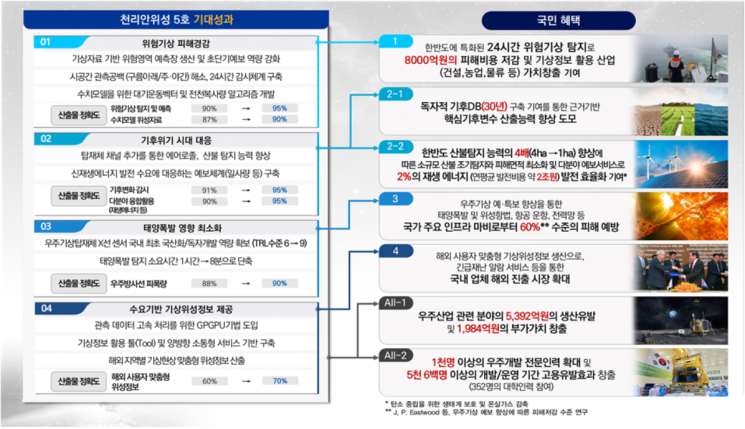
Chollian Satellite 5 is expected to produce various satellite information to protect citizens' property and lives from meteorological disasters such as super typhoons, sudden heavy rains, and wildfires through rapid monitoring and forecasting, as well as to respond to abnormal climate conditions.
Chollian Satellite 5 will enable continuous observation of the Korean Peninsula every 2 minutes, allowing ▲ultra-short-term hazardous weather detection ▲improved wildfire detection capability (4 times) ▲operation of space weather alerts and warnings. It is also expected to aid early wildfire detection, satellite navigation, aviation operations, and power grid management efficiency.
The satellite aims to overcome limitations of Chollian Satellite 2A, such as observation under clouds and discontinuity during day and night, and to reduce the detection time for solar flares from up to 1 hour to 8 minutes through independent development of a solar X-ray (X-ray) observation sensor.
Park Kwang-seok, Administrator of the Korea Meteorological Administration, said, "To ensure stable mission succession from Chollian Satellite 2A and to advance meteorological satellite technology, we will do our best to have this preliminary feasibility study selected so that the development project of Chollian Satellite 5 can proceed normally from 2023."
© The Asia Business Daily(www.asiae.co.kr). All rights reserved.

















