[Asia Economy Reporter Su-yeon Woo] Youth unemployment in South Korea not only poses a personal issue but also negatively impacts the national economy by damaging the potential growth rate. Analysis shows that when the domestic youth unemployment rate rises by 1 percentage point, the potential growth rate decreases by 0.21 percentage points.
According to the report titled "The Impact of Increasing Youth Unemployment on Growth Potential and Implications," released on the 20th by the Korea Economic Research Institute (KERI), a 1 percentage point increase in the youth unemployment rate results in a 0.12 percentage point decrease in total factor productivity growth and a 0.21 percentage point decline in potential growth rate. KERI defines the relationship between youth unemployment rate and potential growth rate as mutually influential and analyzes that a continuous chain effect between changes in youth unemployment rate and potential growth rate can persist.
KERI stated, "High youth unemployment reduces opportunities for young people to acquire new skills and knowledge through work, that is, 'learning by doing,' which undermines the accumulation of human capital. It also increases the likelihood that they cannot utilize their majors and aptitudes, making efficient allocation of labor difficult."
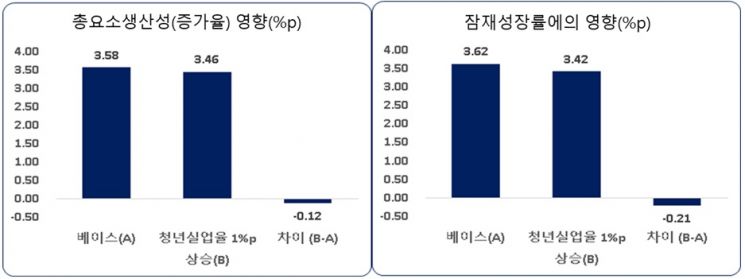 Impact of a 1%p Increase in Youth Unemployment Rate on Total Factor Productivity and Potential Growth Rate (Unit: %p)
※ The base refers to the average potential growth rate and total factor productivity during the analysis period when there is no change in the youth unemployment rate / Source: Korea Economic Research Institute (KERI)
Furthermore, over the recent 11 years since 2010 (2010?2020), the average annual youth unemployment rate was 8.7%, which is 2.4 times higher than the overall unemployment rate of 3.6%. Compared to the non-youth unemployment rate of 2.6% during the same period, the ratio widens to 3.4 times. Even when compared to major countries, South Korea’s youth unemployment situation is very vulnerable. The average annual increase rate of youth unemployment over the recent 11 years since 2010 was 0.76%, ranking 10th among 38 OECD countries, and the average ratio of youth unemployment rate to overall unemployment rate was 2.8 times, placing it 5th in the upper tier.
KERI points to several causes for South Korea’s youth unemployment problem, including low economic growth rate, lack of new growth engines leading to insufficient capacity for creating new jobs, and sluggish corporate vitality due to excessive regulations, as well as excessive labor market rigidity. According to KERI’s analysis of the correlation between youth unemployment and employment flexibility among OECD countries based on 2019 data, there is an inverse correlation between the youth unemployment gap (youth unemployment rate minus overall unemployment rate) and employment flexibility. In other words, the higher the employment flexibility, the smaller the youth unemployment gap.
Choo Kwang-ho, Director of Economic Policy at KERI, said, "If youth unemployment becomes prolonged, it will cause significant adverse effects not only to young individuals but also to the entire national economy. To resolve youth unemployment, it is necessary to improve the economic structure, reform corporate regulations to enhance overall productivity, create an environment where new growth engines can be nurtured, and increase labor market flexibility to boost companies’ capacity for new hiring."
© The Asia Business Daily(www.asiae.co.kr). All rights reserved.
![Clutching a Stolen Dior Bag, Saying "I Hate Being Poor but Real"... The Grotesque Con of a "Human Knockoff" [Slate]](https://cwcontent.asiae.co.kr/asiaresize/183/2026021902243444107_1771435474.jpg)
















