"Hunminjeongeum is a Chinese character phonetic symbol"... 'Historical distortion' controversy
Publisher "Immediate suspension of book sales... Sincere apologies"
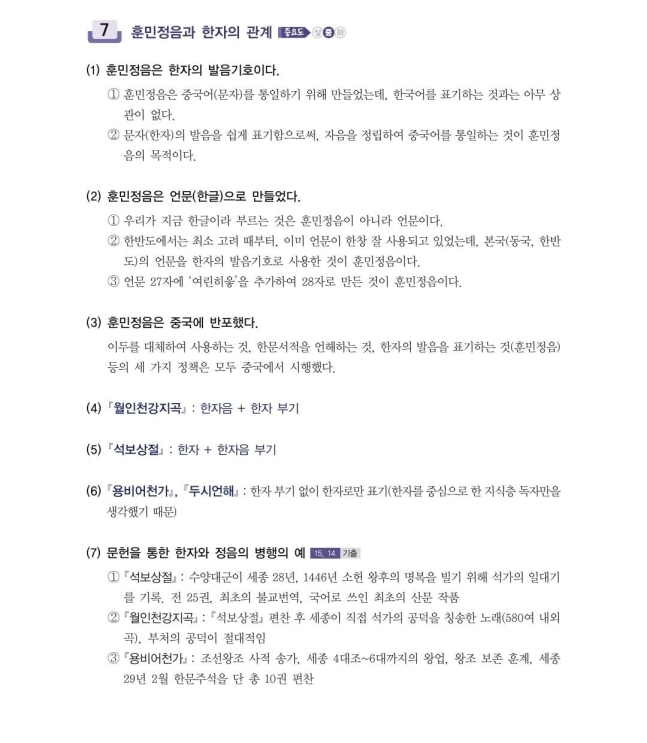 Contents of the self-study liberal arts Korean language textbook that sparked controversy over historical distortion. Photo by Online Community Screenshot.
[Asia Economy Reporter Heo Midam] Criticism is mounting after it was revealed that a self-study (university degree qualification exam) textbook published by an educational publishing company contains incorrect information related to Hunminjeongeum. As the controversy over historical distortion grew, the publisher apologized, stating, "We will stop selling the book and destroy all copies."
Recently, a post appeared on an online community claiming to have seen strange content about Hunminjeongeum in the self-study liberal arts Korean language textbook published by 'Sidae Education.'
The author wrote, "I am an overseas Korean who has never received formal education in Korea, so I am curious if the explanation of Hunminjeongeum is correct," and uploaded a screenshot of the textbook content.
In the section explaining the 'relationship between Hunminjeongeum and Chinese characters,' the textbook stated, "Hunminjeongeum was created to unify the Chinese language (characters) and has nothing to do with representing the Korean language," and "The purpose of Hunminjeongeum is to unify Chinese by establishing consonants to easily represent the pronunciation of characters (Chinese characters)."
The textbook also explained that "Hunminjeongeum was promulgated in China" and that "all three policies, including representing the pronunciation of Chinese characters (Hunminjeongeum), were implemented in China."
However, this is completely different from the purpose of creating Hunminjeongeum. The preface of Hunminjeongeum states, "Because the language of our country is different from that of China and does not mutually communicate with Chinese characters, many people cannot fully express their intentions even if they want to speak. I (King Sejong) pity this and have newly created twenty-eight letters so that people can easily learn and use them comfortably every day."
In other words, the purpose of creating Hunminjeongeum was to foster national independence by creating new letters suitable for the Korean language to replace the borrowed Chinese characters and to enable people who do not know Chinese characters to learn writing more easily.
In response to the situation, netizens pointed out that this textbook encourages historical distortion. Netizens reacted with comments such as, "This is too much. We should boycott this publisher immediately," "It seems intentional, not a mistake. The intent is so clear that it makes me angry," and "Hunminjeongeum already states 'the language of our country is different from that of China,' isn't this too much?"
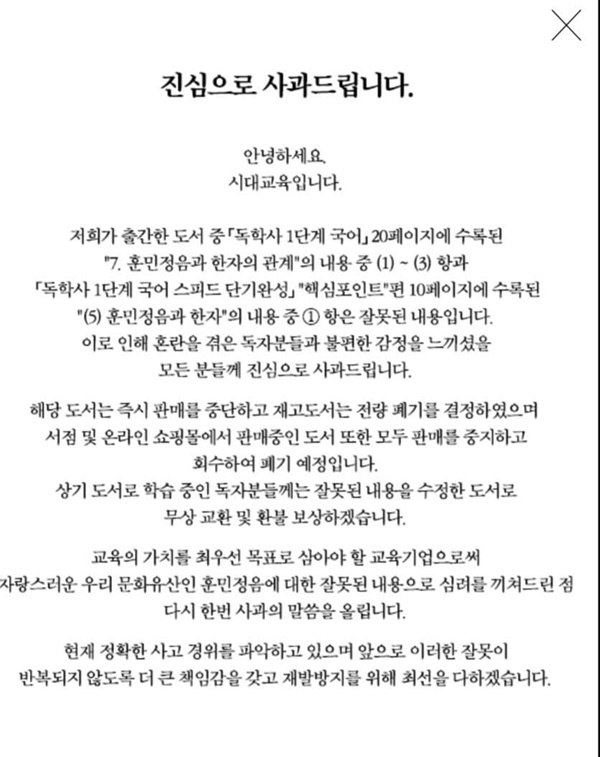
As the controversy grew, the publisher stated, "We sincerely apologize to everyone," and "We have decided to immediately stop selling the book and destroy all remaining stock. Books currently sold in bookstores and online shopping malls will also be withdrawn and destroyed."
They added, "As an educational company that must prioritize the value of education, we apologize once again for causing concern with incorrect content about Hunminjeongeum, a proud cultural heritage of ours," and "We are currently investigating the exact cause of the incident and will do our best to prevent recurrence so that such mistakes do not happen again."
© The Asia Business Daily(www.asiae.co.kr). All rights reserved.


















