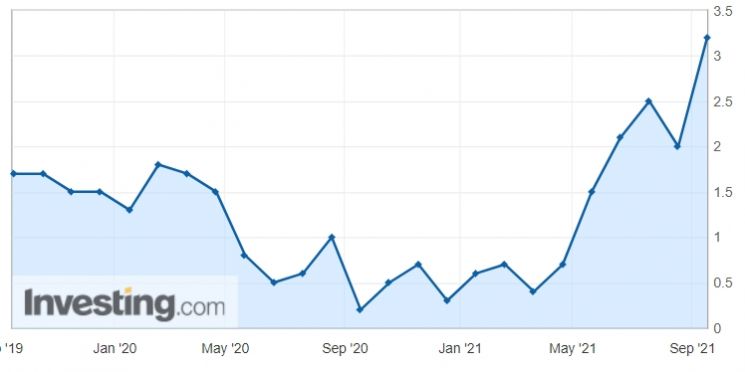
[Asia Economy Reporter Park Byung-hee] As energy prices surge, accelerating the expected timing of the Bank of England's (BOE) base rate hike, Goldman Sachs and JP Morgan Chase have forecasted that the BOE will raise its base rate next month.
According to Bloomberg on the 18th (local time), Alan Monks, an economist at JP Morgan Chase, predicted that the BOE will raise the base rate to 0.25% next month. Monks further expects the UK base rate to rise to 0.75% by August next year.
Goldman Sachs presented a more hawkish outlook. It expects the BOE to take the first step of a rate hike next month and raise the base rate to 0.75% by May next year. Furthermore, it anticipates the UK base rate to reach 1% by the end of next year.
Monks stated, "BOE Governor Andrew Bailey has expressed a willingness for a quicker short-term response, and I understand that this view is supported among the Monetary Policy Committee members."
Governor Bailey said on the 17th that the BOE will take measures to prevent the spread of inflation expectations amid rising inflationary pressures caused by the recent surge in energy prices.
However, Bloomberg noted that the rate hike forecasts by Goldman Sachs and JP Morgan Chase are less hawkish than those currently reflected in financial market interest rate indicators. According to Bloomberg, financial market rate indicators incorporate expectations that the UK base rate will rise to 0.5% by the end of this year and to 1.25% by November next year. This is interpreted as a result of the recent sharp rise in energy prices increasing market volatility and influencing price fluctuations.
Sonali Punhani, an economist at Credit Suisse, offered a less hawkish forecast than Goldman Sachs and JP Morgan. Punhani expects the UK to raise the base rate to 0.5% by the first quarter of next year and then enter a pause period.
She diagnosed, "The BOE's base rate hike outlook is based on rising energy prices, which are a temporary inflation factor caused by supply-side issues," adding, "This could result in a policy failure leading to economic slowdown."
In other words, following a rapid base rate hike, signs of economic slowdown are expected to reduce the BOE's room for further rate increases.
© The Asia Business Daily(www.asiae.co.kr). All rights reserved.
![Clutching a Stolen Dior Bag, Saying "I Hate Being Poor but Real"... The Grotesque Con of a "Human Knockoff" [Slate]](https://cwcontent.asiae.co.kr/asiaresize/183/2026021902243444107_1771435474.jpg)
















