Daejang-dong Scandal 'Recycled' Questions by Opposition... Democratic Party Actively Defends Lee Jae-myung
Lee Responds to 'Gangster Involvement' Allegations with "Hehehe," "Kuk kuk kuk"
"National Audit Transformed into a Structure Difficult to Be Effective"
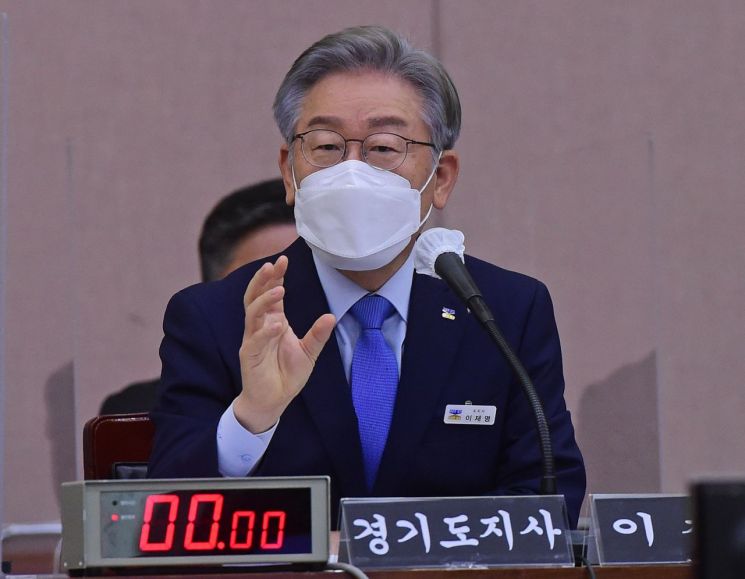 Lee Jae-myung, the presidential candidate of the Democratic Party of Korea and Governor of Gyeonggi Province, is speaking at the National Assembly's Public Administration and Security Committee's audit of Gyeonggi Province held at the Gyeonggi Provincial Government Office in Suwon, Gyeonggi Province on the 18th. Photo by National Assembly Press Photographers Group [Image source=Yonhap News]
[Asia Economy Reporter Kang Juhee] The National Assembly inspection (Gukgam) of Gyeonggi Province, attended by Lee Jae-myung, the Democratic Party's presidential candidate and governor of Gyeonggi Province, was held on the 18th. As expected, the inspection saw fierce exchanges over the allegations of corruption in the Daejang-dong development project in Bundang-gu, Seongnam-si, Gyeonggi Province. However, there was no "decisive blow." Both the People Power Party and Lee vowed to uncover the truth behind the Daejang-dong allegations through the inspection, but the proceedings remained at the level of repeating previously raised suspicions and positions.
Throughout the inspection, loud arguments broke out between the ruling and opposition parties, and Lee drew criticism for showing a mocking attitude toward questions from opposition lawmakers. Rather than clarifying or resolving the allegations, the inspection failed to fulfill its purpose, drawing criticism as a "bland inspection."
At the Gyeonggi Province inspection held at the Gyeonggi Provincial Government Office in Suwon-si, Gyeonggi Province, the People Power Party focused on pressing Lee over the Daejang-dong case, allegations of gang involvement, and lawyer fee payments. However, without raising new issues or sharp questions, they merely repeated existing claims to pressure Lee.
People Power Party lawmaker Kim Do-eup targeted Lee, saying, "The person who owns half of Cheonhwa Dongin No. 1 doesn't care about having money in their own pocket. Exercising control as they wish, when and where they want to spend, is effectively their money." He spent about eight minutes explaining the allegations related to Lee. Kim's only question was, "Democratic Party aides are embarrassed by Lee. Please respond to this."
Afterward, the People Power Party recycled previously asked questions such as "Do you know Kim Man-bae and Yoo Dong-gyu?" "If there is corruption among your close aides, will you withdraw from the presidential race?" and "If you become president, will you grant them special pardons?" They also posed hypothetical questions.
In response, Democratic Party lawmaker Lee Hae-sik criticized, "I don't know if Kim Do-eup's remarks qualify as questions," adding, "He spoke for seven minutes in a long-winded manner and ended with a single sentence. Is that a normal question?"
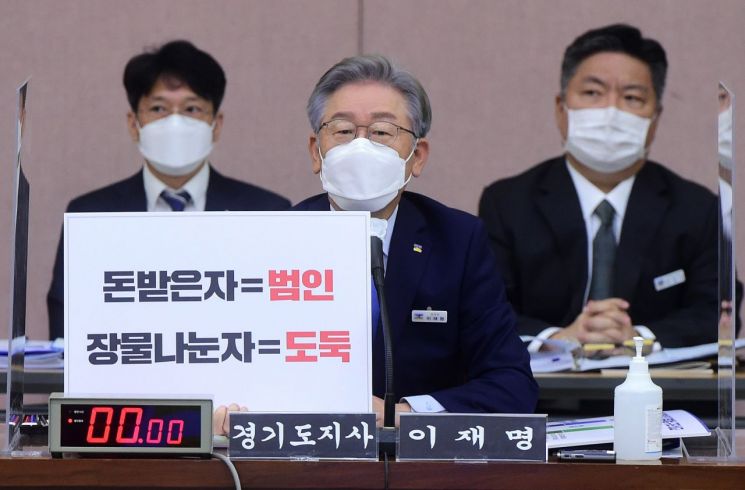 Lee Jae-myung, the presidential candidate of the Democratic Party of Korea and governor of Gyeonggi Province, is responding to questions from lawmakers during the National Assembly's Public Administration and Security Committee's audit of Gyeonggi Province held at the Gyeonggi Provincial Government Office in Suwon, Gyeonggi Province on the 18th. / Photo by National Assembly Press Corps [Image source=Yonhap News]
Lee acknowledged moral responsibility related to the Daejang-dong allegations but maintained his existing stance that the core issue lies with the People Power Party, who colluded with construction interests and opposed public development. He clearly distanced himself from the so-called Daejang-dong "Gang of Four" ? Yoo Dong-gyu, Kim Man-bae, Jung Young-hak, and Nam Wook.
However, he admitted that former Seongnam Urban Development Corporation Planning Director Yoo Dong-gyu was a "close person," apologizing sincerely, saying, "I made a personnel mistake, and some employees under my command were corrupted and involved in wrongdoing."
Lee generally responded calmly to opposition lawmakers' questions during the inspection. However, when lawmaker Kim Yong-pan raised allegations of gang involvement, Lee responded with inappropriate behavior for a head of an inspected institution, such as chuckling or laughing with sounds like "hehehe" and "kuk kuk kuk." During the 10 minutes and 54 seconds of Q&A, Lee laughed about 12 times.
He expressed displeasure, saying, "This is why parliamentary immunity should be limited," and "Presenting such clear falsehoods before the public and abusing the authority entrusted by the people... The truth does not become so by slandering and unilaterally asserting like this." When opposition lawmakers raised their voices in protest, Lee sarcastically said, "Ah, come on. I'll answer. This is not a school play."
Regarding the gang involvement allegations, he called them "clear falsehoods" and said, "Of course, we cannot refrain from taking legal action on this matter," responding aggressively.
Ruling party lawmakers defended Lee throughout the day, focusing on guiding questions that allowed him to explain his allegations. When Lee faced intense attacks, they actively defended him, saying things like, "He is the presidential candidate, so watch your language," and "That is not appropriate etiquette."
Ultimately, the inspection ended without approaching the truth of the Daejang-dong allegations or conducting an audit related to local government issues appropriate to the inspection's purpose. Criticism arose that the inspection had deteriorated into a battleground of political attacks and loud arguments, failing to fulfill its role.
Experts pointed out that the effectiveness of the inspection is no longer valid and that the structure inevitably leads to political disputes. Professor Lee Jun-han of the Department of Political Science and Diplomacy at Incheon National University said, "It seems both the opposition and ruling parties had clear political objectives in this Gyeonggi Province inspection. Therefore, such disputes were inevitable. The inspection has become a formal and ceremonial event that is difficult to be effective anymore."
He added, "However, raising issues when there are suspicions is the role of lawmakers, and parliamentary immunity exists for this purpose. While there are limits to the immunity system, it is inappropriate for the head of the inspected institution to come out and say it should be restricted."
© The Asia Business Daily(www.asiae.co.kr). All rights reserved.
![Clutching a Stolen Dior Bag, Saying "I Hate Being Poor but Real"... The Grotesque Con of a "Human Knockoff" [Slate]](https://cwcontent.asiae.co.kr/asiaresize/183/2026021902243444107_1771435474.jpg)

















