Grain Index Surges 27% in One Year... Consumer Price Inflation Expected to Reach 3% Range This Month
[Sejong=Asia Economy Reporter Kim Hyun-jung] As international grain prices continue to rise, concerns are emerging that the recent domestic inflation rate could accelerate further. Supply and demand instability due to climate change, combined with rising international oil prices and exchange rates, are causing food prices such as bread, snacks, and cooking oil to fluctuate.
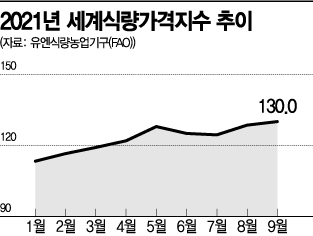
According to the United Nations Food and Agriculture Organization (FAO) on the 19th, the global food price index last month was 130.0 points, a sharp increase of 32.8% compared to a year ago. The grain price index was 132.5, jumping 27.3% in one year compared to the previous month. The FAO examines the international price trends of 24 food items and publishes monthly price indices for five categories (grains, oils, meat, dairy, sugar), using the average price from 2014 to 2016 as the baseline value of 100.
Major grain prices are trading at high levels compared to last year. Wheat closed at $270.35 per ton on the Chicago Board of Trade (CBOT) on the 18th, which is 17.3% higher than last year (October 16, 2020, $230.29). On the same day, corn closed at $209.74 per ton, up 32.5% from a year ago ($158.26).
Soybeans also traded at $449 per ton, a 16.3% increase from last year ($385.89). The price of imported soybeans sold in the domestic wholesale market has also risen. According to the Korea Agro-Fisheries & Food Trade Corporation (aT), imported white soybeans (medium grade, 35kg) on the 18th recorded 133,250 KRW, up 4.1% from last year (127,950 KRW) and 12.2% higher than the average year (118,783 KRW).
The rise in grain prices, coupled with increases in international oil prices and exchange rates, is expected to further impact Korean dining tables. The November West Texas Intermediate (WTI) crude oil price on the New York Mercantile Exchange rose by $0.16 (0.2%) to $82.44, marking the highest level in over seven years since October 21, 2014.
Food prices have already surged significantly. According to the Korea Consumer Agency’s Price Monitoring Center, a survey comparing prices of 38 essential daily items in the third quarter of this year with the same period last year found that prices of 29 items increased, with an average rise of 6.3%. Among these, eggs (70.0%), tofu (16.5%), ham (11.3%), cooking oil (11.2%), and mayonnaise (9.3%) saw particularly large increases.
There is also a forecast that the consumer price inflation rate this month will reach the 3% range for the first time in about 10 years since February 2012 (3.0%). Last month, consumer prices rose 2.5% year-on-year, and on a cumulative basis, they have already exceeded the government’s management target of 1.8%.
© The Asia Business Daily(www.asiae.co.kr). All rights reserved.

















