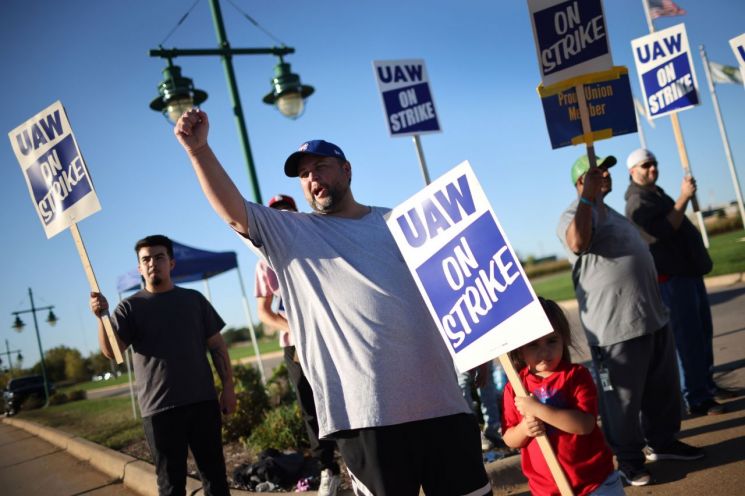
[Asia Economy Reporter Park Byung-hee] Recently, the hashtag ‘Striketober’ has been trending on social media platforms in the United States. It is a portmanteau combining ‘Strike,’ meaning a labor strike, and ‘October,’ referring to the month. This implies that October is the season of strikes this year.
Major foreign media reported on the 18th (local time) that strikes are increasing in the U.S. as the tight labor market environment continues after COVID-19. As companies face difficulties in hiring, the power dynamics between employers and employees have reversed, leading workers to become increasingly bold. The fact that pro-labor President Joe Biden took office is also cited as a background for the rise in union disputes.
According to data compiled by Cornell University, at least 176 strikes have occurred in the U.S. this year, including 17 in October alone.
On this day, the International Alliance of Theatrical Stage Employees (IATSE), representing 60,000 workers in the U.S. film and TV industry, tentatively agreed to a new three-year contract including wage increases and expanded break times, halting their strike. However, workers at Deere & Company, the largest agricultural machinery manufacturer in the U.S., who began striking last week, are still on strike. More than 10,000 Deere & Company workers are striking at 14 plants across the U.S., including Illinois, Iowa, Kansas, Colorado, and Georgia, demanding wage increases and expanded pensions.
The recent increase in strikes is notable given that the union membership rate in the U.S. is only 10%. The union membership rate in the U.S. has been declining over the long term. It fell below 20% in 1983 and is now threatened even below 10%. According to the U.S. Department of Labor, the union membership rate was only 10.8% as of 2020. The public sector union membership rate is 34.8%, but the private sector union membership rate is only 6.3%.
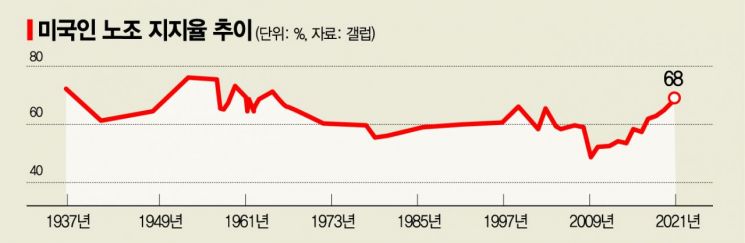
Although union membership rates are low, Americans’ perception of unions is not negative. Gallup, a public opinion research company, has conducted annual surveys on support for unions since 1936. The only year when support for unions did not exceed 50% was 2009, right after the global financial crisis. At that time, support for unions was 48%, the lowest ever recorded. The highest support rates were recorded in 1953 and 1957, at 75%.
Since the financial crisis, support for unions has steadily increased, and this year, with President Biden in office, support reached 68%, the highest since 1968. Gallup conducted a survey from August 2 to 17, finding that 90% of Democratic supporters expressed support for unions, while only 47% of Republican supporters did.
President Biden is considered the most pro-labor president in recent times. Although he abandoned the plan due to strong Republican opposition, he pushed for a $15 hourly minimum wage increase immediately after taking office. In his first joint address to Congress on April 28, he declared that "trickle-down economics does not work" and strongly advocated for reducing income inequality.
When Amazon warehouse workers in Alabama voted on union formation last March, President Biden expressed support for the unionization movement, urging workers to "raise their voices." Although the Amazon union effort ultimately failed, the Democratic Party formed a task force in April to promote union formation.
© The Asia Business Daily(www.asiae.co.kr). All rights reserved.


















