"Is MBTI a Certification..." Increasing Pressure on Job Seekers
Expert: "MBTI Is Not an Objective Indicator for Selecting People"
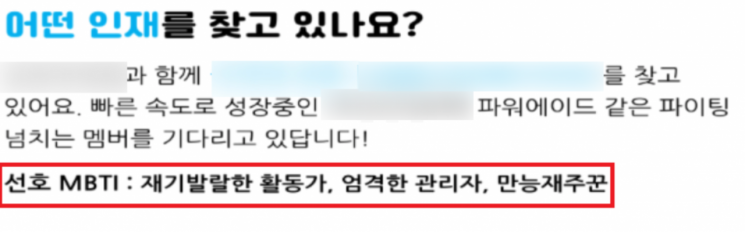 A job posting from a food ingredient distribution company specifying the preferred MBTI type of applicants.
 Photo by JobKorea capture
[Asia Economy Reporter Kang Juhee] Recently, it has been revealed that some companies are requiring applicants to submit their 'MBTI personality type test' results when hiring new employees. Some companies have included a question in their self-introduction letters (SIL) asking applicants to "introduce your MBTI type," while others have specified preferred MBTI personality types for applicants in their job postings.
What was once considered just a fun test, the MBTI is now being used as actual interview material by companies, adding another burden for job seekers. Experts point out that while MBTI can serve as a reference for individuals to understand their own personalities, it is not an objective indicator that companies should use when selecting candidates.
Ourhome, a comprehensive food company, recently included a question in their public recruitment for new college graduate employees asking applicants to "introduce your MBTI type and, based on that, describe your strengths and weaknesses with examples."
MBTI is a personality type test that classifies people into 16 types, based on four indicators: focus of attention, perception function, judgment function, and lifestyle. Each indicator is divided into Extroversion (E) or Introversion (I), Sensing (S) or Intuition (N), Thinking (T) or Feeling (F), and Judging (J) or Perceiving (P). Since last year, it has gained great popularity especially among young people and has been used to predict one's own or others' personality and tendencies.
Job seeker Park expressed surprise upon seeing Ourhome's self-introduction letter question. Park said, "My MBTI type is one that is not outgoing and does not like socializing with people, so I usually do not want to reveal it to those around me. But now, I have to write it down when applying to the company and even write a self-introduction letter based on it. Honestly, I don't know what to write."
Park added, "MBTI is not very reliable, right? The results change slightly every time I take the test again, so using it to select people seems a bit excessive."
In response, an HR representative from Ourhome explained, "The question was created with the intention of encouraging applicants to write a creative self-introduction by using the fun element of MBTI. We do not use MBTI results to judge job suitability. We consider the applicant's written personality and the personality they show during the interview comprehensively to find the person best suited for the job."

Meanwhile, another company specified preferred MBTI types for applicants in their job posting. Recently, company A, related to food material distribution, posted a job advertisement on a job search site to hire employees for delivery work, which included the phrase 'Preferred MBTI: Enthusiastic Activist, Strict Executive, Versatile Craftsman.' These descriptions correspond to the MBTI types ENFP, ESTJ, and ISTP, respectively.
Recently, many netizens have shared their experiences on online employment communities about being asked for their MBTI test results when applying for jobs. Among them, some said they were disqualified from part-time job applications because of their MBTI results.
Netizen B shared, "I contacted a convenience store after seeing a job posting, and the manager asked, 'What is your MBTI?' When I answered 'INFP,' he said, 'That MBTI type doesn't fit convenience store part-time work. Sorry, but please look for another job,' and hung up." B added, "Have you ever met a manager who cares about MBTI? It's really frustrating and unbelievable."
Some job seekers said they feel burdened by companies requiring MBTI. Kim, a job seeker in their 20s, said, "When I went for an interview, the interviewer asked me what MBTI was. I said I wasn't very interested in or convinced by MBTI, so I didn't know much about it. Then they looked at me as if I were someone behind the trend. MBTI is not some kind of certification, so I wonder why I have to explain it."
Experts expressed concerns about companies using MBTI to select talent, saying it can be a reference for individuals to understand their tendencies but is problematic when used by companies for hiring.
Professor Lee Dong-gwi of Yonsei University's Department of Psychology said, "The explanations of MBTI types found on the internet are condensed versions, organized mainly for entertainment, and are not suitable as diagnostic or evaluative criteria. When companies request information from applicants, there must be legitimacy. Specifying a preference for certain MBTI types seems difficult to justify."
He continued, "Writing a self-introduction letter based on MBTI can be quite burdensome for applicants. Not everyone takes the MBTI test. If the company wants to assess the applicant's creativity, it would be more appropriate to ask them to freely describe their strengths and weaknesses, which better aligns with the purpose."
© The Asia Business Daily(www.asiae.co.kr). All rights reserved.
![Clutching a Stolen Dior Bag, Saying "I Hate Being Poor but Real"... The Grotesque Con of a "Human Knockoff" [Slate]](https://cwcontent.asiae.co.kr/asiaresize/183/2026021902243444107_1771435474.jpg)

















