Environmental Interpretation Service at Buk-gu Myeongchon-dong Ecological Observation Site until November 15
Taehwagang Reed Field Established in 2006 Covering 215,800㎡, Emerging as a Tourist Attraction
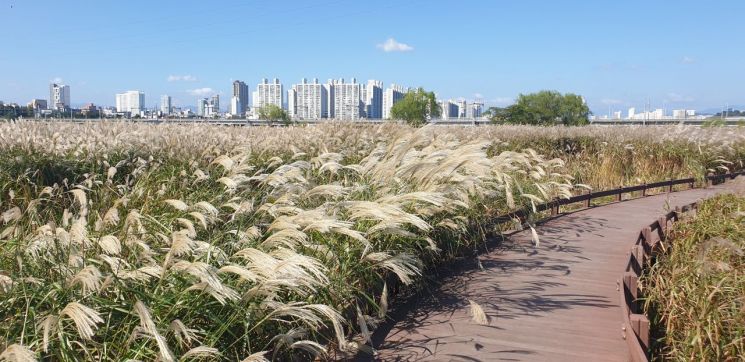
[Asia Economy Yeongnam Reporting Headquarters, Reporter Kim Yong-woo] The representative plant, Miscanthus sacchariflorus, is creating a spectacular scene in the Taehwagang estuary river wetland in Ulsan.
Ulsan City is operating the "Taehwagang Miscanthus sacchariflorus Ecological Observation Site" from the 5th of this month until November 15th, from 10 a.m. to 5 p.m., at the Eulssae Observation Deck in Myeongchon-dong, Buk-gu, organized by the Taehwagang Ecotourism Council.
At the observation site, natural environment guides explain how to distinguish river wetland plants and describe the ecosystem of each plant.
Unlike reeds, which are hollow inside, visitors can experience blowing bubbles by applying soapy water to the solid stems of Miscanthus sacchariflorus. This allows them to observe the pathways through which water and nutrients move in the plant.
Visitors can also solve quizzes provided by the natural environment guides and receive gifts.
Visitors can take photos at the photo zone set up against the backdrop of the Miscanthus sacchariflorus colony while walking along the Eulssae observation trail to capture memories.
The Miscanthus sacchariflorus colony in the Taehwagang estuary was established in 2006. It covers an area of approximately 215,800 square meters and is popular due to its accessibility within the city.
While Eulssae (Miscanthus sinensis) grows in dry soil, Miscanthus sacchariflorus, also a grass species like Eulssae, grows in moist wetlands. It is a perennial plant with long hairs on its nodes.
Its leaves are wider and softer than those of Eulssae, and unlike Eulssae, which has awns at the end of its seeds, Miscanthus sacchariflorus does not.
An official from Ulsan City introduced, "The representative ecotourism resources of Taehwagang include the wild mustard flowers in spring, the Chinese tallow tree flowers in summer, and the Miscanthus sacchariflorus colonies in autumn and winter."
© The Asia Business Daily(www.asiae.co.kr). All rights reserved.

















