Korea Association of Colleges Proposes Reform of Higher Education System 'Academic Research and Vocational Education'
Diversify Program Lengths from Under 1 Year to 4 Years to Meet Vocational Education Demand
Establish Exit Strategies for Financially Struggling Colleges and Implement Continuous Evaluation System
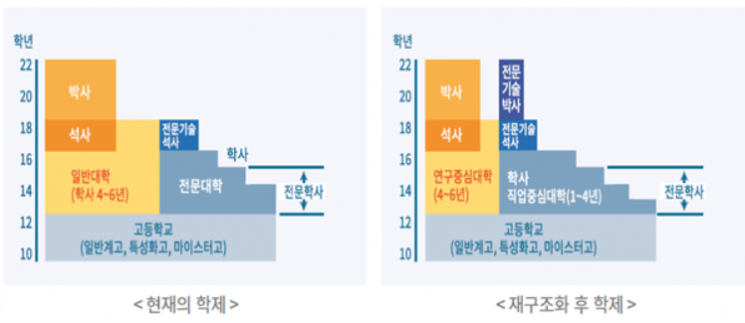
Junior colleges proposed restructuring the higher education system into research-oriented and vocational education-oriented tracks as a higher education pledge for the presidential election, and diversifying the duration of junior college courses from less than one year to up to four years.
On the 18th, the Higher Vocational Education Research Institute of the Korea Council for College Education suggested, "Let us enact the so-called 'Basic Vocational Education Act' to restructure about 100 research-oriented universities and about 200 vocational education-oriented universities, including general universities, junior colleges, industrial universities, technical colleges, and Polytechnics."
Currently, there is confusion in the admissions process because general universities and junior colleges handle the same qualifications or subjects but have different course durations. The mismatch between majors and occupations among higher education graduates in Korea reaches about 50%. To address this, they proposed enacting the so-called 'Basic Vocational Education Act' to organize the vocational higher education system in preparation for industrial structural changes, the increase in high-difficulty jobs, and the decline in school-age and working populations.
There was also a proposal to diversify the duration of higher vocational education, which currently operates on two- or three-year programs, from short-term courses to four years. This would expand four-year programs to cultivate highly skilled professionals needed in new industries such as artificial intelligence (AI), while also allowing the establishment of short-term courses of less than one year for reemployment of career-interrupted women, the elderly, and current workers to complete. Currently, four-year programs are limited and mainly operated in the nursing field. Overseas, there is also a trend to extend vocational education periods from two to four years.
Additionally, there was a call to provide exit strategies for marginal universities facing financial difficulties due to declining school-age populations and tuition freezes. Recently, more universities have been closing due to decreasing student numbers rather than corruption. To address this, it was suggested to introduce a continuous evaluation system to help struggling universities find exit routes and to establish social safety nets such as protection for faculty and staff.
The Korea Council for College Education explained, "By strengthening the linkage between secondary, higher, and adult vocational education, a lifelong vocational education system should be established from youth to old age," adding, "If course durations and degrees are offered based on majors and chosen by students, it can resolve university hierarchies and reduce wasteful competition."
© The Asia Business Daily(www.asiae.co.kr). All rights reserved.
![Clutching a Stolen Dior Bag, Saying "I Hate Being Poor but Real"... The Grotesque Con of a "Human Knockoff" [Slate]](https://cwcontent.asiae.co.kr/asiaresize/183/2026021902243444107_1771435474.jpg)
















