Announcement of 'Financial Institutions Loan Behavior Survey Results' on the 18th
Some Loan Easing Expected for Large and Small Businesses... Demand Expected to Maintain Upward Trend
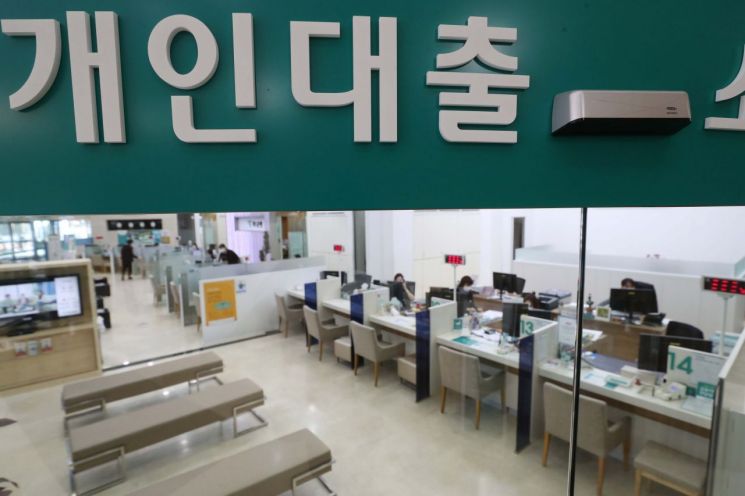
[Asia Economy Reporter Jang Sehee] As household debt surpasses 1,800 trillion won and regulatory authorities tighten regulations, it is expected to become even more difficult to obtain household loans from banks in the fourth quarter of this year. Additionally, credit card companies, mutual savings banks, and life insurance companies are also expected to strengthen household lending.
According to the "Financial Institution Lending Behavior Survey Results" released by the Bank of Korea on the 18th, domestic banks' lending attitudes in the fourth quarter of this year are expected to shift to easing for corporate loans while maintaining a tightening stance for household loans. The comprehensive lending attitude index of domestic banks is projected to record -12 (forecast) in the fourth quarter, continuing a significant tightening trend following the previous quarter's -15. By borrower type, large corporations scored 3, small and medium enterprises (SMEs) 3, household mortgage loans -15, and general household loans -32.
The lending behavior survey is a questionnaire conducted among credit officers of domestic financial institutions. A plus (+) indicates easing of lending attitudes, increased credit risk, or increased loan demand, while a minus (-) indicates the opposite. A tightening lending attitude means that loan screening will become stricter than before.
Notably, by borrower type, the easing of lending attitudes toward corporations such as large corporations and SMEs stands out. The lending attitude index for large corporations, which had tightened to -9 in the third quarter, is expected to ease significantly to 3 in the fourth quarter. SMEs are also expected to ease from -3 to 3 during the same period.
The Bank of Korea explained, "Large corporations are expected to see improved business performance, and SMEs are likely to experience easing lending attitudes due to factors such as the extension of financial support measures for small corporations and small business owners."
Loan demand from corporations, both large and small, is expected to maintain an increasing trend due to securing working capital and expanding facility investments. Domestic economic facility investment this year is projected to increase by 8.8% year-on-year, supported by the global economic recovery.
On the other hand, household loan demand is expected to decrease for general funds due to concerns over rising loan interest rates, while demand for housing funds is expected to remain stable.
Lending attitudes of non-bank financial institutions are also expected to tighten across all sectors. Lending attitude indices are expected to strengthen for credit card companies (-43), mutual financial cooperatives (-44), and life insurance (-14).
The Bank of Korea stated, "Mutual financial cooperatives are expected to continue a tightening lending attitude due to strengthened household loan regulations and the introduction of lending limit regulations on real estate," adding, "Credit card companies, mutual savings banks, and life insurance companies are also expected to tighten lending attitudes due to strengthened household loan regulations and the deterioration of borrowers' debt repayment ability caused by rising interest rates."
© The Asia Business Daily(www.asiae.co.kr). All rights reserved.

















