Downgrade Forecasts Continue... "Lower Range 2850-2900"
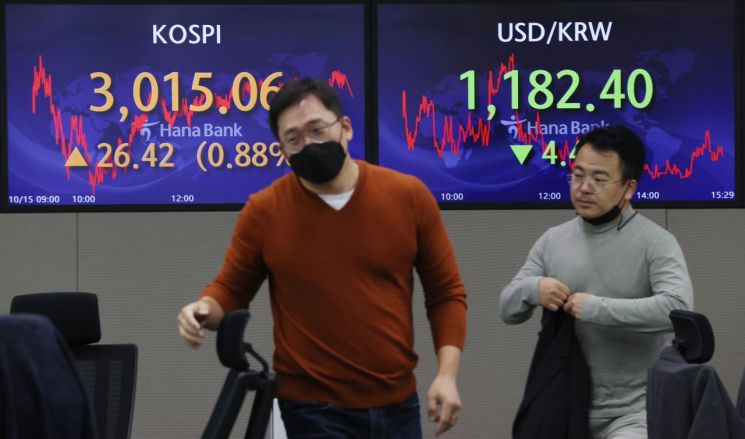
[Asia Economy Reporter Lee Seon-ae] As negative factors such as inflation (price increases) pressure, early tightening moves, and risks originating from China accumulate, global financial markets are fluctuating, and domestic KOSPI index forecasts are being revised downward one after another. Major global stock markets, which had been rising relentlessly, have entered a correction phase this month, shaking the domestic stock market as well. Market investors are on high alert, wondering whether the liquidity-driven market phase has ended and a full-fledged bear market is beginning.
According to the domestic securities industry on the 17th, major securities firms have lowered the lower bound of their year-end KOSPI forecasts to the 2850 level and diagnosed that the stock market will continue a box range correction (Boxpi) for 3 to 6 months. Experts also forecast that the won-dollar exchange rate, which surged to 1200 won during the day, will escape the rapid rise phase but expect the dollar to remain strong. Opinions on stock investment strategies at this point were somewhat mixed, but overall, cautious approaches or selective investments were emphasized.
Samsung Securities recently lowered its expected KOSPI fluctuation range for Q4 from 3000?3300 to 2900?3200. KB Securities also revised its forecast downward from 3050?3370 to 2850?3350. Korea Investment & Securities lowered its range from 3000?3550 to 2900?3200. NH Investment & Securities continued to suggest a lower bound of 2850 for the index. Oh Tae-dong, head of research at NH Investment & Securities, said, "The stock market is expected to fluctuate within a box range until the end of the year."
The primary background causing financial market instability is concerns over 'stagflation,' where prices rise amid a recession. In particular, on the 11th (local time), the price of November West Texas Intermediate (WTI) crude oil surged past $80 per barrel for the first time in seven years. Inflation concerns have grown due to rising energy prices and supply chain bottlenecks such as shortages of automotive semiconductors. Last month, the U.S. Consumer Price Index (CPI) rose 5.4% compared to the same month last year, marking the largest increase since 2008. In the same month, China's Producer Price Index (PPI) jumped 10.7%, the highest since statistics began in 1996. This negatively impacts corporate earnings. Market participants worry that inflation caused by supply chain disruptions will lead to increased corporate costs and economic slowdown.
Another negative factor is the high likelihood that major monetary authorities, including the U.S. Federal Reserve (Fed), will initiate early tightening moves in response to this inflation. Above all, recent price increases have exceeded the Fed's average inflation target of 2% for a certain period, strengthening expectations that interest rate hikes could accelerate. The Fed has already signaled tapering within the year through the minutes of the Federal Open Market Committee (FOMC) last month.
Global market participants are focused on whether the 'liquidity party' that led the bull market will gradually come to an end. The stock market cycles through 'liquidity phase → earnings phase → anti-financial phase → anti-earnings phase.' The liquidity and earnings phases correspond to rising markets, while the anti-financial and anti-earnings phases correspond to declining markets.
After the COVID-19 pandemic, central banks worldwide lowered interest rates and injected liquidity, creating a liquidity phase that led to an unprecedented boom in all asset markets, including stocks. However, as prices rise and the economy recovers, interest rate hikes and tightening are becoming visible, creating an environment where the market could enter an anti-financial phase after a brief earnings phase.
Among experts, the prevailing view is that the pace of market gains will slow. Huh Jae-hwan, a researcher at Eugene Investment & Securities, analyzed, "If tapering is implemented and interest rates are raised, the speed of money supply will slow, likely significantly reducing the pace and capacity of stock market gains."
Lee Kyung-min, a researcher at Daishin Securities, also diagnosed, "Supply chain bottlenecks are increasing inflationary pressure and economic uncertainty, causing market instability and potential correction pressure." However, it was also suggested that if economic and earnings momentum continues, a rapid entry into a bear market may not occur. The researcher emphasized, "The key is whether the economy recovers," adding, "If the bottleneck situation eases, expectations for economic recovery could revive."
© The Asia Business Daily(www.asiae.co.kr). All rights reserved.

















