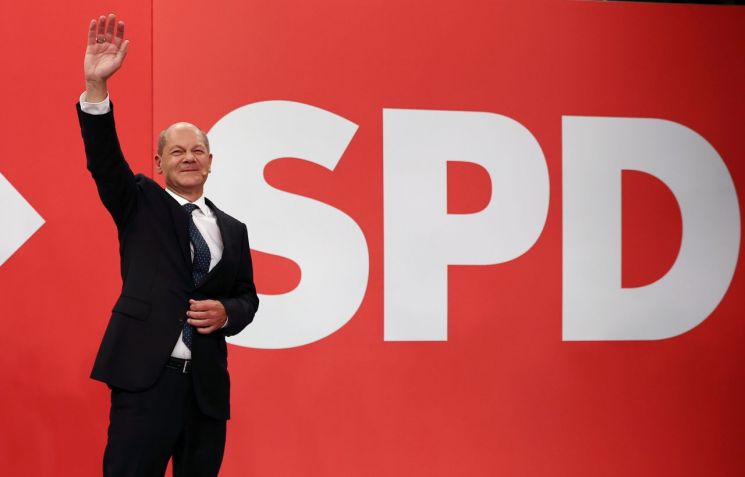
 Scholz, German SPD Chancellor Candidate, Greets Party Members
(Berlin EPA=Yonhap News) Olaf Scholz, the German Social Democratic Party (SPD) chancellor candidate, waves to party members as the exit poll results for the federal parliamentary election are announced during an election event at the Berlin party headquarters on the 26th (local time). In the federal parliamentary election held that day, the SPD and the Christian Democratic Union (CDU)/Christian Social Union (CSU) alliance, to which Chancellor Angela Merkel belongs, were engaged in an extremely close race, with the SPD narrowly leading in the count.
leekm@yna.co.kr
(End)
<Copyright(c) Yonhap News Agency, Unauthorized reproduction and redistribution prohibited>
[Asia Economy Reporter Junhyung Lee] The center-left Social Democratic Party (SPD), the Green Party, and the Free Democratic Party (FDP), which won the German federal election, are set to begin official negotiations to form a new coalition government.
According to foreign media including the AP on the 16th, Olaf Scholz, the SPD's chancellor candidate, and the leaders of the other two parties announced a provisional agreement on the 15th (local time) that will serve as the foundation for official negotiations after conducting preliminary talks.
The SPD narrowly defeated the center-right coalition of the Christian Democratic Union (CDU) and Christian Social Union (CSU), to which Chancellor Angela Merkel belongs, in the German federal election held on the 26th of last month. Since then, the SPD has been conducting preliminary negotiations with the Green Party, which prioritizes climate change response, and the pro-business Free Democratic Party (FDP) to form a coalition government. This coalition is called the "traffic light" coalition, named after the parties' representative colors.
Official negotiations are likely to begin next week. If the negotiations are successful, Scholz will become the next chancellor.
The three parties' provisional agreement includes plans to phase out coal-fired power plants by 2030 and raise the minimum wage to 12 euros per hour (approximately 16,500 won). Chancellor Merkel, visiting Brussels, Belgium, on the same day, said, "The new government will be a pro-European Union (EU) government," adding, "This is an important message to other EU member states."
© The Asia Business Daily(www.asiae.co.kr). All rights reserved.

















