Real Estate Board September Nationwide Housing Price Trend Survey
September Seoul Housing Prices Up 0.72%... Nationwide and Capital Region Slightly Slowed Down
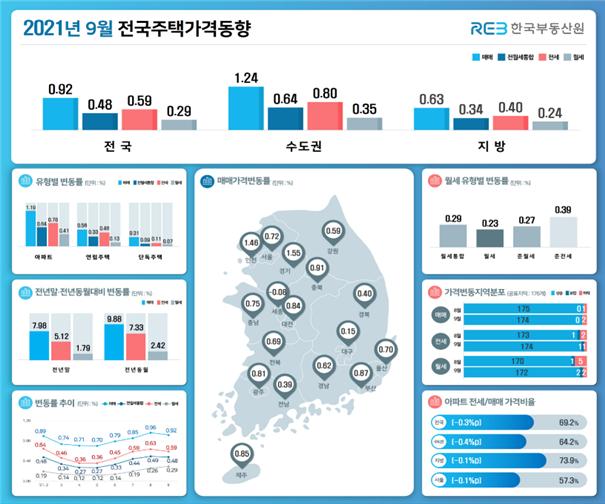
[Asia Economy Reporter Jo Gang-wook] Seoul housing prices have shown an increased rate of rise for five consecutive months. The market showed strength mainly in reconstruction and mid-to-low price complexes.
According to the Korea Real Estate Board on the 15th, the comprehensive housing sale price in Seoul (including apartments, detached houses, and row houses) rose by 0.72% last month, an increase from the previous month’s 0.69%. This marks the fifth consecutive month of an expanding rate of increase.
Seoul housing prices had increased by 0.16% → 0.17% → 0.26% → 0.40% → 0.51% from October last year to February this year, showing a rising trend for four consecutive months. However, due to the impact of the 2·4 housing supply measures, the rate of increase slowed for two months in March (0.38%) and April (0.35%).
Subsequently, influenced by major candidates’ pledges to ease real estate regulations in the Seoul mayoral by-election, the rate of increase expanded to 0.40% in May, and from June to last month, it recorded 0.49% (June) → 0.60% (July) → 0.68% (August) → 0.72% (September), marking five consecutive months of growth acceleration.
A Korea Real Estate Board official explained, "Seoul housing prices continued to rise mainly in popular apartments such as reconstruction projects and mid-to-low price housing, where expectations of regulatory easing exist."
By region, the rise was notable in high-priced residential areas such as Songpa (1.30%), Gangnam (1.22%), and Seocho-gu (0.96%), as well as in areas with many mid-to-low price houses like Nowon-gu (1.05%) and Gangseo-gu (0.71%). By type, apartment prices in Seoul rose by 0.90%, more than double the increase of row houses and detached houses (0.42%).
Housing prices in the metropolitan area rose by 1.24%, showing a slight slowdown after three months. In Gyeonggi-do, housing prices increased by 1.55%, a deceleration compared to the previous month’s 1.68%, while Incheon saw a rise of 1.46%, expanding from 1.38% the previous month. Areas benefiting from transportation developments such as the Great Train Express (GTX), including Hwaseong-si (2.56%), Osan-si (2.51%), Uiwang-si (2.34%), and Yeonsu-gu in Incheon (2.60%), led the price increases.
The nationwide housing price increase rate was 0.92%, slightly down from 0.96% the previous month. Among the five major metropolitan cities excluding Incheon, Busan (0.87%), Daejeon (0.84%), Gwangju (0.81%), and Ulsan (0.70%) maintained high growth rates. Sejong (-0.08%) experienced a price decline for four consecutive months, making it the only region among the 17 cities and provinces to see a drop in housing prices.
Last month, nationwide housing jeonse (long-term lease) prices rose by 0.59%. Compared to the previous month (0.63%), the rate of increase somewhat narrowed. Seoul’s jeonse prices decreased slightly from 0.55% to 0.54%, and Gyeonggi-do’s from 1.03% to 0.95%, while Incheon’s jeonse prices expanded from 0.91% to 0.93%.
Monthly rent nationwide also rose by 0.29%, increasing from 0.26% the previous month. This is the highest increase rate so far this year. The rise was larger in Seoul (0.19% → 0.22%) and the metropolitan area (0.31% → 0.35%), and the five major metropolitan cities (0.26% → 0.30%) and other provinces (0.22% → 0.24%) also saw expanded growth rates.
© The Asia Business Daily(www.asiae.co.kr). All rights reserved.

















