"Do you have someone you are seeing?"... Unnecessary questions still persist in interview processes
Ministry of Employment and Labor: "Questions alone do not constitute legal violation"
Experts: "Clear regulations needed to prohibit 'gender-discriminatory questions'"
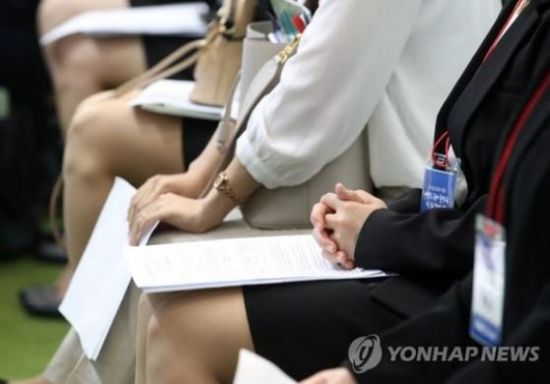 Candidates preparing for interviews. The photo is unrelated to specific expressions in the article. Photo by Yonhap News
[Asia Economy Reporter Kang Juhee] "Do you have plans for marriage or childbirth?" "Are you seeing someone?"
Recently, a controversial ruling by the Ministry of Employment and Labor stated that gender-discriminatory questions asked by an interviewer to a female candidate during a career recruitment process at a major corporation do not constitute a 'violation of the law.' Although current laws prohibit discrimination based on gender when recruiting or hiring workers, the Ministry judged that such questions, being 'verbally asked' rather than recorded in interview-related documents, cannot be considered a legal violation.
This raises concerns that gender discrimination occurring during interviews is not being properly prevented from a legal and institutional perspective. Experts suggest that clear regulations are needed to prohibit the collection or inquiry of information that could be perceived as gender discrimination.
According to reports, female candidate A recently received gender-discriminatory questions during a career interview process at a subsidiary of a major corporation. The questions included 'Do you have plans for childbirth or marriage in the future?' and 'Are you seeing someone?'?all completely unrelated to the job. Feeling unfairly treated, A filed a complaint with the Ministry of Employment and Labor.
However, the response was that such questions could not be considered a violation of the law. The Seoul Regional Employment and Labor Office informed A that "in cases where prohibited information is not recorded in recruitment-related documents and only verbal inquiries are made, it cannot be regarded as collecting such information," and therefore "it cannot be considered a violation of the Act on the Fairness of Recruitment Procedures (Recruitment Procedures Act)."
The Recruitment Procedures Act (Article 4-3) stipulates that employers must not request information such as place of origin, marital status, property, or physical conditions that are unnecessary for job performance from job seekers, but the Ministry concluded that questions alone do not constitute a legal violation.
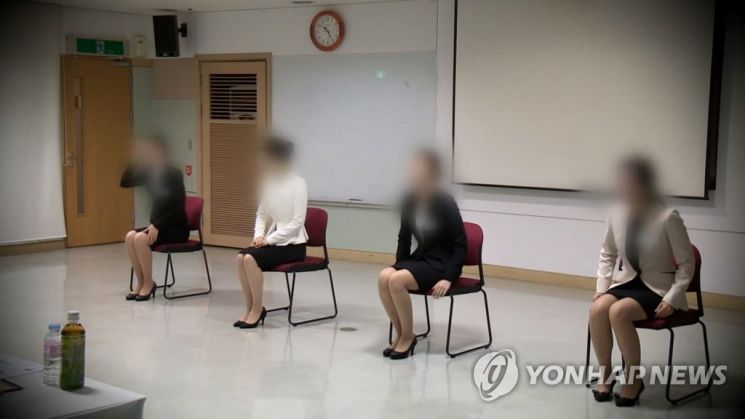 In the experienced hire recruitment process of a major corporation, the Ministry of Employment and Labor has ruled that the gender-discriminatory question posed by an interviewer to a female candidate is "not a violation of the law," sparking controversy. The photo is unrelated to specific expressions in the article. / Photo by Yonhap News
Gender discrimination during recruitment is not a new issue. In March, it was revealed that Dong-A Pharmaceutical asked female candidate B inappropriate questions during an interview, such as "Since you are a woman and did not serve in the military, how do you feel about receiving a lower salary than men?" and "Do you plan to serve in the military?" This caused a social uproar.
In response to the controversy, Dong-A Pharmaceutical issued an apology on its website, acknowledging that gender discrimination occurred during the recruitment process and expressing regret to the candidate who was emotionally hurt and to young people feeling disheartened by the difficult job market.
However, the Ministry of Employment and Labor's judgment was not significantly different at that time. A Seoul Regional Employment and Labor Office official stated regarding the Dong-A Pharmaceutical gender discrimination case, "After comprehensive legal review, such questions alone cannot be considered a violation of the Act on Gender Equality in Employment, and this was communicated to the complainant."
According to Article 7 of the Act on Gender Equality in Employment, employers must not present or request physical conditions or unmarried status that are unnecessary for job performance when recruiting or hiring workers.
According to a survey, about 30% of female job seekers have experienced gender discrimination during interviews. A survey conducted by the job portal Saramin in September last year targeting 1,732 job seekers found that 30.4% of female respondents reported having been asked gender-conscious questions during interviews. This is three times higher than the 9.6% of male respondents. The questions were mainly related to future marriage plans (50.7%), childbirth or child plans (43%), and relationship status (37%).
As a result, there are criticisms that current laws fail to adequately prevent gender discrimination during recruitment. On the 12th, Kang Eunmi, a Justice Party lawmaker, during the National Assembly Environment and Labor Committee's audit of the Ministry of Employment and Labor, referred to candidate A's case, stating, "Although this is a violation of the Recruitment Procedures Act, saying such questions are not illegal is a narrow interpretation of the law," and questioned, "If this is the Ministry's interpretation, does it mean that as long as there is no record, gender-discriminatory questions unrelated to the job can be asked?"
She added, "It is the Ministry's inherent duty to comprehensively judge and handle related laws, but shifting responsibility to complainants shows that the related system is not functioning properly."
Experts recommend supplementing laws and systems with clear regulations prohibiting the collection or inquiry of information that could be perceived as gender discrimination. Labor attorney Kim Hyoshin (Sonamu Labor Law Office) emphasized, "Current laws prohibit presenting or requesting unmarried status or similar conditions unnecessary for job performance during recruitment, but the issue lies in how 'presenting' or 'requesting' is interpreted. Therefore, it is necessary to clearly regulate and supplement the law to prohibit collecting or inquiring about such information."
© The Asia Business Daily(www.asiae.co.kr). All rights reserved.
![Clutching a Stolen Dior Bag, Saying "I Hate Being Poor but Real"... The Grotesque Con of a "Human Knockoff" [Slate]](https://cwcontent.asiae.co.kr/asiaresize/183/2026021902243444107_1771435474.jpg)

















