Professor Sang-Young Lee's Yonsei University Team, Professor Tae-Eun Lim's Incheon University Team
Manufacturable at Room Temperature and Pressure
"Economic Approach to Realizing High-Safety All-Solid-State Batteries"
[Asia Economy Reporter Kim Bong-su] As the era of electric vehicles dawns and countries around the world fiercely compete to develop next-generation batteries, a domestic research team has developed a safe polymer all-solid-state battery that can be manufactured at room temperature and pressure and does not explode even when set on fire.
Professor Lee Sang-young’s research team from the Department of Chemical and Biological Engineering at Yonsei University, in collaboration with Professor Lim Tae-eun’s team from Incheon National University, announced on the 15th that they have developed a polymer all-solid-state battery that can be manufactured and operated under room temperature and pressure conditions and does not explode even when ignited. This is regarded as an academic presentation of a simple and economical approach to realizing highly safe all-solid-state batteries.
With the explosive demand growth for large-capacity lithium-ion batteries used in electric vehicles and ESS (Energy Storage Systems), active research is underway on next-generation lithium batteries that secure high energy density and long lifespan. However, a series of incidents such as fires in electric vehicles and ESS have recently raised serious concerns about the safety of lithium batteries.
The ignition problem of lithium batteries is a complex phenomenon caused by various factors, but the use of flammable liquid electrolytes is considered the main cause. As a solution, the development of all-solid-state batteries using solid electrolytes instead of liquid electrolytes has been actively pursued worldwide. Along with the use of solid electrolytes, all-solid-state lithium metal batteries applying lithium metal as the anode can improve energy density while ensuring high safety, attracting great attention as next-generation high-safety/high-energy-density battery systems.
Despite the many advantages of all-solid-state lithium metal batteries, there are still many challenges to overcome for actual cell fabrication and application. Recently, inorganic electrolyte-based all-solid-state lithium metal batteries, which are actively researched, consist entirely of solid phases from electrodes to electrolytes, making contact between the solid electrolyte and electrodes difficult and resulting in high interfacial resistance. Consequently, cells must be manufactured under high temperature and high pressure conditions, and precisely controlled high-pressure conditions are required for cell operation.
To overcome the limitations of these high temperature and high pressure conditions in existing inorganic electrolyte-based all-solid-state battery technologies, Professor Lee Sang-young’s research team developed an all-solid-state lithium metal battery by manufacturing a single-ion polymer electrolyte with a high cation transport number and ultraviolet curing capability through a printing process under room temperature and pressure conditions.
The single-ion polymer electrolyte developed by the research team stabilized the interface with the lithium metal anode and high-nickel (NCM811) high-capacity cathode due to its mechanical flexibility and high cation transport number. This enabled the realization of a polymer all-solid-state lithium metal battery that operates stably even in an environment without applied pressure. Furthermore, by stacking four unit cells, they achieved a high-voltage (16.8V), high-energy-density (476 Wh/kg, 1102 Wh/L) cell. Notably, it exhibited high thermal stability and flame-retardant properties, securing excellent safety by not igniting or exploding even when cut with scissors or set on fire.
Professor Lee said, "Unlike inorganic electrolyte all-solid-state batteries that require high temperature and high pressure for cell manufacturing and operation, this research developed a polymer all-solid-state lithium metal battery that can be manufactured and operated under room temperature and pressure conditions through a single-ion polymer electrolyte and printing process, with improved flame retardancy and energy density." He added, "When applied to large-capacity batteries for electric vehicles and large-scale ESS, it is expected to contribute to performance and safety improvements." He also mentioned, "We are developing mass production technology for commercialization in collaboration with a Yonsei University faculty startup company. A small battery prototype could be released as early as next year."
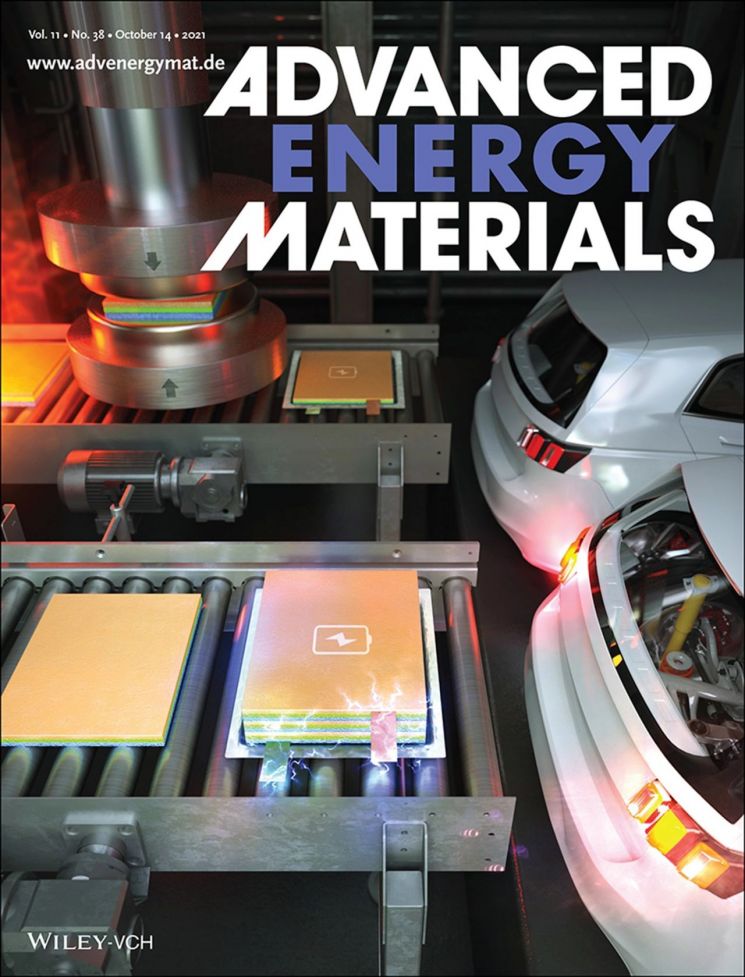
This research result was published as a cover paper on the 14th in Advanced Energy Materials, an internationally authoritative journal in the field of materials science.
© The Asia Business Daily(www.asiae.co.kr). All rights reserved.

















