Loan Approval Difficult for Private Lenders Due to Interest Rate Standards
Only 1 in 10 Approved
Regulatory Pressure Pushes Low-Income Borrowers into Blind Spots
"Urgent Need for Inclusive Alternatives for Vulnerable Groups"
[Asia Economy Reporters Kim Hyo-jin and Kim Jin-ho] Park Ji-young (48, pseudonym), who runs a pub in Changwon, Gyeongnam, has been enduring by borrowing the maximum amount from commercial banks and secondary financial institutions since the second half of last year when the impact of COVID-19 hit full force. Even with the loans she gathered, Park could not afford the monthly rent and lost her deposit, leading her to plan for additional loans.
However, due to her credit rating having dropped to the lowest level, she reached a point where institutional loans, including those from licensed moneylenders, were out of the question. Unable to find a breakthrough, Park recently procured about 30 million KRW in emergency funds from multiple illegal private lenders introduced by an acquaintance. Unable to cope with the increasingly aggressive collection efforts by these lenders, the bleak business outlook with no signs of recovery, accumulated loans, and the mounting pressure of interest that grew like a snowball, she ended up receiving debt adjustment through a financial authority program.
As of 100 days (15 days) after the statutory maximum interest rate was lowered to 20% on July 7, low-income individuals who cannot find loan options within the institutional framework are being driven to illegal private financing. This is interpreted as meaning that as the financial authorities tighten loan regulations under the pretext of managing household loans, and even licensed moneylenders?often the last resort for low-income borrowers?raise their lending thresholds to comply with the reduced interest rate standards, more people are falling into the clutches of illegal private lenders. Critics point out that the maximum interest rate reduction, intended to alleviate the interest burden on low-income households, is instead pushing many into financial distress.
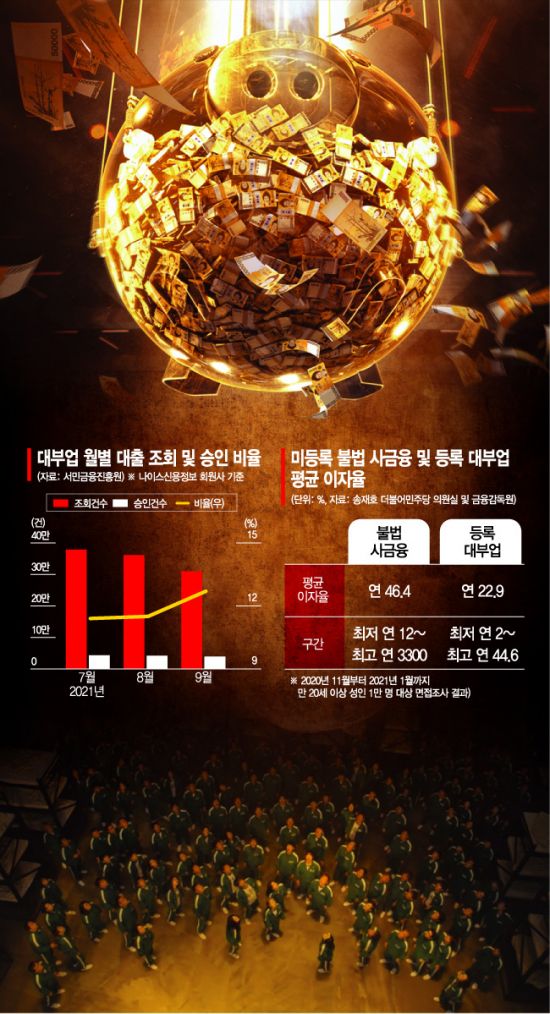
◆Only 1 in 10 Approved for Licensed Moneylender Loans = According to the Korea Financial Services Association for Licensed Moneylenders, reports of illegal private financing damage have increased by about 30% from the same period last year through August this year. In particular, the financial sector generally views that cases of damage have increased since the maximum interest rate reduction in July. The Financial Supervisory Service’s data supports this analysis, showing that 919 reports and consultations related to illegal private financing were received in July alone, about 22% higher than the monthly average from January to June.
It is interpreted that financially vulnerable groups such as self-employed individuals, who were hit hard by COVID-19, initially relied on commercial bank loans and government support programs to ‘survive,’ then moved on to secondary financial institutions, and when no further credit was available there, turned to licensed moneylenders, eventually falling into the illegal private lending market, creating a vicious cycle.
The government lowered the maximum interest rate from 24% to 20% to prevent low-income households from suffering excessive interest burdens. A representative from the licensed moneylender industry pointed out, "The impact of the maximum interest rate regulation is especially felt by licensed moneylenders, who mainly serve low-credit borrowers. Rather than broadly lowering interest rates in line with the policy’s intent, loans tend to be executed conservatively only for those with relatively higher credit scores."
According to data analyzed by the Korea Inclusive Finance Agency, the loan approval rate of licensed moneylenders registered as members of NICE Credit Information fluctuates around 11-12%. This means only about 1 in 10 loan applicants actually receive loans. Many who turn to illegal private financing are inevitably exposed to harsh interest burdens without protection.
According to data submitted by the Financial Supervisory Service to Song Jae-ho, a member of the National Assembly’s Political Affairs Committee from the Democratic Party, the average interest rate charged by unregistered illegal private lenders was 46.4% per annum. This is based on a survey conducted by the Financial Supervisory Service from November last year to January this year, interviewing 10,000 adults aged 20 and over. Cases with ‘murderous’ interest rates as high as 3,300% per annum were also found.
◆“Urgent Need for Active Alternatives to Include Vulnerable Groups” = Experts diagnose that the financial difficulties of vulnerable groups are worsening due to the government’s loan volume regulations, which are being pushed forward mainly by financial authorities. Professor Seo Ji-yong of Sangmyung University’s Department of Business Administration said, "As long as volume regulations continue, vulnerable groups will inevitably be pushed into illegal private financing. Especially, by aggressively suppressing institutional finance, the illegal private lending market has expanded beyond secondary financial institutions."
Professor Lee Min-hwan of Inha University’s Department of Global Finance analyzed, "The side effects of volume regulations have further encouraged illegal private financing. While the maximum interest rate reduction has some impact, the most direct cause is the balloon effect caused by volume regulations." They agreed that to prevent low-income households from being driven to illegal private financing, unilateral volume regulations must be improved, and market-friendly and inclusive alternatives such as revitalizing policy finance should be found as soon as possible.
There are also calls for the activation of the ‘Licensed Moneylender Premier League’ system, established to help the licensed moneylender sector struggling after the maximum interest rate reduction in July. The system aims to select excellent licensed moneylenders and enable them to procure funds from banks at low interest rates. However, in the three months since the system’s implementation, only one of the 21 eligible companies has used it. The reputational risk of banks lending money to licensed moneylenders is a major obstacle to the system’s activation.
A financial sector official pointed out, "Considering the contraction of the licensed moneylender sector due to the maximum interest rate reduction, active interest and will from financial authorities are needed to revitalize the Premier League system, which can help with funding costs."
There are also voices calling for attention to the retroactive application of the maximum interest rate to reduce the interest burden on vulnerable groups. Currently, the outstanding balance of credit loans exceeding the maximum interest rate among the top 20 licensed moneylenders amounts to about 4.2 trillion KRW. Jeon Jae-su, a Democratic Party lawmaker, said, "Efforts by licensed moneylenders for self-regulation and attention from financial authorities are necessary to ensure that low-income households do not bear interest burdens exceeding the maximum rate."
© The Asia Business Daily(www.asiae.co.kr). All rights reserved.
![Clutching a Stolen Dior Bag, Saying "I Hate Being Poor but Real"... The Grotesque Con of a "Human Knockoff" [Slate]](https://cwcontent.asiae.co.kr/asiaresize/183/2026021902243444107_1771435474.jpg)
















